



World & Culture Encyclopedia No.028
Snow Monkeys of Jigokudani
Nagano, JapanWild animals and hot springsA place to watch Japanese macaques
In Jigokudani, a valley in the mountains of Nagano, wild Japanese macaques soak in a hot spring in winter. They do it to warm their bodies. Visitors come from all over the world.
Key facts
| Type | Jigokudani Wild Monkey Park, a place where you can watch wild Japanese macaques |
|---|---|
| Location | Yamanouchi Town, Nagano, Japan. It is in the valley of the Yokoyu River. |
| Height above sea level | About 850 meters (as explained on the official website) |
| Opened | 1964 |
| Winter weather | The official website explains that temperatures can drop below minus 10 degrees, and snow can pile up deeper than 1 meter. |
| How it became famous | In 1970, monkeys bathing in a hot spring appeared in the American magazine LIFE and were reported by media around the world. |
| Origin of the name | It is said the valley was called "Jigokudani" (Hell Valley) because hot spring water and steam burst out in many places (accounts differ). |
| Rules | Visitors may not feed the monkeys inside the park. No food is sold there, either. |
What kind of place is it?
In Yamanouchi Town, in northern Nagano, there is a deep valley called Jigokudani. Wild Japanese macaques live here.
Japanese macaques are monkeys that live in Japan. In the cold winter, you can see them soak in a hot spring in this valley. The place that protects the area and lets people watch the monkeys is the Jigokudani Wild Monkey Park. In Japanese, the word for "wild monkey" is written with characters that mean a monkey that lives in the wild.
The monkeys do not live in cages. They live in nature. Visitors walk in the same place as the monkeys, so it is important to follow the rules.
Why do they get into the hot spring?
According to the official website, the main reason the monkeys enter the hot spring is to warm their bodies and get through the cold winter. They are not washing themselves.
The website explains that bathing is not something the monkeys are born knowing. They learned it by watching other monkeys, and it has been passed down through generations.
But bathing is not something the monkeys must do. Not every monkey bathes all the time, and they do not bathe much in warm seasons. Even in winter, some days and some monkeys are different.
History and origin
The park opened in 1964. There are a few explanations of how it began. The official website explains that a young monkey happened to enter the open-air bath (an outdoor hot spring) of a nearby inn. Other monkeys saw this and slowly copied it, and the habit spread.
There is also an explanation that monkeys raiding nearby fields was a problem, and this was part of the background to building the park. Because the story of the beginning differs depending on the source, please think of it as "accounts differ."
In 1970, monkeys in a hot spring appeared in the American magazine LIFE, and became known around the world. The official website also explains that many people from around the world visited around the time of the 1998 Nagano Winter Olympics.
Highlights and rules
Apart from the hot springs for people, there is an open-air bath made only for the monkeys. The official website explains that using the same water as people is not good for cleanliness (hygiene).
When you visit, treat the monkeys as wild animals. Inside the park, visitors may not feed them. Feeding could change how the monkeys normally behave, and it would be dangerous for both people and monkeys.
Follow the park's guidance and watch quietly. For example, do not get too close, do not touch them, and do not stare into their eyes.
Cultural things worth knowing
In Japan, hot springs have long been loved as places to warm the body and relax. People from other countries seem to find the sight of monkeys in a hot spring unusual. That is why they are called "snow monkeys," and tourists come from around the world.
This sight can also make us think about the harsh winter in the mountains and how people and monkeys live side by side. Wild animals are not only fun to watch. They are living neighbors in nature. Keeping a distance and watching quietly is important so that people can keep visiting in the future.
About this illustration
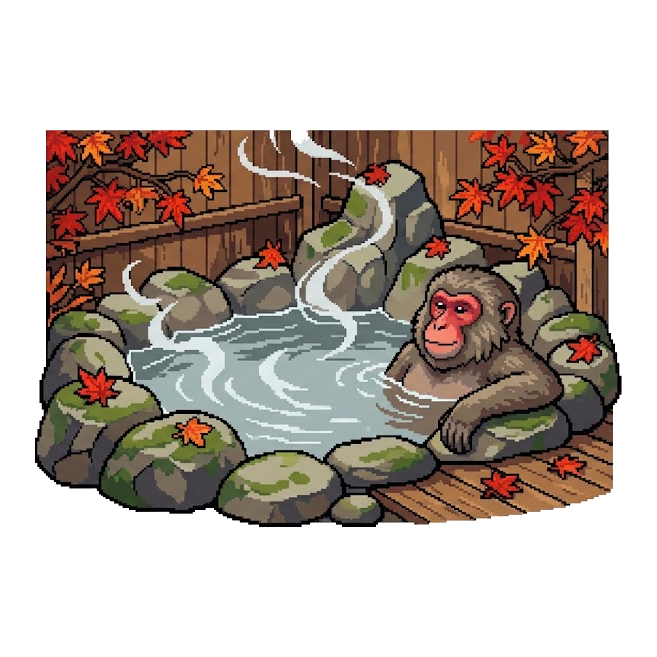
This is a pixel-art picture (a picture made of tiny squares) of a Japanese macaque soaking in a hot spring. Trees with autumn leaves surround it, to suggest Jigokudani in Nagano. But a hot spring among autumn leaves is the artist's own idea, not how the real place looks. In real life, monkeys are mostly seen bathing in the cold winter.
Fun facts
- The name Jigokudani (Hell Valley) does not have a bad meaning. It is said to come from hot spring water and steam bursting out in many places in the valley.
- The park has an open-air bath made just for the monkeys.
- According to the official website, bathing in a hot spring is a behavior the monkeys learned. It is thought to have been passed from parents to children and to other monkeys.
Quick quiz
Q. According to the official website, what is the main reason the monkeys get into the hot spring?
The official website explains that the monkeys soak in the hot spring to warm their bodies and get through the cold winter. They are not washing themselves.
References
- Jigokudani Wild Monkey Park official website (English "About" page): supports the opening year (1964), height above sea level, winter weather, why the monkeys bathe, the 1970 media coverage, the monkeys' own open-air bath, the ban on feeding, and the 1998 Olympics
- 観光庁(国土交通省)多言語解説文データベース (Japan Tourism Agency, multilingual explanation database): supports the description of Jigokudani Wild Monkey Park as a tourist spot
- 政府広報オンライン『Highlighting Japan』2022年1月号 (Government of Japan online public relations, "Highlighting Japan," January 2022 issue): supports the article about the monkeys and hot spring in Jigokudani
- 長野県観光公式サイト GO NAGANO (Nagano Prefecture official tourism site, GO NAGANO): supports the introduction of Jigokudani Wild Monkey Park
Accounts may differ between sources and regions, and facts or figures can change with new research or rules. This page was translated from the Japanese original.
Download the pixel art
- Free
- No registration
- Commercial use OK
- Edits OK
- Credit optional
- No usage report needed
Please read the terms of use before using it.