



World & Culture Encyclopedia No.005
Maneki-neko (Beckoning Cat)
JapanGood-luck charmCeramic figure
The maneki-neko is a figure of a cat with one paw raised, calling in good luck and customers. You often see it at shop entrances. There is no single story about where it came from. Many legends have been handed down.
Key facts
| Type | A figure that is a good-luck charm (something believed to bring good fortune). It is often made of clay or ceramics (fired pottery). |
|---|---|
| Where | All over Japan. Seto City and Tokoname City in Aichi Prefecture are known as the two major production areas for maneki-neko. |
| Beginning | It is thought to have spread in the late Edo period, in places such as Imado ware around Asakusa in Edo (today's Tokyo). But when and where it was first made is not clear (accounts differ). |
| Look | A sitting cat raises one paw (or both) and makes a beckoning motion beside its face. |
| Meaning of the paw | In general, the right paw is said to call in money luck, and the left paw to call in people (customers). This way of saying it spread later, and ideas differ by region and by maker. |
| Well-known legends | Stories linked to Gotoku-ji Temple (Setagaya Ward) and Jishō-in Temple (Shinjuku Ward), and a story about an old woman in Asakusa, are well known. Imado Shrine (Taito Ward) and others are also sometimes named as the birthplace. |
| Memorial day | September 29 is "Maneki-neko Day." It is a wordplay: "9 (ku)" and "29 (fuku)" can be read together as "kuru fuku," meaning "good luck is coming." It is said to have been decided in 1995 by a group of maneki-neko fans (the Japan Maneki-neko Club)." |
What is it?
A maneki-neko is a cat figure that raises its front paw as if calling, "Come here, come here!" You can see it at shop entrances, at the front doors of homes, and at shrines and temples.
People display it hoping that business goes well and that good luck comes to the home. A thing that people believe will bring good things is called an "engimono" (a good-luck charm).
It is made from many materials, such as clay, pottery, porcelain (a hard, white kind of pottery), wood and paper. The sizes range from small enough to fit in your palm to very large.
History and origins
We do not really know when or where the maneki-neko was first made. It is thought to have become popular around Asakusa in Edo in the late Edo period.
A well-known story is about an old woman in Asakusa. She was poor and had to give up her pet cat. Then a cat appeared in her dream and said, "If you make a doll in my shape, good luck will come." She made dolls and sold them, and they became popular, the story says. This story is often said to appear in the Edo-period record 'Buko Nenpyo' (in the entry for the 5th year of Kaei, 1852), but the details differ depending on the source. The "Marujime cat" of Imado ware in Asakusa (clay dolls and tableware) is known as an early example of a maneki-neko.
Gotoku-ji Temple in Tokyo has another legend. In the early Edo period, Ii Naotaka, the lord of Hikone, was passing in front of the temple on his way back from falconry (hunting with a trained hawk). A cat from the temple beckoned to him. He stopped at the temple, and suddenly a thunderstorm came. Naotaka was glad to have escaped trouble, the story goes. The temple later became the Ii family's bodaiji (a temple where a family's ancestors are honored).
There is also a story that Ota Dokan, a warrior of the Muromachi period, got lost and was beckoned by a black cat, and so reached Jishō-in Temple. The details of every story differ by region and by source.
Features to enjoy
Maneki-neko come in many forms. First, think about the raised paw. In general, a cat with the right paw up is said to call in money luck, and one with the left paw up is said to call in people and customers. Some have both paws up.
There is also a saying that if the paw is higher than the ear, it calls in big luck from far away, and if it is lower, it calls in happiness close by. But these ideas spread in later times, and there are no fixed rules.
The body color also has meanings. White stands for good luck, black for warding off evil, gold for money luck, and so on. Each color came to carry its own wish. These meanings were not set long ago either. They are views that grew over time.
Many cats hold a koban (an old gold coin). The cat at Gotoku-ji has no koban. Some explain that it shows a wish for good luck itself rather than for money.
Where they are made and how
Aichi Prefecture has two major production areas for maneki-neko: Seto City and Tokoname City.
Seto has long been a town of pottery. Aichi's tourism guide explains that after mass production of porcelain began in Seto, slim cat figures, close to a real cat's shape, came to be made. The time when this began differs a little by source.
In Tokoname, making maneki-neko became popular later than in Seto. Its cats are known for a two-head-tall, plump shape with big eyes, holding a koban. This is introduced as a standard design since the Showa era. The maneki-neko most of us picture today is said to be mainly of the Tokoname type. Aichi's tourism site says that the Tokoname type is said to make up about 80% of those in Japan (the basis for the exact figure cannot be confirmed, so treat it as a rough guide).
Culture worth knowing
In Japan, cats have long been animals close to daily life. They were also welcome because they protected rice and silkworms (the insects that make silk) from mice. Such feelings may have led people to see cats as messengers of good luck.
September 29 is "Maneki-neko Day." The Japan Maneki-neko Club, a group of fans formed in 1993, is said to have decided it in 1995, saying, "Let's thank the maneki-neko, who always keep a paw up for us, at least once a year." Around this day, maneki-neko festivals are held in places such as Seto City and Okage Yokocho in Ise City, Mie Prefecture.
Today you can see maneki-neko not only in Japan but also in shops overseas. But the meaning of the paw can differ from country to country. Learning about these differences can widen how you see culture.
About this illustration
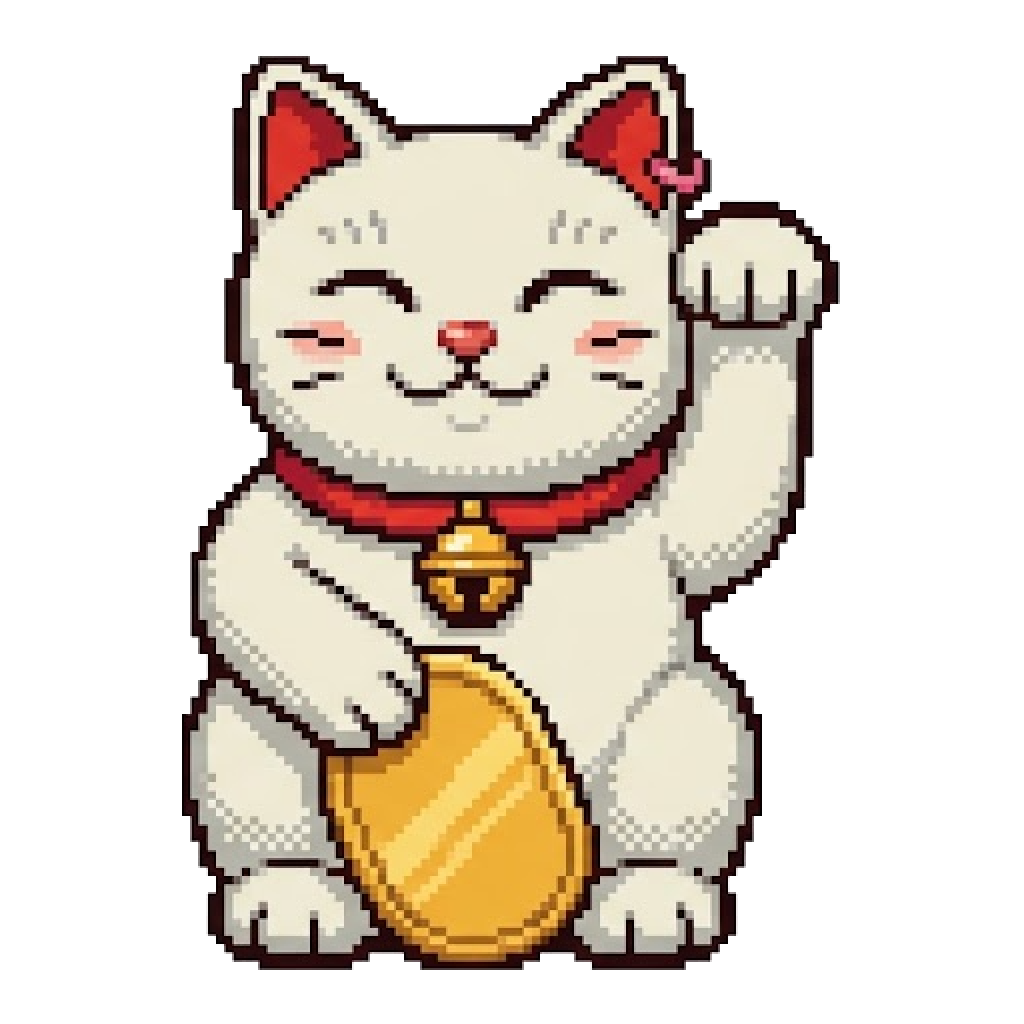
This is a pixel-art picture (a picture made of tiny square dots) of a maneki-neko raising its right paw to call in good luck. It is drawn to suit a shop scene and a Japanese-style mood. The key feature of the picture is a cat sitting with its right paw up. Small decorations such as the collar, the koban, the color scheme and the cheek marks are not set by real objects or by legends. They are just the artist's way of drawing it.
Fun facts
- September 29 is "Maneki-neko Day." It is a wordplay: "9 (ku)" and "29 (fuku)" together read as "kuru fuku," meaning "good luck is coming."
- The meaning of the paws (right paw for money luck, left paw for calling people) is said to be an idea that spread later, and it differs by region and by maker.
- There are legends about the origin of the maneki-neko linked to several temples and shrines, such as Gotoku-ji, Imado Shrine and Jishō-in. It is not clear which one is the true beginning.
Quick quiz
Q. In general, what is a maneki-neko with its right paw raised said to call in?
In general, a maneki-neko with its right paw raised is said to call in money luck, and one with its left paw raised to call in people and customers. But this idea spread later, and it differs by region and by maker.
References
- Aichi Prefecture tourism site 'Aichi Now' feature, 「招き猫の二大産地 常滑・瀬戸へ行こう!」 (supports the production areas of Seto and Tokoname and their features)
- 斎藤月岑『武江年表』 (Saito Gesshin, 'Buko Nenpyo'; an Edo-period record about the Imado ware maneki-neko in Asakusa and the old woman and cat doll story. The original text can be checked in places such as the National Diet Library Digital Collections.)
- Setagaya Ward official materials and the temple tradition of Gotoku-ji (support the legend of Ii Naotaka and the cat)
- 一般社団法人 日本記念日協会「招き猫の日(9月29日)」 (Japan Anniversary Association, 'Maneki-neko Day (September 29)'; supports the origin of the memorial day)
- JAL「SKYWARD Plus」招き猫の特集記事 (JAL 'SKYWARD Plus' maneki-neko feature article; supports the Imado ware Marujime cat, legends from various places, and the maneki-neko of Tokoname and Seto)
Accounts may differ between sources and regions, and facts or figures can change with new research or rules. This page was translated from the Japanese original.
Download the pixel art
- Free
- No registration
- Commercial use OK
- Edits OK
- Credit optional
- No usage report needed
Please read the terms of use before using it.