



World & Culture Encyclopedia No.004
Ghost (Obake)
Japan and the worldHalloween charactersGhosts, spirits and yokai
"Obake" is a word for strange beings that ordinary ideas cannot explain. On this page, you will learn about old Japanese ways of thinking and where Halloween comes from.
Key facts
| Type | Imaginary beings (they appear in folk tales, legends and events) |
|---|---|
| Meaning of the word | "Obake" is often explained as coming from the verb "bakeru," which means to change shape. |
| What it covers | It is sometimes used as a name for ghosts, yokai and more. It is a wide word, so it is hard to separate them exactly. |
| Difference from a ghost | A ghost (yurei) is the spirit of a dead person who left feelings behind in this world. Yokai are often explained as beings that appear at fairly fixed places and times. |
| Halloween | An event held on October 31. The ancient Celtic festival of Samhain is explained as one of its backgrounds. |
| The name Halloween | It is said to come from words meaning "the evening before All Saints' Day (November 1)" (All Hallows' Eve). |
| Ghosts in pictures | The look of a ghost covered with a white sheet is an idea that spread mainly through modern pictures and decorations. |
What is it?
An obake is a strange being that cannot be seen, or whose true form is unknown. Stories about them have been told in scary places, such as dark night roads and old houses.
In Japan, there are several words, such as "obake," "yurei" (ghost) and "yokai." They overlap a lot. In daily talk, they are sometimes used to mean almost the same thing. Countries around the world also have stories about the spirits of dead people and strange creatures.
Differences in words
The word "obake" is explained as coming from "bakeru." To bakeru means to change from an ordinary shape into another shape. So "obake" is a wide word for all kinds of strange things, such as ghosts and yokai.
A ghost (yurei) is the spirit of a person who died leaving feelings behind in this world.
Yokai are said to be often beings that appear at fairly fixed places and times. Kappa (water imps) and tengu (long-nosed goblins) are given as examples. But scholars and books divide them in different ways, and there is no fixed answer. The folklorist Kunio Yanagita explained the difference by the time and place where they appear. This is also just one way of thinking.
History and origins
In Japan, books of the Heian period (about 1,000 years ago), such as The Tale of Genji, also have stories of "mononoke," spirits that possess people. People thought that illness and bad luck were caused by unseen powers.
In the Edo period, many pictures and stories of obake and yokai were made, and people enjoyed them. They were not only scary. There came to be many funny stories too.
Halloween and ghosts
Halloween is an event held on October 31. The ancient Celtic festival of Samhain is explained as one of its backgrounds. It is sometimes said that people believed the souls of the dead visited their homes around Samhain, and that this became linked to stories of ghosts and the like.
On the other hand, the Encyclopaedia Britannica also explains that Halloween grew up by taking a lot from medieval Christian days for remembering the dead (All Saints' Day on November 1 and All Souls' Day on November 2). The name "Halloween" is said to be a short form of the evening before All Saints' Day (All Hallows' Eve).
But old beliefs have not simply continued unchanged to today. Researchers also disagree about the details of how it changed.
In Halloween today, children dress up as ghosts and other characters and have fun. Here, the fun of a lively event matters more than being scared.
Culture worth knowing
The look of ghosts is different in each country and time. Japanese ghosts are often drawn in a white robe. In Halloween today, a round, cute look, as if covered with a white cloth, is often used.
In this way, ghosts are also like a mirror that shows what people found scary and how they tried to enjoy themselves. However, there is no scientific proof that ghosts really exist. They are something to learn about as stories and ways of expression handed down from long ago.
About this illustration
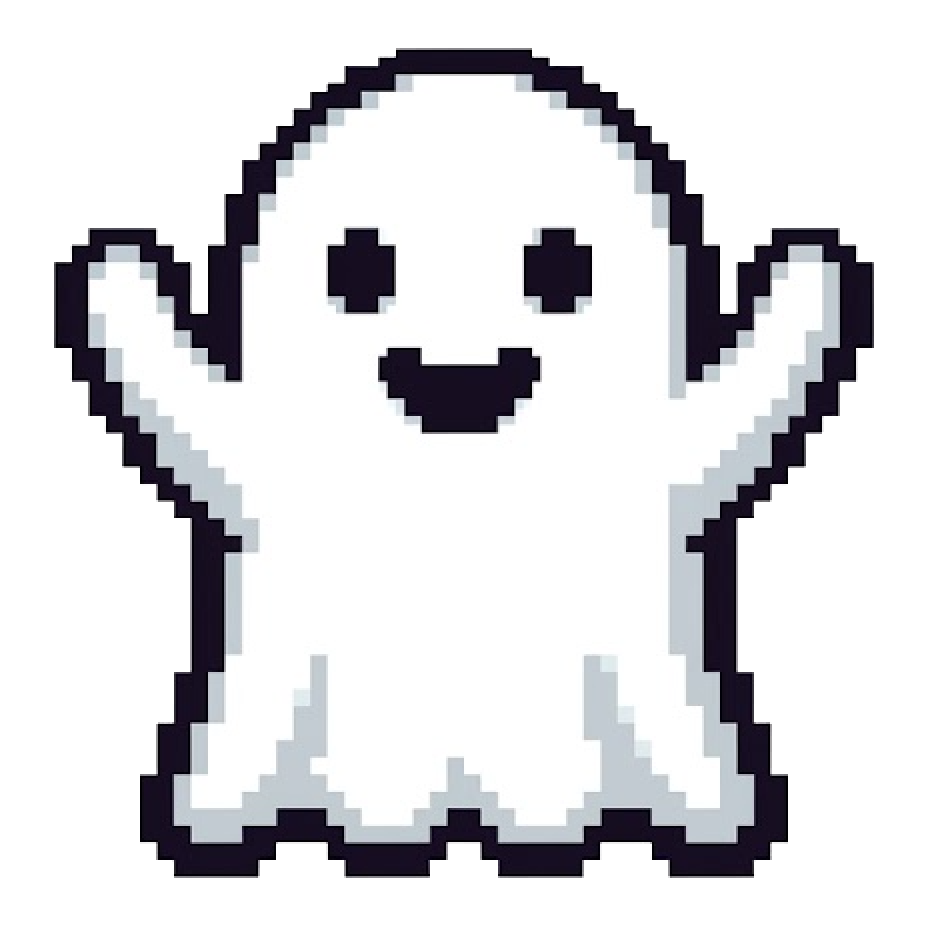
This is a pixel-art picture of a smiling white ghost with its hand raised. The design can be used for Halloween scenes. The smiling, hand-raised look is a friendly way of showing a ghost. It is not a real thing and does not come from any legend. It is "an illustration, different from the real thing." There is no fixed rule for how a ghost looks.
Fun facts
- Besides yokai and ghosts, "obake" is also used to mean "something unusually big" (for example, a giant pumpkin).
- The name Halloween is said to be a short form of an old English phrase meaning "the evening before All Saints' Day" (All Hallows' Eve).
- Ghost stories exist all over the world. Their looks and personalities differ by country and time.
Quick quiz
Q. Which verb is the word "obake" most often explained as coming from?
"Obake" is most often explained as coming from "bakeru," which means to change shape. It has become a wide word that covers ghosts, yokai and more.
References
- ブリタニカ百科事典「Halloween」「Samhain」 (Encyclopaedia Britannica, "Halloween" and "Samhain"): the origins of Halloween, its link to All Saints' Day and All Souls' Day, and the festival of Samhain
- 『日本国語大辞典』(小学館)や、コトバンク掲載の辞典項目「お化け」「幽霊」 (Nihon Kokugo Daijiten, and dictionary entries on Kotobank for "obake" and "yurei"): the meaning and use of the words
- 柳田國男『妖怪談義』 (Kunio Yanagita, Yokai Dangi): a folklorist's view on the difference between obake and ghosts
- 紫式部『源氏物語』 (Murasaki Shikibu, The Tale of Genji): an example of how mononoke were described in the Heian period
Accounts may differ between sources and regions, and facts or figures can change with new research or rules. This page was translated from the Japanese original.
Download the pixel art
- Free
- No registration
- Commercial use OK
- Edits OK
- Credit optional
- No usage report needed
Please read the terms of use before using it.