



World & Culture Encyclopedia No.003
Great Torii of Itsukushima Shrine
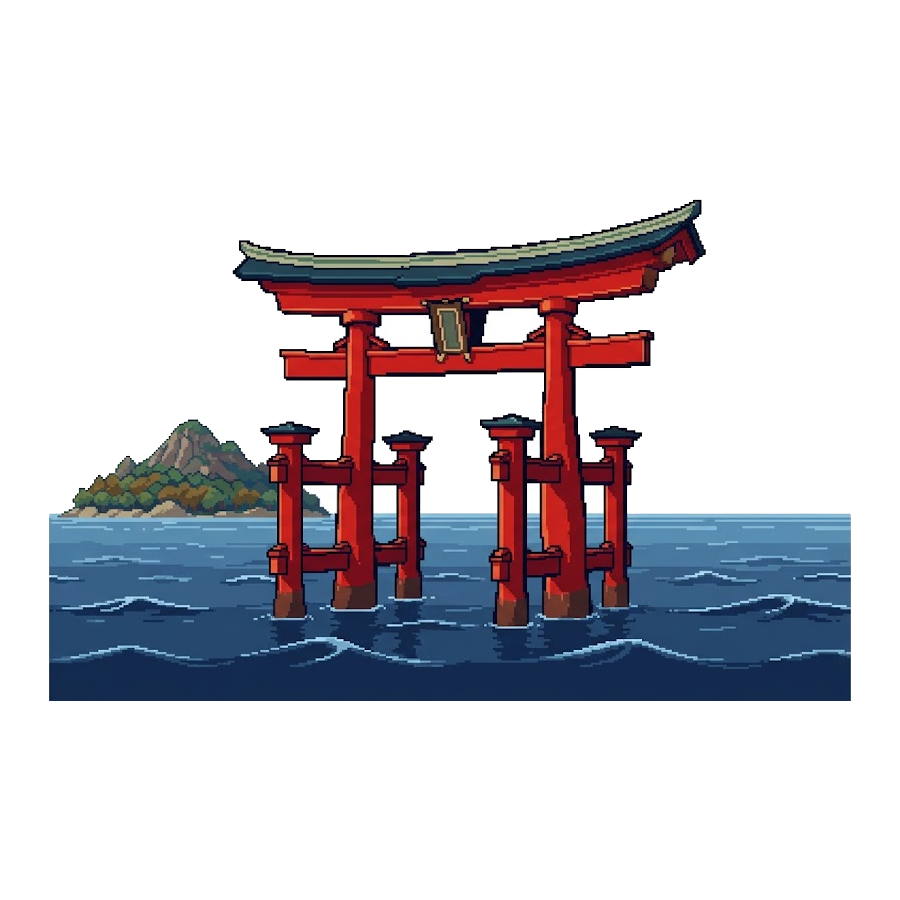
Hiroshima Prefecture, JapanA shrine gate (torii)Part of the World Heritage site "Itsukushima Shinto Shrine"
This is a big red gate standing in the sea off Miyajima Island in Hiroshima Prefecture. At high tide it looks as if it is floating on the sea. At low tide you can walk up close to it.
Key facts
| Type | A shrine gate (torii), made of wood |
|---|---|
| Location | Miyajima (Itsukushima) in Hatsukaichi City, Hiroshima Prefecture, Japan. It stands in the sea in front of Itsukushima Shrine. |
| Beginnings | It is explained that a torii has stood at the entrance to the island since around 1168, in the time of Taira no Kiyomori. |
| The present torii | It was built in 1875 (Meiji 8). Sources differ on whether it is the "8th" or the "9th" one (accounts differ). |
| Size | About 16 meters tall (some sources say 16.6 meters). It weighs about 60 tons, which is explained to include about 7 tons of stones placed inside the roof. |
| Material | It is explained that camphor trees more than 500 years old were used for the main pillars, which come as a pair. Camphor wood does not rot easily and resists insects. |
| World Heritage | It was listed as a World Heritage Site (cultural heritage) in 1996, as part of Itsukushima Shrine. |
| Recent repairs | A major repair began in 2019 and ended in December 2022. |
What kind of place or thing is it?
On Miyajima Island in Hiroshima Prefecture, there is an old shrine called Itsukushima Shrine. In the sea in front of the shrine stands a big red gate. This is the "Great Torii."
A torii is a gate that marks the entrance to a sacred place of the gods. Usually, a torii stands on a path on land. But this Great Torii stands in the sea. It looks as if it is floating on the water, and that is why it is so famous.
Why does it stand in the sea?
Miyajima Island itself has long been thought of as a place where a god lives. So it is said that, in the old days, people avoided stepping directly on the island's soil, and instead went to the shrine by boat from the sea.
The shrine buildings are also built to reach out over the water. Because of this, the torii in the sea is explained as the "front entrance" of the shrine.
At high tide (when the sea rises and the water is high), the torii seems to float on the sea. At low tide (when the sea pulls back and the water is low), you can walk across the sand to the foot of the torii.
History and origins
In the multilingual explanation texts of Japan's Ministry of Land, Infrastructure, Transport and Tourism (Japan Tourism Agency), it is explained that a torii has stood at the entrance to the island since 1168. The first torii is thought to have been built by Taira no Kiyomori, a warrior who held the shrine dear.
Wooden torii have been rebuilt many times because of wind, waves and damage from insects. The present torii was made in 1875 (Meiji 8). Depending on how you count, it is called the "8th" or the "9th" one.
Highlights and how it works
The Great Torii is said to be about 16 meters tall and weigh about 60 tons. It is one of the largest wooden torii in Japan.
The surprising thing is that its pillars are said not to be buried in the seabed. It stands by its own weight. However, some sources explain that, under the base of the pillars, piles were driven in to make the ground stronger, and stones were placed on top of them.
In front of and behind each of the two big main pillars, there are two smaller pillars (support pillars). So it is held up by six pillars in all, which makes it more stable. It is also explained that about 7 tons of stones are placed inside the roof to add weight.
In recent years, people have worried that visitors pushing coins into gaps in the pillars might damage the wood. To protect the torii, please do not copy this.
Cultural things to know
A torii is thought of as a border between the human world and the world of the gods. So many people give a small bow when they pass through one.
Itsukushima Shrine was listed as a World Heritage Site in 1996. It is also valued because the Great Torii and the shrine buildings make a beautiful view together with the sea, the island and the mountains.
A major repair of the Great Torii began in 2019, and it was usually covered with scaffolding during that time. The repair ended in December 2022, and people can now see its clean red form again. Wooden buildings are kept safe for a long time by caring for them like this.
About this illustration
This is a pixel-art picture of a big red torii standing in the sea. An island can be seen beyond the gate. It is based on the scenery of Itsukushima Shrine in Hiroshima. The fine colors and simplified shapes are part of the pixel-art style and are different from the real thing.
Fun facts
- The Great Torii looks completely different at high tide and low tide. At high tide it seems to float on the sea, and at low tide you can walk up close to it.
- The Great Torii is said to stand by its own weight, without its pillars buried in the seabed. About 7 tons of stones are also placed inside its roof.
- The present Great Torii was built in 1875. Sources count it as the 8th or the 9th, because they count in different ways.
Quick quiz
Q. Where does the Great Torii of Itsukushima Shrine stand?
The Great Torii of Itsukushima Shrine stands in the sea off Miyajima. At high tide it looks as if it is floating, and at low tide you can walk up to it.
References
- Ministry of Land, Infrastructure, Transport and Tourism, Japan Tourism Agency, Multilingual Explanation Text Database, "Itsukushima Shrine Great Torii" (supports 1168, 1875, the weight of about 60 tons and about 7 tons of stones, camphor wood, and standing by its own weight without being buried in the seabed)
- UNESCO World Heritage Centre, "Itsukushima Shinto Shrine" (supports the 1996 World Heritage listing)
- Government of Japan, Highlighting JAPAN, April 2023 issue (introduces the Great Torii after its repair ended in December 2022)
- Report on the Great Torii by the Tokyo National Research Institute for Cultural Properties (supports the structure of the base)
Accounts may differ between sources and regions, and facts or figures can change with new research or rules. This page was translated from the Japanese original.
Download the pixel art
- Free
- No registration
- Commercial use OK
- Edits OK
- Credit optional
- No usage report needed
Please read the terms of use before using it.