



World & Culture Encyclopedia No.030
Chopsticks and Chopstick Rests (Hashi and Hashioki)
JapanEating toolsJapanese table manners
Hashi are the two sticks used to eat food. Hashioki are small stands where chopsticks rest. They hold Japan's eating habits and its thoughtfulness.
Key facts
| Category | Eating tools: chopsticks (hashi) and a small stand to rest them on (hashioki) |
|---|---|
| Where they are used | Japan, and countries in East Asia and Southeast Asia such as China, Korea and Vietnam |
| How they came to Japan | They are thought to have come from China. The time differs by source. Some explain that they came around the Asuka period. Others explain that they spread around the Nara period. (Accounts differ.) |
| Beginnings | At first, they are thought to have been special tools, such as for making offerings to the gods. (Accounts differ.) |
| Features of Japanese chopsticks | They are shorter than Chinese chopsticks and have thin tips. Many are made of wood or bamboo. |
| Beginnings of chopstick rests | They are also said to go back to the "chopstick stand" used in rituals for the gods. Much of their history is unclear. (Accounts differ.) |
| Chopsticks Day | August 4 (a wordplay: "ha" is 8 and "shi" is 4, which sounds like "hashi") |
What is it?
Chopsticks are a set of two sticks. You use them to pick up, pinch and break apart food. They can do many different moves with just one tool.
A chopstick rest is a small stand. You rest your chopsticks on it while you eat. The tips stay off the table, so the table stays clean. They come in many shapes, such as animals, flowers, vegetables and shells. They are made of pottery, glass, wood, metal and more.
History and origin
Chopsticks are thought to have come to Japan from China. But sources explain differently when they spread. Some say they came around the Asuka period. Others say that using them for meals spread around the Nara period.
It is said that some old chopsticks were made by bending bamboo, like a pair of tweezers. Some also think that at first they were special tools for making offerings to the gods.
At first, they were used by people of high rank, such as nobles and officials. Later they are explained to have spread to ordinary people too. Some sources say lacquered chopsticks (nuri-bashi) appeared in the Edo period. Disposable wooden chopsticks (waribashi) are said to have appeared near the end of the Edo period. (Accounts differ on both.)
Features of Japanese chopsticks
In China, food is often put on a big plate and everyone shares it. The chopsticks are rather long.
In Japan, from long ago, the main way was to serve each person's food on a small tray (an ozen, a stand that holds a meal). So Japanese chopsticks are said to have grown shorter. It is also said that the tips became thin so that people could pick apart fish easily.
In Japanese homes, each family member has their own chopsticks. Like a rice bowl, "my own chopsticks" are treated with care.
The role of chopstick rests
One explanation says chopstick rests come from the "chopstick stand" used in rituals for the gods. It was a stand so that the offered chopsticks were not put straight onto something.
In Japan, there is a manner of placing chopsticks sideways in front of yourself. The chopstick rest is where they go. Some explain it this way: "Beyond the chopsticks is the world of food." So the rest makes a border between you and the food. (This is one way of thinking.)
When a restaurant has no chopstick rest, some people fold the paper wrapper into a rest. This is because rolling chopsticks can bother the people nearby.
Manners worth knowing
There are ways of using chopsticks that you should not do. They are called "kirai-bashi" (disliked chopstick moves). For example, there is "sashi-bashi" (stabbing food with chopsticks), "saguri-bashi" (moving chopsticks around the dishes as if searching) and "hashi-watashi" (passing food from chopsticks to chopsticks).
Standing chopsticks straight up in rice is also avoided, because it reminds people of an offering.
Celebration chopsticks, used at New Year and other times, are thin at both ends. It is sometimes explained that one end is used by a person and the other by the gods.
When you share food, using serving chopsticks instead of your own shows that you care about others.
About this illustration
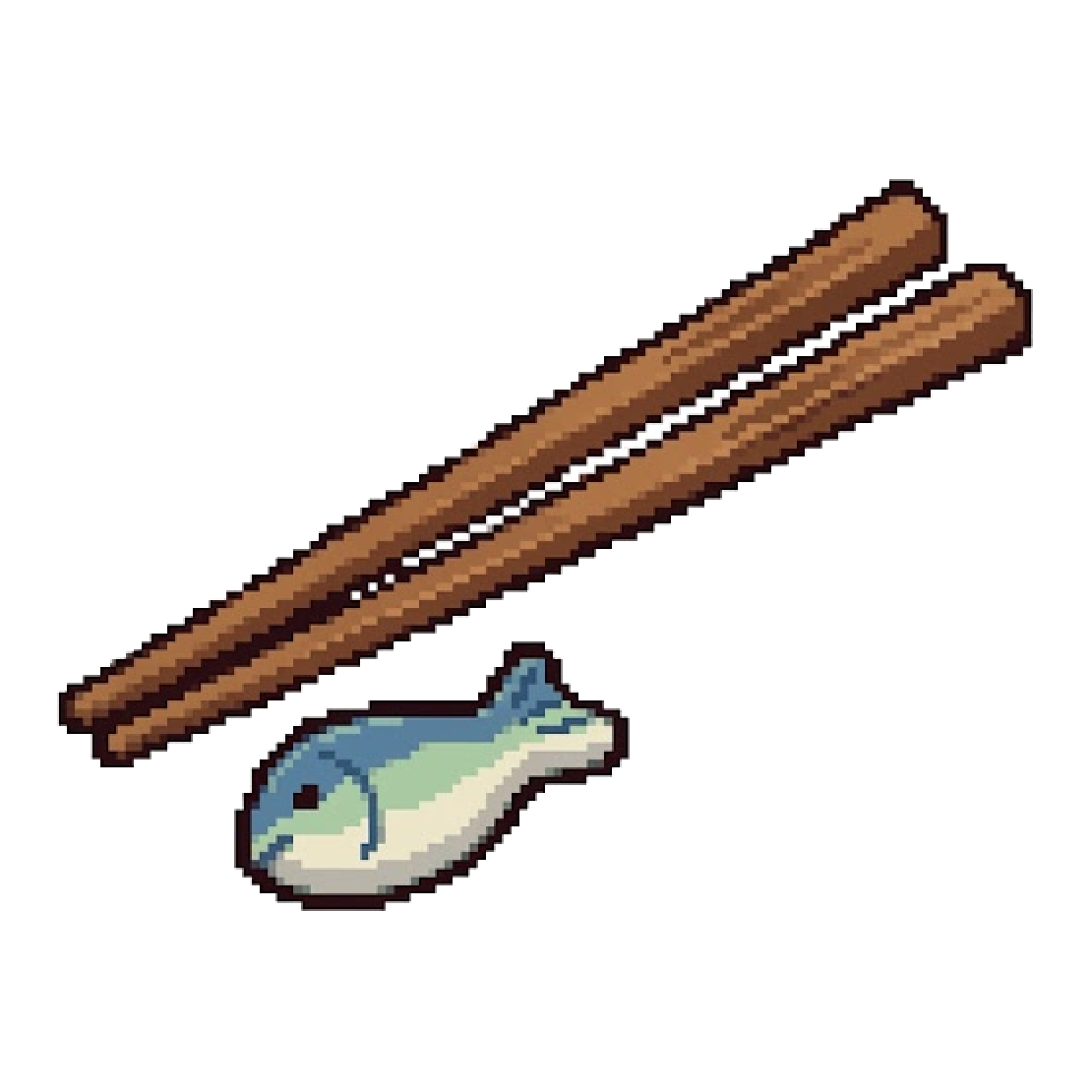
This is a pixel-art picture of chopsticks and a chopstick rest. It can be used for a Japanese meal scene. The shapes are shown with small square dots. The colors, patterns and decorations in the picture are the artist's own style. They are different from the real things.
Fun facts
- In Japan, "hashi" (chopsticks) and "hashi" (bridge) sound the same. It is said that in many regions they are told apart by accent (where the high and low sounds fall).
- August 4 is "Chopsticks Day." It is a memorial day made from a wordplay.
- In Korea, people commonly use a spoon for rice and soup. In China too, people use a flat spoon (called a renge) for soup.
Quick quiz
Q. Japanese chopsticks are said to have become shorter than Chinese ones. What main way of eating led to this?
In Japan, the main habit was to serve each person's food on a small tray. Chinese chopsticks, used to share food from big plates, are said to be longer.
References
- 農林水産省『aff(あふ)』2016年5月号 特集2「お箸のはなし」 (Ministry of Agriculture, Forestry and Fisheries magazine, May 2016 issue; supports chopstick rests and rethinking disliked chopstick moves)
- nippon.com「箸」 (supports the kinds of Japanese chopsticks, celebration chopsticks and disposable chopsticks)
- 日本記念日協会の記念日情報「箸の日(8月4日)」 (Japan Anniversary Association; supports Chopsticks Day on August 4)
- 一色八郎『箸の文化史』 (Hachiro Isshiki's book on the history of chopsticks; supports how chopsticks came to Japan)
Accounts may differ between sources and regions, and facts or figures can change with new research or rules. This page was translated from the Japanese original.
Download the pixel art
- Free
- No registration
- Commercial use OK
- Edits OK
- Credit optional
- No usage report needed
Please read the terms of use before using it.