



World & Culture Encyclopedia No.008
Kinkaku-ji (Golden Pavilion of Rokuon-ji)
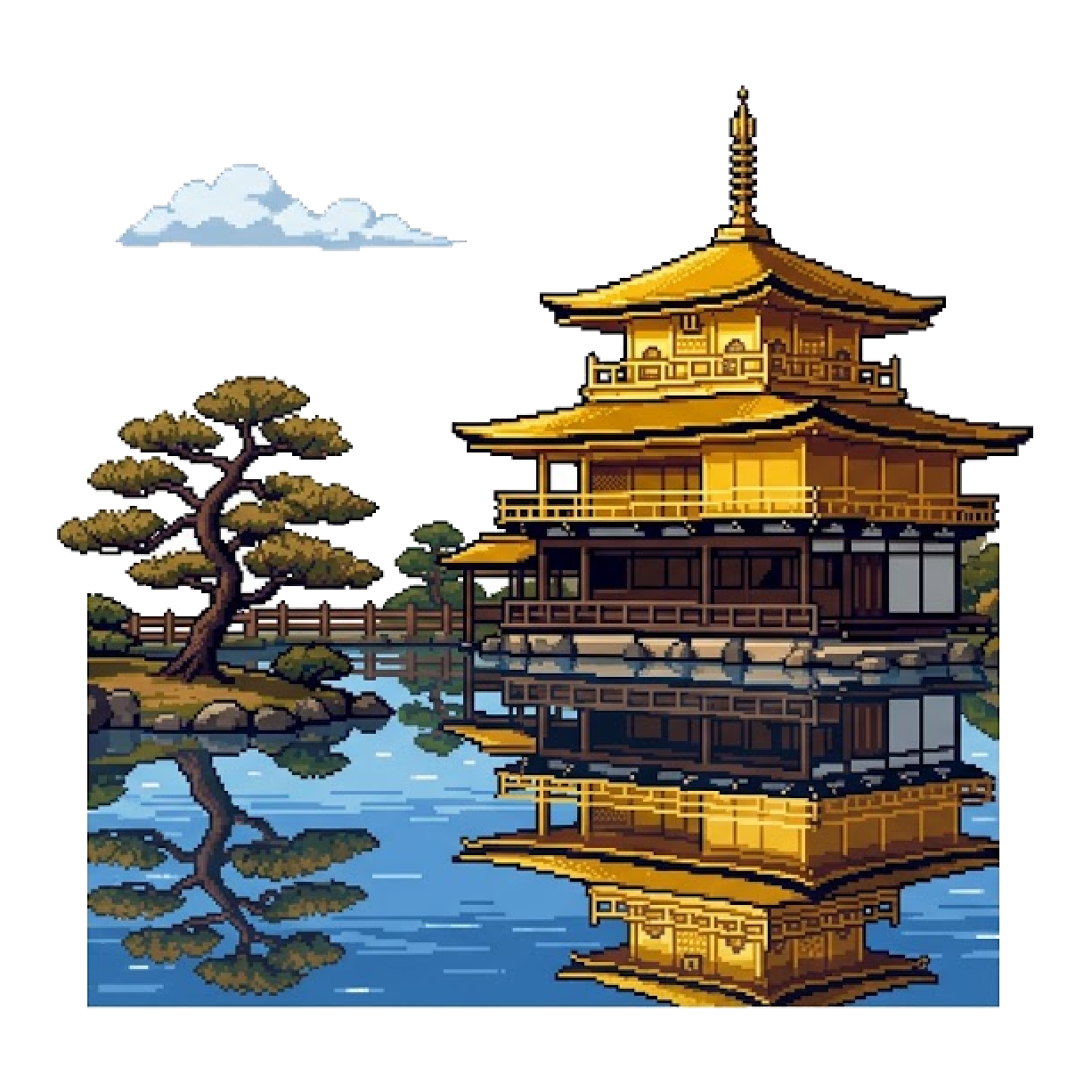
Kyoto Prefecture, JapanA Zen Buddhist templePart of the World Heritage site "Historic Monuments of Ancient Kyoto"
This is a three-story building covered with shining gold leaf at Rokuon-ji temple in Kyoto. It is famous for its view reflected in the pond. It is linked to Ashikaga Yoshimitsu, a shogun (military ruler) of the Muromachi period.
Key facts
| Type | A Zen (Rinzai school) Buddhist temple. The Golden Pavilion is a "shariden," a hall that keeps relics (sacred remains) of the Buddha, such as his bones. |
|---|---|
| Location | Kita Ward, Kyoto City, Kyoto Prefecture, Japan |
| Beginning | It is said to have begun in 1397, when Ashikaga Yoshimitsu took over a mountain villa and started building. |
| Official name | Rokuon-ji. Because the Golden Pavilion is so famous, the whole temple is called "Kinkaku-ji" (Golden Pavilion Temple). |
| Features of the building | It has three stories. The first, second and third floors are in different building styles. Gold leaf is applied to the outside of the second and third floors. |
| The pavilion today | The building burned in a fire in 1950 and was rebuilt in 1955 (work began around 1952). |
| Regilding | The gold leaf was replaced in a major repair in 1986–1987. The roof was repaired in 2003. |
| World Heritage | In 1994 it was added to the World Heritage List (cultural heritage) as one of the "Historic Monuments of Ancient Kyoto." |
What is it like?
In the north of Kyoto, there is a temple called Rokuon-ji. The golden building standing there is the "Kinkaku," or Golden Pavilion. Many people call the temple Kinkaku-ji, so that has become a nickname for the whole temple.
The Golden Pavilion stands beside a pond, and its upside-down reflection shines on the water. It looks different with the seasons and weather. Snowy days and the time of autumn leaves are also popular.
History and origin
This land first had a mountain villa (a vacation home in the hills) belonging to the noble Saionji family. In 1397, Ashikaga Yoshimitsu, the 3rd shogun of the Muromachi shogunate, took it over and began building new halls. The Golden Pavilion was the main building among them.
After Yoshimitsu died, the villa became a temple. The name "Rokuon-ji" is said to come from Yoshimitsu's Buddhist name given after his death. Some sources give 1398 as the year the Golden Pavilion was finished, and others say around 1399. The sources do not agree.
Many buildings were lost in the Ōnin War (a war from 1467 to 1477) and other conflicts, but the Golden Pavilion survived. Large repairs were also done in the Meiji period.
Highlights and features
A big feature of the Golden Pavilion is that each floor has a different building style. The first floor is said to be in "shinden-zukuri," seen in the homes of nobles. The second is in "buke-zukuri," seen in the homes of samurai (warriors). The third is in "Zen-shū-yō," a style common in Zen temples.
Gold leaf is applied to the outside of the second and third floors, and it glows in the sunlight. On top of the roof stands a bronze (a metal made mainly from copper) phoenix covered with gold leaf. The phoenix is an imaginary bird that came from China.
The pond in front is called Kyōko-chi (Mirror Pond). Islands and rocks are placed in it, and together with the Golden Pavilion they make a beautiful garden.
The burned pavilion and its return
The Golden Pavilion burned down in a fire in 1950. After that, it drew the attention of many people, and it was rebuilt in 1955.
It is explained that detailed drawings and records from the repairs in the Meiji period had survived. Because of this, the building could be restored (made again as it was) almost exactly like the original.
It was found that the gold leaf put on at the rebuilding had come off by the 1980s. So in 1986–1987, a major repair was done to apply new gold leaf. The building is protected by care like this, kept up over time.
Cultural things worth knowing
Kinkaku-ji was added to the World Heritage List in 1994 as part of the "Historic Monuments of Ancient Kyoto." Kiyomizu-dera and Ginkaku-ji (Jishō-ji) are also part of the same listing.
The Golden Pavilion is treasured as a building that shows the Muromachi period, when three cultures mixed: those of nobles, samurai and Zen. The culture that flourished in this age is sometimes called "Kitayama culture."
When you visit, you cannot go inside the building. You look at its outside from across the pond. You can enjoy walking through the gardens around it along the path.
About this illustration
This is a pixel-art illustration (a picture drawn with small square dots) of the gold three-story Golden Pavilion standing beside a pond. Its main feature is the building reflected on the water. The depth of the colors and the fine details of the background are the illustrator's choices. They are an artistic style and differ from the real place.
Fun facts
- On top of the Golden Pavilion's roof stands a bronze phoenix covered with gold leaf.
- The first floor of the Golden Pavilion has no gold leaf. It is applied to the outside of the second and third floors.
- Kinkaku-ji, Kiyomizu-dera and Ginkaku-ji were added to the same World Heritage listing in 1994.
Quick quiz
Q. What stands on the very top of the Golden Pavilion's roof?
A bronze phoenix covered with gold leaf stands on the Golden Pavilion's roof. The phoenix is an imaginary bird.
References
- 文化庁「鹿苑寺(通称:金閣寺)」 (Agency for Cultural Affairs, explanation of World Heritage nomination material): supports the history, the 1950 fire and the rebuilding
- UNESCO World Heritage Centre「Historic Monuments of Ancient Kyoto (Kyoto, Uji and Otsu Cities)」: supports the 1994 listing
- 京都市情報館「京都市歴史資料館 文化財年表」 (Kyoto City Official Information site, chronology of cultural properties): supports the rebuilding and repairs of the Golden Pavilion
- 鹿苑寺(金閣寺)公式サイト (Official Rokuon-ji / Kinkaku-ji website): supports the guide to the buildings and gardens
Accounts may differ between sources and regions, and facts or figures can change with new research or rules. This page was translated from the Japanese original.
Download the pixel art
- Free
- No registration
- Commercial use OK
- Edits OK
- Credit optional
- No usage report needed
Please read the terms of use before using it.