



World & Culture Encyclopedia No.007
Mount Fuji and Cherry Blossoms
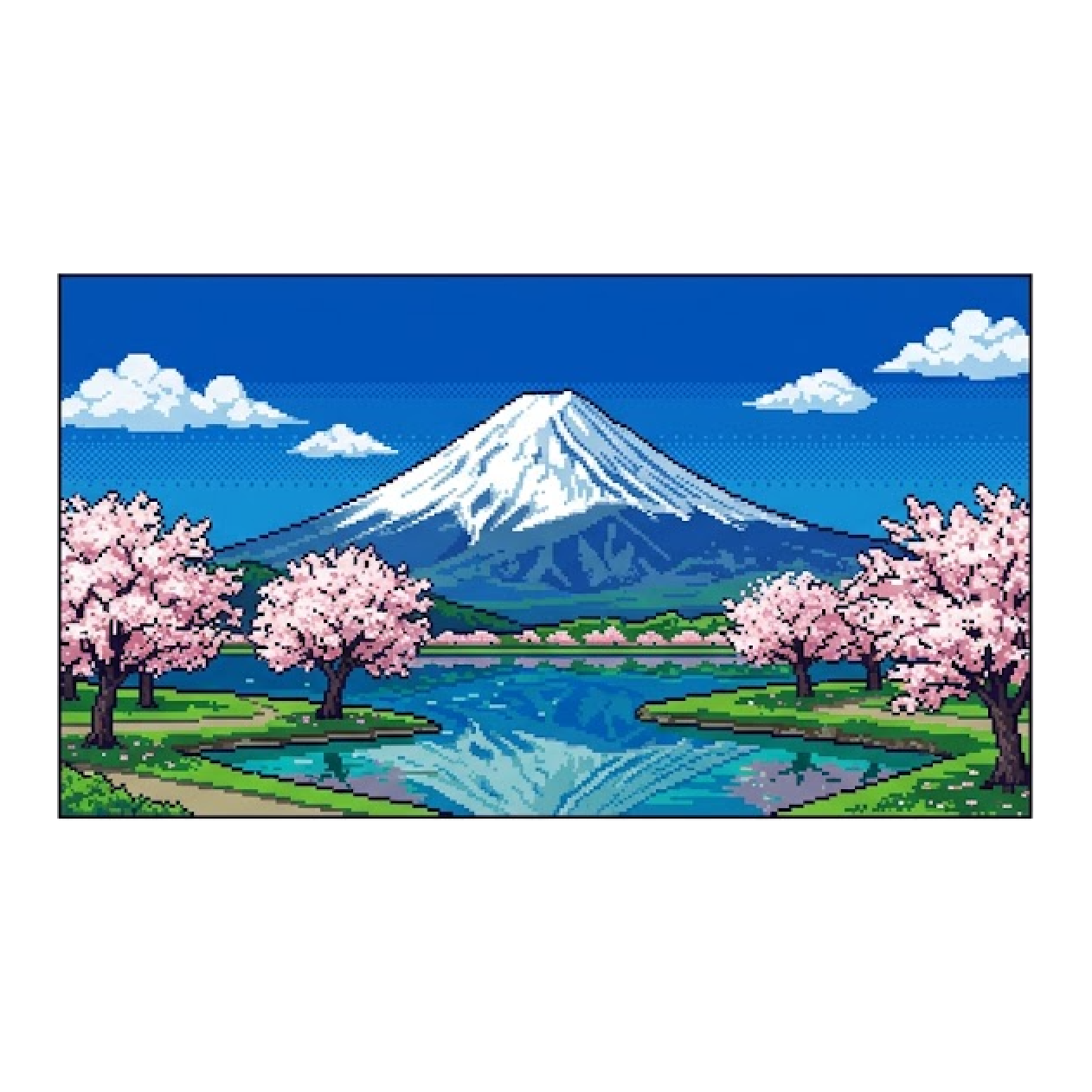
Japan: Yamanashi and Shizuoka PrefecturesA scene of a mountain and flowersWorld Heritage site "Fujisan, sacred place and source of artistic inspiration"
This is a scene that puts together Japan's highest mountain, Mount Fuji, and cherry blossoms that bloom in spring. Mount Fuji stands across Yamanashi and Shizuoka Prefectures. It became a World Cultural Heritage site in 2013.
Key facts
| Type | A stratovolcano (a mountain built up from layers of volcanic ash and lava), and a spring flower scene |
|---|---|
| Location | Japan, on the border of Yamanashi and Shizuoka Prefectures. Many cherry blossom spots are in the Fuji Hokuroku area of Yamanashi (around Lake Kawaguchi, in Fujiyoshida City and so on) |
| Height | 3,776 meters above sea level. The highest mountain in Japan |
| World Heritage | Listed as a World Cultural Heritage site in June 2013 under the name "Fujisan, sacred place and source of artistic inspiration." It was Japan's 17th World Heritage site (and the 13th cultural one) |
| What is listed | 25 component assets, including the sacred places at the summit, the climbing trails, the Sengen shrines, the Fuji Five Lakes, Oshino Hakkai, Shiraito Falls and Miho no Matsubara |
| Best time for blossoms | At spots at the foot of Mount Fuji, early to mid April is the usual guide. It changes with the year and the place |
| An example of a blossom spot | Arakurayama Sengen Park (Fujiyoshida City, Yamanashi). It is said to have about 650 Somei-Yoshino cherry trees (depending on the source) |
| Cultural meaning | Konohanasakuya-hime, who is enshrined as the goddess of Mount Fuji, is sometimes talked about together with the beauty of flowers |
What kind of place is it?
Mount Fuji is the highest mountain in Japan. It towers across Yamanashi and Shizuoka Prefectures. Its height above sea level is 3,776 meters.
In spring, cherry trees bloom in the towns and around the lakes at the foot of the mountain. Beyond the pink flowers, you can see the white, snow-capped Mount Fuji. This pairing is well known as a typical scene of Japanese spring.
Around Mount Fuji there are five lakes called the Fuji Five Lakes. At some places you can look at the mountain reflected on the water.
What kind of mountain is Mount Fuji?
Mount Fuji is a kind of volcano called a stratovolcano. Volcanic ash and lava piled up many times and made its neat shape, with slopes that spread wide at the bottom.
People long ago found eruptions frightening. So Mount Fuji was treated with care as a mountain where gods live. In time, people also began to climb it to pray, which is called "tohai."
Mount Fuji has also been the subject of many paintings and waka poems (short Japanese poems). It is a mountain that has had a big influence on both faith and art.
Why it became a World Heritage site
On June 26, 2013, the World Heritage Committee of UNESCO met in Phnom Penh, Cambodia. It decided to list Mount Fuji as a World Cultural Heritage site. It was Japan's 17th World Heritage site (and the 13th cultural one).
The listed name is "Fujisan, sacred place and source of artistic inspiration." At first, people aiming for the listing had a natural heritage site in mind. But because of problems such as litter, the plan changed to aim for a cultural heritage site.
What is listed is not only the mountain itself. There are 25 component assets (the places that make up the heritage). They include the sacred places at the summit, the climbing trails, the Sengen shrines, the Fuji Five Lakes, Oshino Hakkai, Shiraito Falls and Miho no Matsubara.
Enjoying cherry blossoms and Mount Fuji
In the Fuji Hokuroku area of Yamanashi, there are several spots where you can see cherry blossoms and Mount Fuji together. For example, Arakurayama Sengen Park in Fujiyoshida City is known as a place where you can see Mount Fuji, a five-story pagoda (the Chureito) and cherry blossoms all at once. One guide says the park has about 650 Somei-Yoshino cherry trees.
The usual guide for the best time is early to mid April. But it differs by place and year, and it changes a lot with that year's temperatures. Check the blossom reports before you go.
At popular spots, the stairs and the viewing places can get crowded. If you go early in the day or on a weekday, you can often enjoy the view more slowly.
Culture worth knowing
Fujisan Hongu Sengen Taisha in Fujinomiya City, Shizuoka Prefecture, is said to be the head shrine of the more than 1,300 Sengen shrines around the country. It is a shrine that worships Mount Fuji itself as a mountain where a god lives. It has an inner shrine at the summit.
The main goddess is Konohanasakuya-hime (also called Sengen no Okami). In the myth, she is said to have given birth safely to a child in the middle of fire. So she has been worshipped as a goddess of safe childbirth and of protection from fire disasters.
Enjoying cherry blossoms and Mount Fuji as a pair is a familiar view of Japanese spring. But sources differ on when and why cherry blossoms and Konohanasakuya-hime came to be linked (accounts differ).
About this illustration
This is a pixel-art picture (a picture made of tiny square dots) of Mount Fuji seen across cherry blossoms and a lake. It shows a scene that feels like spring in Japan. The mix of colors, the placing of the cherry trees and the size of the lake are this illustration's own expression and differ from the real scenery. It is not a copy of any particular place.
Fun facts
- In 2013, Mount Fuji became a World Heritage site as a cultural heritage site, not a natural one.
- Around Mount Fuji there are five lakes called the Fuji Five Lakes.
- Fujisan Hongu Sengen Taisha is said to be the head shrine of the Sengen shrines around the country.
Quick quiz
Q. What kind of World Heritage site was Mount Fuji listed as in 2013?
In 2013, Mount Fuji was listed as a World Cultural Heritage site under the name "Fujisan, sacred place and source of artistic inspiration." Its influence on faith and art was valued.
References
- 文化庁「文化遺産オンライン」特設ページ (Agency for Cultural Affairs, special page on Cultural Heritage Online: Mount Fuji's World Heritage listing and its component assets)
- 静岡県・山梨県の富士山世界遺産の公式サイト (fujisan-whc.jp, official site of Shizuoka and Yamanashi Prefectures: the component assets)
- 静岡県「富士山世界遺産」関連ページ (Shizuoka Prefecture, pages on Mount Fuji World Heritage: how the listing came about and the 25 component assets)
- nippon.com「富士山の世界遺産登録」 (an article on Mount Fuji's World Heritage listing: how the listing came about)
- ウェザーニュース「桜開花情報」山梨県のページ (a weather news site, cherry blossom reports for Yamanashi: the number of trees and the best-time guide for Arakurayama Sengen Park)
- 富士山本宮浅間大社の紹介ページ・各旅行情報サイト (the shrine's introduction page and travel information sites: the head shrine of the Sengen shrines and the enshrined goddess)
Accounts may differ between sources and regions, and facts or figures can change with new research or rules. This page was translated from the Japanese original.
Download the pixel art
- Free
- No registration
- Commercial use OK
- Edits OK
- Credit optional
- No usage report needed
Please read the terms of use before using it.