



World & Culture Encyclopedia No.015
Statue of Liberty
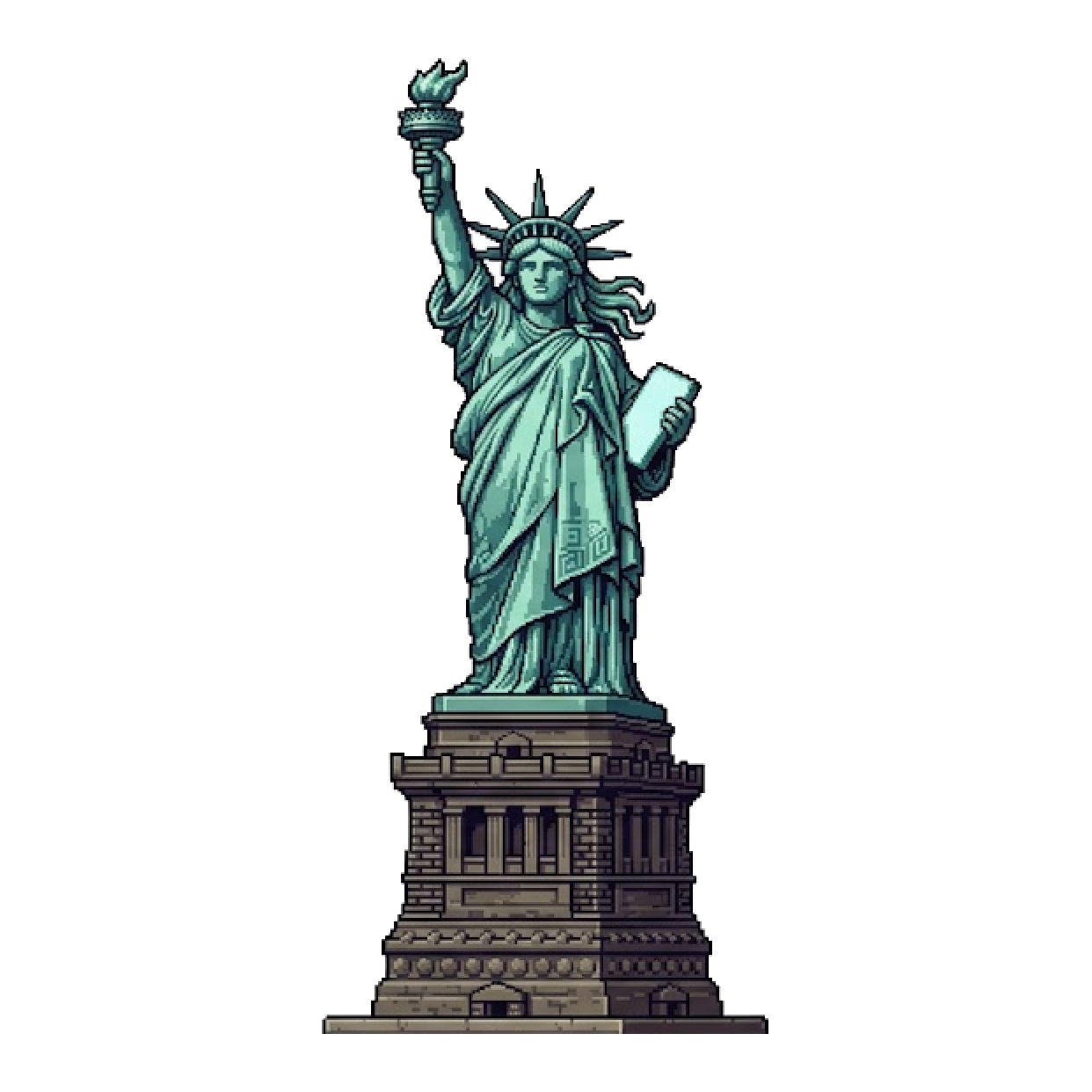
New York, USAMemorial statue (sculpture)World Heritage Site
This is a huge statue of a woman holding up a torch in New York Harbor. It was a gift from the people of France to the United States. It is known around the world as a symbol of freedom.
Key facts
| Type | A memorial statue (sculpture) made of copper |
|---|---|
| Location | Liberty Island, New York Harbor, USA |
| Official name | "Liberty Enlightening the World" |
| Beginnings | It was built in France from 1875 to 1884 and shipped to New York in 1885. A ceremony was held on October 28, 1886. |
| Designers | The sculptor Frédéric Auguste Bartholdi designed the statue. Gustave Eiffel made the iron framework inside. |
| Height | The statue alone is about 46 meters (151 feet 1 inch). From the ground to the tip of the torch, including the pedestal and base, it is about 93 meters (305 feet 1 inch). |
| Weight | The statue is estimated at about 254 tons (560,000 pounds), according to the National Park Service. The numbers differ depending on the source. |
| World Heritage | It was added to the World Heritage List (cultural heritage) in 1984. |
What kind of place or thing is it?
In New York Harbor in the United States, there is a small island called Liberty Island. The Statue of Liberty stands on this island.
The woman holds a torch (a stick with a flame) high in her right hand. In her left hand, she holds something like a tablet. The statue is known around the world as a sign of American freedom and democracy (a way of governing in which everyone has a say).
Its official name is "Liberty Enlightening the World." The torch is said to stand for a light that shines on the world.
History and origins
The statue was a gift from the people of France to the United States. It was meant to mark 100 years since the United States became independent in 1776, and to celebrate the friendship between the two countries. However, it was not finished in time for the 100th year.
The idea is said to have come from the French political thinker Édouard de Laboulaye and the sculptor Bartholdi.
The statue was built in France and finished in 1884. Then it was taken apart into many pieces and carried by ship. It arrived in New York in 1885. It was put together on top of its pedestal (the base that holds up a statue), and a ceremony was held on October 28, 1886.
It is explained that the cost of the statue was paid by donations from the French side, and the cost of the pedestal by donations from the American side. It is also well known that Joseph Pulitzer, who ran a newspaper, asked people to give money for building the pedestal.
Highlights and how it works
The outside of the statue is made of thin copper sheets. Inside is an iron framework that helps it stand up to strong winds. Gustave Eiffel, who later became famous for the Eiffel Tower in Paris, helped make this framework.
The copper sheets are said to be made so they can move a little on the framework. The harbor is a windy place, so this clever design was important.
When the statue was new, its body was the color of copper (reddish brown). Rain, wind and air slowly changed its surface. By the early 1900s, it had turned the green color it has today. This change happens naturally, and the green coating is called verdigris.
The tablet in the left hand is engraved with "July IV, MDCCLXXVI." This is July 4, 1776, written in Roman numerals. That is the day the United States declared its independence. At the statue's feet lies a broken chain. The National Park Service explains that it stands for the end of slavery.
The flame of the torch is covered with gold leaf (gold hammered into a very thin sheet).
Size and visiting
The statue alone is about 46 meters tall. From the ground to the tip of the torch, it is about 93 meters. The pedestal is said to be about 47 meters tall. However, the way of counting can differ depending on the source.
Visitors can climb up to the pedestal and to the crown. The National Park Service explains that reaching the crown means climbing 377 steps. How you can visit and which areas are open change from time to time. Check the official information before you go.
Good to know about culture
Since 1933, the Statue of Liberty has been looked after by the U.S. National Park Service. Big repairs began in 1984, ahead of the 100th anniversary in 1986. Around the time those repairs began, in 1984, it was also added to the World Heritage List.
It is also said that for many people arriving in New York, it was one of the first sights they saw from the ship. For this reason, it has also been loved as a symbol of the start of a new life in a new country.
There are statues shaped like the Statue of Liberty in many places around the world. The wish for "freedom" that the statue stands for has been passed on across countries.
About this illustration
This is a pixel-art illustration (a picture drawn with small square dots) of the Statue of Liberty holding its torch high. It is based on features of the real statue. But the colors, the number of dots, and the details of the pose are the illustrator's own way of drawing, and they differ from the real statue.
Fun facts
- The tablet in the left hand is engraved with "July IV, MDCCLXXVI," which is July 4, 1776, written in Roman numerals.
- The flame of the torch is covered with gold leaf.
- The National Park Service explains that the copper parts of the statue weigh about 81,000 kilograms (179,200 pounds). Some older sources give lighter numbers.
Quick quiz
Q. What color was the Statue of Liberty at first, and what color did it turn over time?
When it was new, it was the reddish brown of copper. Rain, wind and air changed its surface, and by the early 1900s it had turned green. This green coating is called verdigris.
References
- U.S. National Park Service (NPS), "Statue of Liberty Facts" and "Statue Statistics" (supports height, weight, the tablet's text, the broken chain, gold leaf, number of steps and more)
- UNESCO World Heritage Centre, "Statue of Liberty" (World Heritage No. 307) (supports the 1984 listing)
- 『ブリタニカ百科事典』"Statue of Liberty" (Encyclopaedia Britannica; supports Bartholdi, Eiffel, the building of the statue and how it was given)
- Google Arts & Culture, "The Statue of Liberty" (explained by the National Park Service) (supports the history and the repairs)
Accounts may differ between sources and regions, and facts or figures can change with new research or rules. This page was translated from the Japanese original.
Download the pixel art
- Free
- No registration
- Commercial use OK
- Edits OK
- Credit optional
- No usage report needed
Please read the terms of use before using it.