



World & Culture Encyclopedia No.016
The Monkey Companion in Momotaro
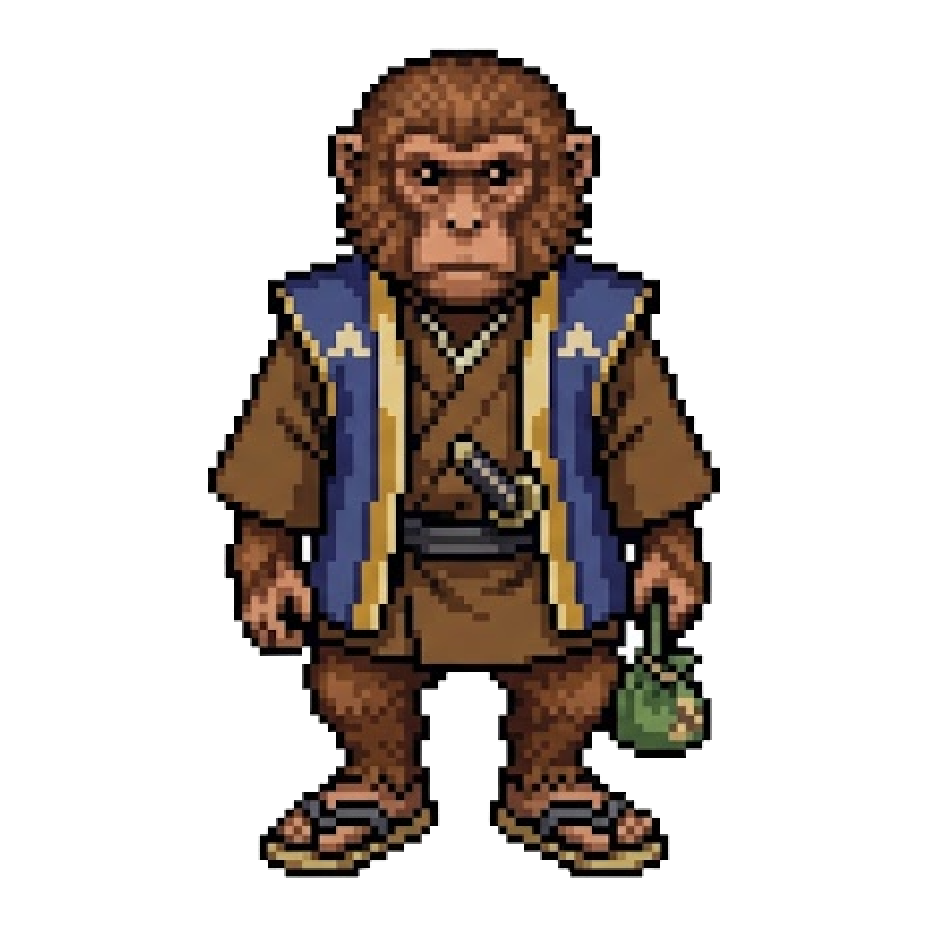
Japan / FolktaleCompanion of MomotaroThe Monkey in the Chinese zodiac (Japanese: "saru")
In the folktale "Momotaro," the monkey goes along with Momotaro, together with the dog and the pheasant. Several accounts have been handed down about why a monkey was chosen.
Key facts
| Category | An animal companion in the Japanese folktale "Momotaro" |
|---|---|
| Friends who go along | Usually three animals: a dog, a monkey and a pheasant. But the companions can differ by region and by source. |
| Link to the Chinese zodiac | The monkey matches the zodiac sign "saru" (monkey). It is sometimes explained through the idea of the demon gate and the zodiac (accounts differ). |
| Oldest written source | The oldest surviving written source is explained to be the small picture book "Momotaro" (a type called akakobon), printed in 1723 (Kyoho 8). |
| Why the companions gather | There are several accounts: the demon gate and zodiac idea, the idea that they were retainers (followers) of Kibitsuhiko-no-Mikoto, and local traditions. There is no single settled answer. |
| Tradition in Kagawa Prefecture | In a tradition from the Kinashi area of Takamatsu City, the monkey came from "Saruo" in Sue, Ayagawa Town, and served the hero. |
| The companions' relationship | It is sometimes explained that before the Meiji era, the companions were not servants but fellow travelers. |
| Other examples | One picture book from the Kamigata region (the Kyoto and Osaka area) has a story where the companions are a sardine spirit and a holly spirit, not a dog, monkey and pheasant. |
What is it?
Momotaro is a folktale about a boy who is born from a peach and goes to an island where demons live. On the way, Momotaro gives out millet dumplings (kibi dango) and gains friends. One of those friends is the monkey.
The monkey helps Momotaro, together with the dog and the pheasant. Monkeys are quick and good at climbing trees, so in the story the monkey is often shown working busily.
Folktales were passed on by word of mouth and spread that way. So the story differs by region and by source. What is told here is just one version.
Why was the monkey chosen?
There are several accounts of why the monkey became a companion. No one of them is known to be the right one.
One account links the demon gate (the northeast direction, said to be where demons come and go) with the Chinese zodiac. In the zodiac, the northeast is "ushi-tora" (ox-tiger). On the opposite side, the "back demon gate," is the monkey, followed by the rooster and the dog. So the idea is that the monkey, pheasant and dog were chosen to stand up to the demon.
Another account is based on stories handed down at places such as Kibitsu Shrine in Okayama Prefecture. Kibitsuhiko-no-Mikoto, said to be the origin of Momotaro, had retainers. In this view, those people were matched with the dog, monkey and pheasant. But there is no clear proof for this either.
History and origins
By the Edo period, the Momotaro story was being read in picture books.
The oldest book found so far is explained to be a small picture book (akakobon) called "Momotaro," published in 1723. Another account says there were older books before this. In the Edo period, the story spread through akahon, picture books for children.
In the Edo-period akahon, an old man and woman ate a peach and became young again, and then Momotaro was born. The version where he is born from a peach is said to have become widely known in a later period.
Different companions in different regions
The companions are not always a dog, monkey and pheasant. In some regions, it is said that the companions can be a stone mortar, a needle, a bee or a crab. In a picture book from the Kamigata region (around today's Kansai), the companions are a sardine spirit and a holly spirit. Holly is a tree used in decorations for Setsubun, a spring festival.
In the Kinashi area of Takamatsu City, Kagawa Prefecture, there is a different tradition. The hero is said to be not Kibitsuhiko-no-Mikoto but Wakatakehiko-no-Mikoto. The dog, monkey and pheasant are said to have come from Inujima (in Okayama Prefecture), Saruo (Sue, Ayagawa Town) and Kijigatani (Kinashi-cho, Takamatsu City), and to have served Wakatakehiko-no-Mikoto.
Even for the same monkey, the role and home place differ from story to story. That is one of the fun things about folktales.
Cultural things to know
In the Meiji era, Momotaro spread through textbooks and other books. It is sometimes explained that from around then, the dog, monkey and pheasant were more often shown as "servants." The view is that before that, the companions were fellow travelers with no ranks between them.
The monkey is also the zodiac sign "saru." The zodiac animals were also used to show directions and times of day. You can also read the Momotaro story through those old ways of thinking.
Stories change little by little with the times. If you compare different books, you may make new discoveries.
About this illustration
This is a pixel-art picture (a picture made by lining up tiny squares) of the monkey companion in Momotaro. Anything that is not in the real animal or the tradition, such as colors, items, expression and decorations, is only the artist's own style. The monkey in the folktale has no fixed look.
Fun facts
- The oldest surviving Momotaro book is explained to be the akakobon "Momotaro," printed in 1723 (Kyoho 8).
- In the Edo-period akahon, Momotaro was not born from a peach. He was born to an old couple who ate a peach and became young again.
- One Kamigata picture book has a rare version of "Momotaro" in which the companions are a sardine spirit and a holly spirit.
Quick quiz
Q. Which of these matches the explanation in the text about Momotaro's companions?
The companions differ by region and by source. In a Kamigata picture book, a sardine spirit and a holly spirit appear. It is also sometimes explained that before the Meiji era, they were fellow travelers, not servants.
References
- "Nihon Mukashibanashi Taisei" (by Keigo Seki): on the types of folktales such as Momotaro and on versions that differ by region
- National Diet Library Digital Collections: Edo-period akahon, kusazoshi and other materials
- A paper from Onomichi University, "A Study of the Kamigata Picture Book 'Momotaro': How the Kyogen 'Setsubun' Was Worked In": on the Kamigata picture book where a sardine spirit and a holly spirit are the companions
- Traditions of Kibitsu Shrine (Okayama Prefecture): stories about Kibitsuhiko-no-Mikoto and his retainers
- The Momotaro legend of the Kinashi area, Takamatsu City (including the view of Sentaro Hashimoto): traditions about where the dog, monkey and pheasant came from
- "Nihon Kokugo Daijiten" (Shogakukan) and "Sekai Daihyakka Jiten" (Heibonsha): the entries on "Momotaro"
Accounts may differ between sources and regions, and facts or figures can change with new research or rules. This page was translated from the Japanese original.
Download the pixel art
- Free
- No registration
- Commercial use OK
- Edits OK
- Credit optional
- No usage report needed
Please read the terms of use before using it.