



World & Culture Encyclopedia No.025
Golden Gate Bridge
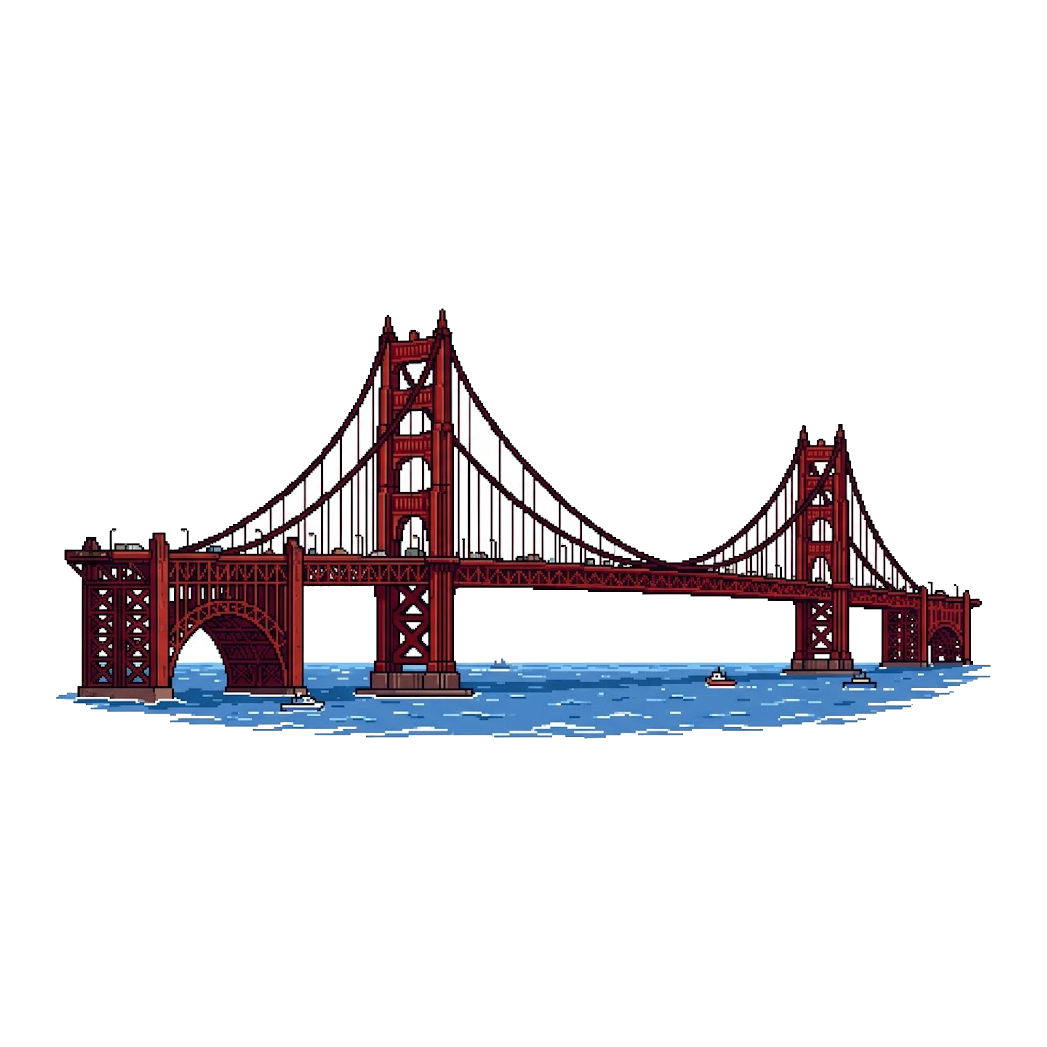
California, United StatesSuspension bridgeSymbol of San Francisco
This is a large reddish-orange suspension bridge at the entrance to San Francisco Bay in the United States. It opened in 1937. Until 1964, its main span (the part between the two towers) was the longest of any suspension bridge in the world.
Key facts
| Category | Suspension bridge (a bridge whose road hangs from cables held up by towers) |
|---|---|
| Location | California, United States. It links the city of San Francisco with Marin County to the north. |
| Construction | From 1933 (January 5 is the official start date) to 1937. |
| Opening | It opened to pedestrians on May 27, 1937, and to cars the next day, May 28. |
| Length | The main span between the towers is about 1,280 meters (4,200 feet). The whole bridge, from land at one end to land at the other, is about 2.7 kilometers (about 1.7 miles). |
| Tower height | About 227 meters (746 feet) above the water. |
| Color | A color called "International Orange." The bridge's name comes from the name of the strait, not from a gold color. |
| Record | Until the Verrazzano-Narrows Bridge in New York was built in 1964, its main span was the longest of any suspension bridge in the world. |
What kind of place is it?
The Golden Gate Bridge is a large bridge in San Francisco, on the west coast of the United States. It crosses a narrow stretch of sea where the Pacific Ocean meets San Francisco Bay, and it links the city to the land on its north side.
Its two tall reddish-orange towers and the thick cables stretching from them are easy to spot. It is known all over the world as a view that stands for San Francisco.
A suspension bridge is a bridge with cables stretched between tall towers, and the road hangs from those cables. Its special strength is that it can cross a long distance without putting many pillars in the water.
Where the name comes from
"Golden Gate" was the name of the strait (a narrow path of sea) even before the bridge was built.
The bridge's official website explains that in 1846, the explorer John C. Fremont named this strait "Chrysopylae," which means "golden gate" in Greek. There is also a story that the name was chosen to compare it to the Golden Horn, the harbor of Constantinople (today's Istanbul).
It is said that the name became widely known later, during the Gold Rush (when many people gathered to look for gold). It is not because the bridge is gold in color.
History and background
The idea of building a bridge across this strait became serious in the early 1900s. The sea currents are fast, and the wind and fog are strong, so some people reportedly said, "A bridge can't be built here."
Joseph Strauss is known as an engineer who was deeply involved in the bridge's plan. Many other engineers and architects also took part, such as Leon Moisseiff. The architect Irving Morrow put great effort into the design of the bridge's color and decoration.
Construction began in 1933, and the bridge opened in 1937. On opening day, many people crossed the bridge on foot.
Highlights and features
The main span is about 1,280 meters long. When the bridge was finished, it was the longest suspension bridge in the world. This record lasted until 1964.
The towers rise about 227 meters above the water.
The bridge's color is "International Orange." The bridge's official website explains that this color was chosen because it goes well with the green hills around it and stands out sharply against the blue of the sea and sky.
The towers, railings and other parts of the bridge also use Art Deco design (a decorating style that became popular around the 1920s and makes use of straight lines).
Cultural things worth knowing
The Golden Gate Bridge is a symbol of San Francisco and is popular with visitors. You can also walk across it and enjoy the view from the bridge.
The bridge's color is kept the same as when it was built. It is explained that the bridge keeps getting repainted and cared for to prevent rust. Even after a big bridge is finished, people keep looking after it.
On foggy days, the upper part of the bridge can sometimes be hidden in the fog. You can see a mysterious look that is different from a sunny day.
About this illustration
This is a pixel-art illustration (a picture made by lining up small squares) of a red-orange suspension bridge. It is based on the shape of the real bridge, but the number of colors and the small details are left out. The details and background are the artist's own style and are different from the real thing.
Fun facts
- The bridge is named after the strait, "Golden Gate," and not after the color of the bridge.
- The official name of the bridge's color is "International Orange."
- It is recorded that the opening to cars on May 28, 1937 was signaled by President Roosevelt, who pressed a telegraph key at the White House.
Quick quiz
Q. Where does the word "Golden" in Golden Gate Bridge come from?
The strait that the bridge crosses was called the "Golden Gate," so the bridge took that name. The bridge's color is not gold. It is International Orange.
References
- Golden Gate Bridge Highway and Transportation District official website (goldengate.org), "Key Dates in Bridge History" (supports the start and opening dates, and Fremont's naming in 1846)
- Same site, "Design & Construction Stats" (supports the main span, total length and tower height)
- Same site, "Color & Art Deco Styling" (supports International Orange, Irving Morrow and Art Deco)
- History.com, "Golden Gate Bridge" (supports the history of construction)
- EBSCO Research Starters, "Golden Gate Bridge" (supports an overview of the world record)
Accounts may differ between sources and regions, and facts or figures can change with new research or rules. This page was translated from the Japanese original.
Download the pixel art
- Free
- No registration
- Commercial use OK
- Edits OK
- Credit optional
- No usage report needed
Please read the terms of use before using it.