



World & Culture Encyclopedia No.022
Onigashima (Ogre Island)
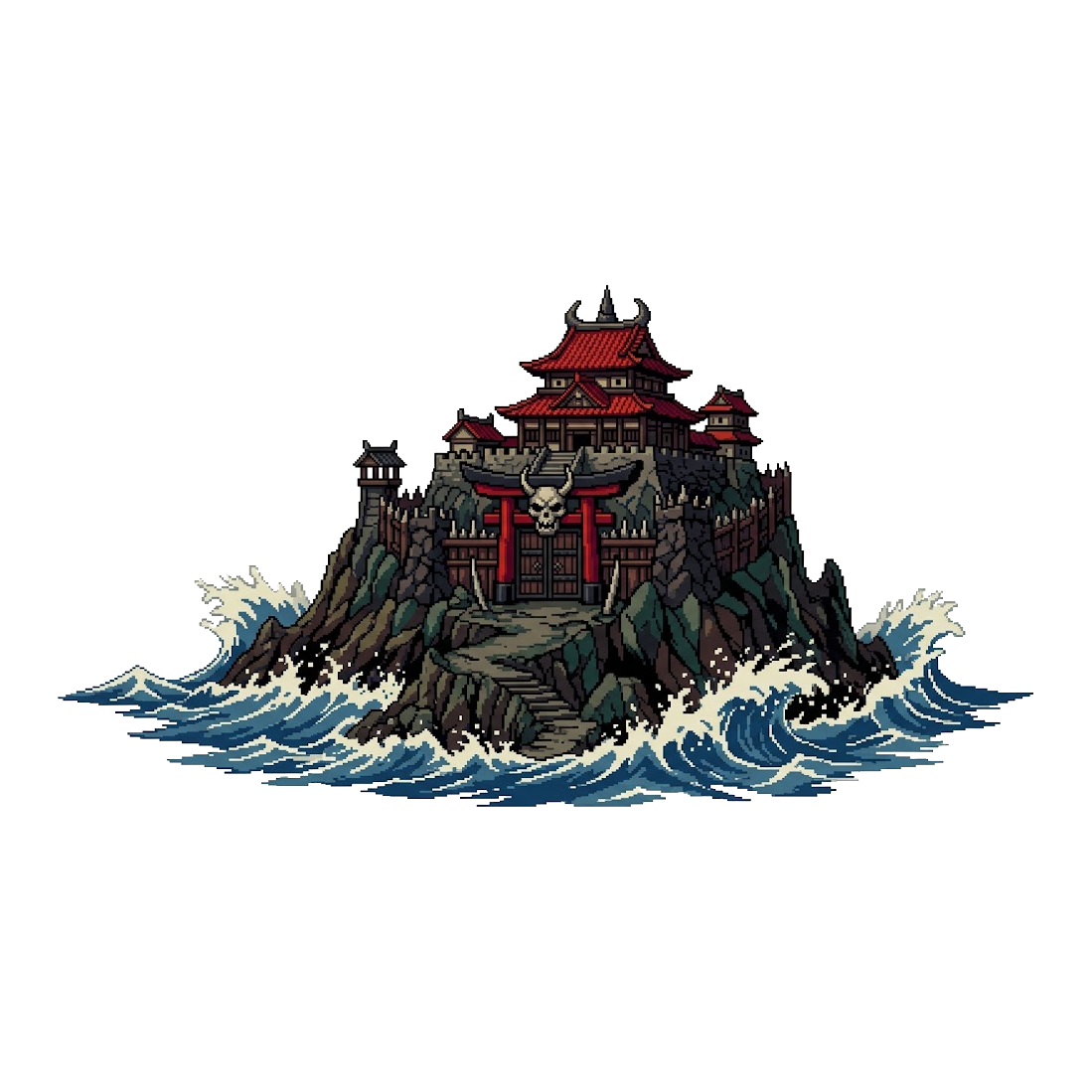
Japanese folktaleThe island in MomotaroSeveral ideas about the model
In the folktale "Momotaro," this is the island where the ogres are said to live. It is not a real island. But several places are said to be its model, such as Megijima in Kagawa Prefecture and Kinojo in Okayama Prefecture.
Key facts
| Type | An island in a folktale (an imaginary place) |
|---|---|
| Story it appears in | The folktale of Momotaro. The small details of the story differ by region and by source. |
| Places said to be the model | Megijima (pronounced meh-gee-jima) in Takamatsu, Kagawa Prefecture, and Kinojo (pronounced kee-no-jo) in Soja, Okayama Prefecture, among others. It is not clearly settled which one was the origin (accounts differ). |
| Megijima | An island off Takamatsu Port. In the middle of the island is the "Onigashima Great Cave." It is introduced as about 4,000 square meters in area and about 400 meters in total length. |
| When the cave was found | It is introduced as having been found in 1914 (Taisho 3) by Sentaro Hashimoto, a local historian. In 1931 (Showa 6), it was opened to the public and linked with the story of Momotaro. |
| Kinojo | An ancient mountain fortress in Soja, Okayama Prefecture. It was designated a national historic site, "Kinojo-san," on March 25, 1986 (Showa 61). |
| Cultural meaning | As the stage of the "ogre-defeating story," it is loved across Japan in folktales, tourism and efforts to bring life to local towns. |
What kind of place is it?
Onigashima is the island where the ogres live in the folktale "Momotaro." Momotaro takes a dog, a monkey and a pheasant as his helpers, and goes to this island to defeat the ogres.
Onigashima is not the name of a real island on a map. It is an imaginary place in a story. But there are several places in Japan that are said to be the model for Onigashima.
In the story of Momotaro
The folktale of Momotaro has spread all over Japan. So the small details differ depending on the region, the time it was told, and the book.
The look of Onigashima also differs from story to story. It is often an island across the sea. A well-known version goes like this: the ogres were causing trouble, so Momotaro went there and defeated them. In some versions he brings back the ogres' treasure, and in others he does not. No single version is the "correct" one.
A place said to be the model 1: Megijima in Kagawa Prefecture
Megijima, an island off Takamatsu in Kagawa Prefecture, is also called "Onigashima." You can get there in about 20 minutes by ferry from Takamatsu Port.
On Washigamine (pronounced wah-shee-gah-mee-neh), a peak in the middle of the island, there is the "Onigashima Great Cave." It is a large cave said to be about 4,000 square meters in area and about 400 meters in total length.
It is said that this cave was found in 1914 (Taisho 3) by Sentaro Hashimoto, a local historian. Then in 1931 (Showa 6), it was opened to the public as "Onigashima," linked with the story of Momotaro. In other words, the link between Megijima and Momotaro seems to have spread in more recent times, rather than being an old tradition from long ago. There is no proof that the cave was really a home for ogres. It is a place to enjoy as a legend.
A place said to be the model 2: Kinojo in Okayama Prefecture
Okayama Prefecture also has a place closely tied to the story of Momotaro. It is Kinojo (pronounced kee-no-jo), on a mountain in Soja.
Kinojo is an ancient mountain fortress (a stronghold built on top of a mountain). It is thought to date from the 7th century, about 1,300 years ago. Stone walls and walls made of packed earth (called earthen ramparts) circle the mountaintop for about 2.8 kilometers. It is a mysterious castle, because it hardly appears in old historical records.
In Okayama, there is a legend about an ogre named Ura and a prince named Okibitsuhiko-no-mikoto (pronounced oh-kee-bee-tsoo-hee-ko no mee-ko-to). It is said that the castle where this ogre lived was Kinojo, and some say this was the origin of Momotaro. But this is only one of several ideas.
Things worth knowing about the culture
The model for Onigashima is not settled in one place because the story of Momotaro has been passed down in many places over a long time. In some places, such as the Kinashi area of Takamatsu in Kagawa Prefecture, a slightly different Momotaro legend is told.
As folktales are told from person to person, they join with local legends and change. Rather than deciding "which idea is right," try asking "why was this story told in so many places?" That makes folktales even more fun.
Today, Onigashima is also used for tourism and for bringing life to local towns. Visitors are welcomed with ogre statues, millet dumplings and more.
About this illustration
This is a pixel-art illustration. It shows Onigashima as the island where ogres live. It is not a picture of the real Megijima or Kinojo. It is an image of the world of the folktale. The colors, the shape of the island and the decorations are the illustrator's own ideas, and are not from the real places or the legends.
Fun facts
- The model for Momotaro's Onigashima is not settled in one place. There are many ideas, including Megijima in Kagawa Prefecture and Kinojo in Okayama Prefecture.
- The Onigashima Great Cave on Megijima is introduced as having been found in 1914 (Taisho 3) and opened to the public in 1931 (Showa 6), linked with the story of Momotaro.
- Kinojo in Okayama Prefecture was designated a national historic site, "Kinojo-san," in 1986 (Showa 61).
Quick quiz
Q. On Megijima in Kagawa Prefecture, which big attraction is called "Onigashima"?
Megijima has the "Onigashima Great Cave," said to be about 4,000 square meters in area and about 400 meters long. It is loved as the Onigashima of Momotaro.
References
- Japan Tourism Agency, Ministry of Land, Infrastructure, Transport and Tourism, "多言語解説文データベース" (Multilingual Explanation Database): the explanation of Megijima and the Onigashima Great Cave
- Official materials of Okayama Prefecture and the Okayama tourism website (おかやま観光ウェブ): an overview of Kinojo (Kinojo-san) and the date it was designated a national historic site
- Setouchi Triennale (Art Takamatsu) introduction materials on Megijima: how the cave was found and how it is linked to the Momotaro legend
- Soja City and the Japan Heritage story "『桃太郎伝説』の生まれたまち おかやま" (Okayama, the Birthplace of the Momotaro Legend): the Ura legend and Kinojo
Accounts may differ between sources and regions, and facts or figures can change with new research or rules. This page was translated from the Japanese original.
Download the pixel art
- Free
- No registration
- Commercial use OK
- Edits OK
- Credit optional
- No usage report needed
Please read the terms of use before using it.