



World & Culture Encyclopedia No.021
Dutch Windmills and Tulip Fields (Kinderdijk style)
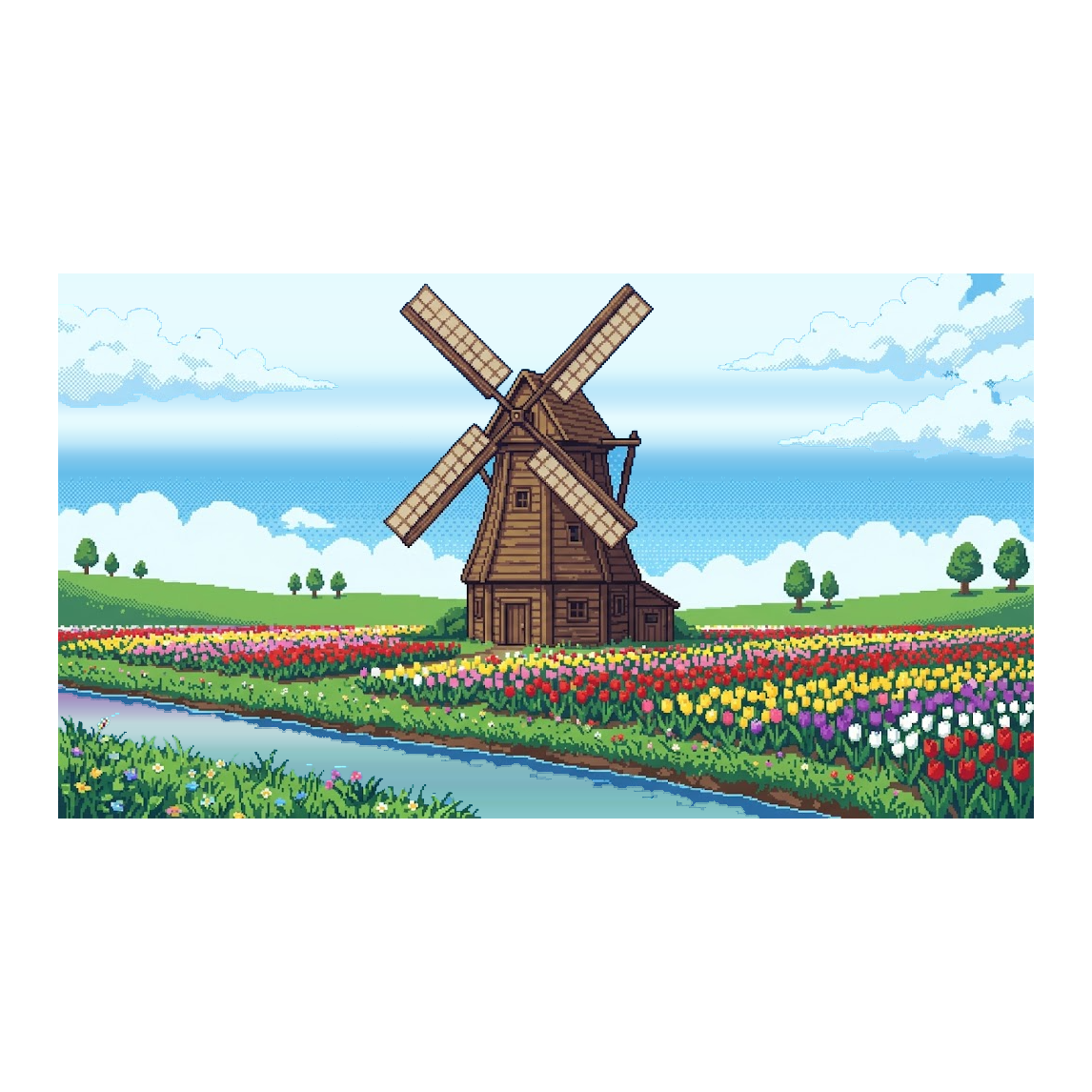
The NetherlandsWindmills and flower sceneryWorld Heritage Site: "Mill Network at Kinderdijk-Elshout"
Windmills and tulip fields are scenery that stands for the Netherlands. Windmills pump out water to protect the land. Tulips are known as a spring flower industry.
Key facts
| Type | Windmills (buildings that use wind power to turn blades, used to pump out water and for other jobs) and flower-growing scenery |
|---|---|
| Place | The Netherlands. The best-known windmill place is Kinderdijk in the province of South Holland. Tulips are grown mainly along the western coast |
| When the windmills were built | The Kinderdijk windmills were mostly built around 1738 and 1740 (the year differs from mill to mill) |
| Number of windmills | 19 mills remain ("mill" here is counted as a unit; some sources say there were originally 20) |
| World Heritage | Listed as a UNESCO World Heritage Site (cultural heritage) in 1997 as the "Mill Network at Kinderdijk-Elshout" |
| Job of the windmills | To lift water that collects on low land up into higher waterways, and so prevent flooding |
| Home of the tulip | Not the Netherlands. It is said to be the mountain regions of Turkey and Central Asia |
| When tulips came to the Netherlands | It is explained that around 1593, the botanist Clusius began growing them in the botanical garden of Leiden University (some sources say 1594, and accounts differ) |
What kind of place is it?
When people think of the Netherlands, many picture windmills and tulips. Windmills with big blades and fields full of red, yellow and pink flowers are scenery that symbolizes the country (stands for it).
But these two are not always seen in the same place. Kinderdijk, the famous windmill village, and the areas with many tulip fields are in different places. The illustration puts the two together in one picture.
The job of windmills
The name of the country is sometimes explained as meaning "low land," and much of the country is lower than the sea. If nothing is done, water collects.
So many windmills were built that turn their blades with wind power and lift the collected water into waterways. Some windmills ground wheat, but the Kinderdijk windmills were mainly for pumping out water.
Land drained in this way is called a "polder." It has been used for fields, pastures and towns.
The Kinderdijk windmills
Kinderdijk is in a low-lying area called the Alblasserwaard in South Holland. Windmills made of stone, brick and other materials stand in a row along the waterways.
The windmills were mostly built around 1738 and 1740. Nineteen remain.
In 1997, the site was listed as a World Heritage Site (a place protected as a treasure for all people), together with the surrounding waterways, dikes (banks that hold back water) and pumping stations. It is treasured as a place that tells the history of how people long ago struggled against water and came up with clever ideas.
The history of tulips
Tulips are said to have first grown wild in the mountains from Turkey to Central Asia.
In the Netherlands, it is known that at the end of the 16th century, the botanist (a person who studies plants) Carolus Clusius grew them in the botanical garden of Leiden University. This is explained as around 1593, but some sources say 1594, so the exact year differs by source (accounts differ).
Later, rare flower bulbs (the swollen, root-like part of the plant) sold for high prices, and in 1637 prices fell sharply. This is called "tulip mania," and it is often talked about in the history of economics.
Tulip fields and the flower park
Even today, spring in the Netherlands is colored by bulb flowers. Rows of bright colors make stripes across the fields.
Keukenhof, a famous flower park, was planned in 1949 by people such as bulb farmers as a place to show off flowers, and it opened in 1950. The number of people who took part in the planning differs by source, from 10 to 20. In its first year, visitors are described as about 200,000 to 240,000 (officially about 236,000). The history of the park's land is said to go back to the 15th century, which is a separate story from the history of tulips.
Good things to know about the culture
Windmills are not only a sign for tourists. They are also a form of wisdom from people who live with water. There are stories that people passed on feelings, like words, by the direction of the blades or the way they were stopped, but these differ by region and by source.
The tulip was also a beloved flower in Turkish culture. It traveled across borders and has now become the flower that stands for spring in the Netherlands. When you look at the scenery, try to remember the link between people and nature.
About this illustration
This is a pixel-art picture (a picture made of small squares) of windmills and colorful tulip fields. The real Kinderdijk windmills stand along waterways, and the tulip fields are in a different area. Putting them together in one picture is an illustration's way of showing things, not how it looks in real life. The colors and layout are also the illustration's own way of showing things.
Fun facts
- The Kinderdijk windmills were listed as a World Heritage Site in 1997.
- The tulip was not born in the Netherlands. Its home is said to be the mountain regions of Turkey and Central Asia.
- Keukenhof opened as a flower park in 1950.
Quick quiz
Q. What is the main job of the Kinderdijk windmills?
The Kinderdijk windmills were mainly built to lift water from low land into waterways and prevent flooding.
References
- UNESCO World Heritage Centre "Mill Network at Kinderdijk-Elshout" (for the year and name of the World Heritage listing)
- Official World Heritage site Kinderdijk (for the number of windmills and their history)
- Keukenhof official site "History" and "75th anniversary" (for the opening year, the planning story and visitor numbers)
- Universiteit Leiden "Carolus Clusius" and the Hortus botanicus Leiden explanation (for Clusius, the botanical garden and the arrival of tulips)
Accounts may differ between sources and regions, and facts or figures can change with new research or rules. This page was translated from the Japanese original.
Download the pixel art
- Free
- No registration
- Commercial use OK
- Edits OK
- Credit optional
- No usage report needed
Please read the terms of use before using it.