



World & Culture Encyclopedia No.023
Black Cat
Legends from around the worldA symbol of HalloweenA bringer of good fortune in Japan
A black cat is a cat whose fur is black all over. At Halloween, it is famous as a witch's companion. But in different countries, people see it differently, for example as having "mysterious powers" or as a "sign of good luck."
Key facts
| Type | A name for a fur color. It is a house cat with black fur, not the name of a breed. |
|---|---|
| Places linked to it | Europe and the United States (a witch's companion), Scotland in the United Kingdom (said to bring wealth when it comes), and Japan (calls in good fortune and keeps bad things away) |
| Link to Halloween | It is thought to come from a European legend that witches use animals as "familiars" (helpers). |
| Examples of legends | Bad luck if it crosses your path (parts of Europe and the United States) / Good luck if it comes to your home (Scotland) / Good luck if it is taken aboard a ship (sailors in the United Kingdom and other places) |
| How people see it in Japan | It is explained that black cats have been seen as lucky since before Western culture spread. Many of these stories have unclear sources, so accounts differ. |
| Related special days | Cats Protection, a cat charity in the United Kingdom, has marked October 27 as "National Black Cat Day" since 2011. The United States is also said to have a day on August 17 (the explanation of how it began differs between sources). |
| Cultural meaning | An animal that has been given two meanings: something scary and a sign of good luck |
What kind of animal is it?
A black cat is a cat whose fur is black all over. It is not the name of a special breed. It is a name based on fur color. Some ordinary house cats (cats that live with people) have black fur.
Its black body blends into the dark, and its eyes seem to glow. This mysterious look has fired people's imaginations for a very long time.
Halloween and the witch's companion
Black cats often appear in Halloween decorations. This is thought to come from a European legend.
People used to believe that "a witch keeps animals as helpers by her side." These helpers were called "familiars," and the black cat was one of the best-known examples. Stories about familiars appear a lot in the records of witch trials in England in the 16th and 17th centuries (the period after the Middle Ages). It is explained that this idea later reached the United States too.
But this image came from the beliefs of people long ago. A black cat itself does not cause bad things to happen.
Different views in different countries
How people see black cats is very different from place to place.
Some regions think it is bad luck if a black cat crosses your path. But in Scotland, in the United Kingdom, there is a legend that "if a black cat comes to your home, you will become wealthy." There is also a story that sailors in the United Kingdom and other places thought a black cat on board brought good luck. Cats were also helpful on ships, because they chased away the mice that nibbled the food.
The details of each story differ by region and by source, and for many of them the exact origin is not known.
Black cats in Japan
In Japan, black cats are explained as having been loved as animals that bring good fortune, and as a charm against evil (a lucky charm that keeps bad things away). Cats were also welcome because they chased away the mice that went after rice and other grains.
There is a story that "the oldest beckoning cat (a lucky cat figure) in Japan was a black cat." However, a clear source for this could not be confirmed, so it is best to think of it as "one account among others." As Western culture spread, the image of the "Halloween black cat" seems to have been added in Japan as well.
Cultural things worth knowing
Because of the legends about black cats, it is sometimes said that black cats are less likely to be adopted from animal shelters (places that take in animals with nowhere to go). So days were created to help people learn about the good points of black cats.
Cats Protection, a cat charity in the United Kingdom, has marked October 27 as "National Black Cat Day" since 2011. In the United States, a similar day is said to be held on August 17, but the explanation of how it began differs between sources.
The Halloween black cat is a fun decoration. But real black cats, like other cats, are often very affectionate animals. It is important to think about legends and the real animal separately.
About this illustration
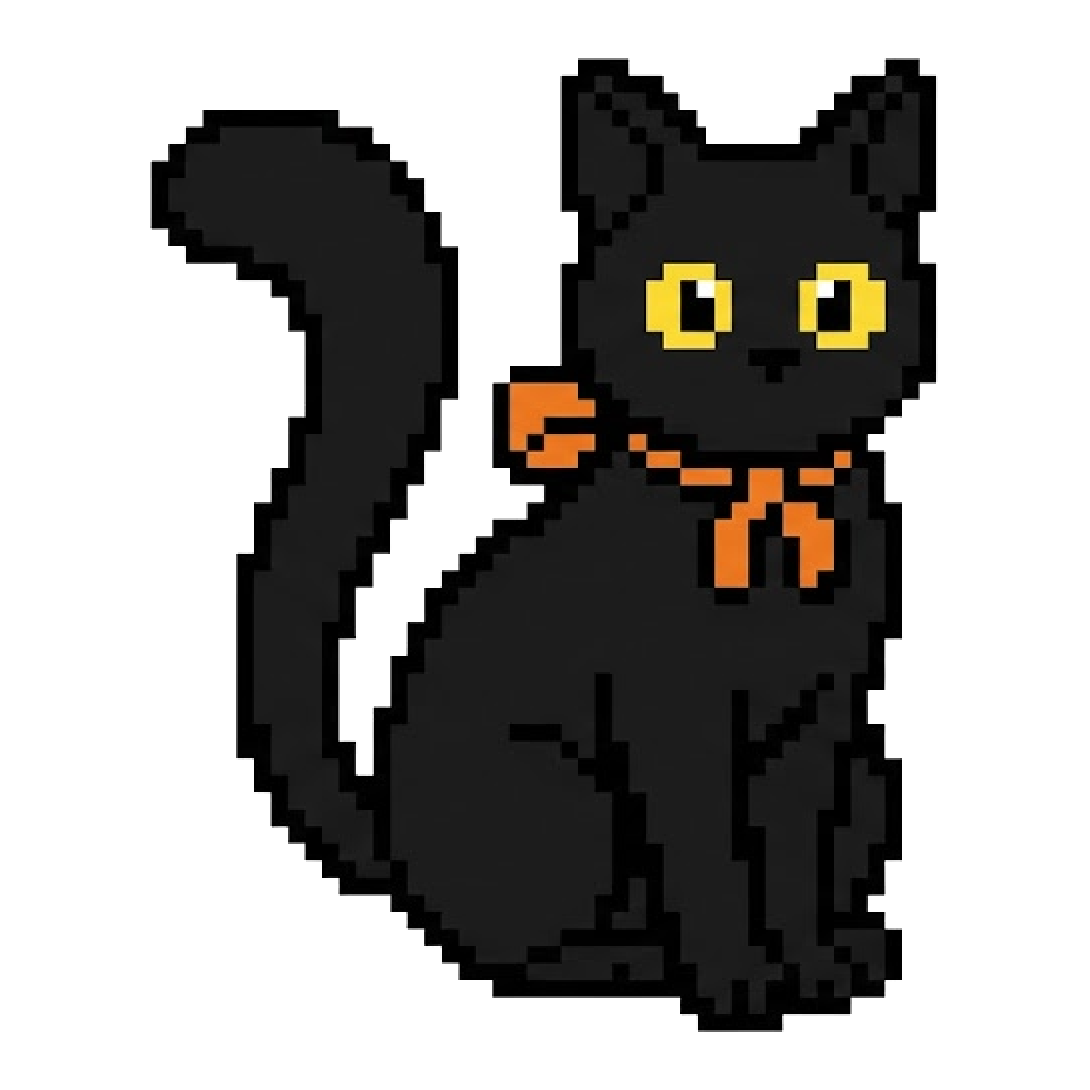
This is a pixel-art illustration (a picture made by lining up tiny squares) of a black cat with yellow eyes, wearing an orange ribbon. It can be used in Halloween scenes. The orange ribbon and the yellow eyes are design choices for the picture. Real black cats and the legends are not fixed that way. It is an illustration, so it differs from the real animal.
Fun facts
- "Black cat" is a name for a fur color, not the name of a special breed.
- The black cat is known as a witch's companion at Halloween because it is thought to come from the European legend of the "familiar."
- In Scotland, there is a legend that a black cat coming to your home brings wealth. This is an example of the meaning being the opposite in different countries.
Quick quiz
Q. Which of these is a correct statement about black cats?
Views of black cats differ by region. In Europe and the United States they are seen as a witch's companion, and in Scotland and Japan they are sometimes seen as lucky or as a charm against evil. Also, "black cat" is a name for a fur color, not a breed.
References
- HISTORY "Black Cats and Superstitions" (article by Elizabeth Yuko): about the history of black cats, witches and superstitions
- Cats Protection (a cat charity in the United Kingdom) "History of National Black Cat Day": about how National Black Cat Day (October 27) began
- Cats Protection "Black cat superstitions": about legends linked to black cats
- Kinship "The History of Cats and Witches": about the history of the image of cats and witches
- FOUR PAWS "Black Cat Appreciation Day": about the August 17 day
Accounts may differ between sources and regions, and facts or figures can change with new research or rules. This page was translated from the Japanese original.
Download the pixel art
- Free
- No registration
- Commercial use OK
- Edits OK
- Credit optional
- No usage report needed
Please read the terms of use before using it.