



Society Encyclopedia No.002
Piano
Musical instrumentKeyboard instrument (strings struck by hammers)Early 1700s, Italy
When you press a key, a hammer inside hits a string and makes a sound. How hard you press changes how loud the sound is. It is said to have been invented in Italy around 1700.
Key facts
| Type | Keyboard instrument. Hammers strike strings to make sound (also called a struck-string instrument or a string instrument) |
|---|---|
| Beginnings | Said to have been invented by Cristofori of Italy around 1700 (it appears in a list of instruments owned by the Medici family in 1700. Some sources say around 1709, so accounts differ) |
| Origin of the name | The first name was an Italian phrase meaning "harpsichord that can play soft and loud." People took "piano" (soft) and "forte" (loud) from it, and began to call it by that short name |
| How it works | Press a key → a hammer hits a string → the string shakes and makes sound. When the hammer bounces back, a stopper (the damper) touches the string and stops the sound |
| Number of keys | The standard today is 88 keys. Cristofori's piano of 1720 had 54 keys when it was made |
| Kinds | Grand piano (strings stretched flat), upright piano (strings stretched up and down), digital piano, and others |
| Oldest surviving pianos | Three pianos by Cristofori survive (from 1720, 1722 and 1726). The 1720 one is held in the collection of the Metropolitan Museum of Art in the United States ("held" means the museum keeps it with care) |
What is it?
The piano is an instrument that makes sound when you press keys (the parts you press with your fingers). Inside are many strings (stretched metal wires). When you press a key, a small hammer hits a string, and the string shakes and makes a sound.
Its best feature is that you can change the loudness by how hard you press. Press gently for a soft sound. Press hard for a loud sound. One person can play both the melody and the accompaniment (the sounds that support the melody). So it is used in many ways, such as for practice, writing music, and accompanying a choir.
How the sound is made
When you press a key, several parts move in order, and the hammer hits the string. The hammer bounces back right after it hits. This lets the string shake freely, and the sound lasts.
When you lift your finger from the key, a stopper called a damper falls onto the string and stops the sound. If you press the pedal, the dampers stay away from the strings, so the sound can last longer. A grand piano has its strings stretched flat, and an upright piano has them stretched up and down. So their shapes and sizes are different.
History: from the harpsichord to the piano
Before the piano was born, a keyboard instrument called the harpsichord was widely used. In a harpsichord, pressing a key makes a small claw pluck a string. Its sound is beautiful, but it was hard to change the loudness by how hard you pressed.
Bartolomeo Cristofori (1655–1731) made instruments in Florence, Italy. He aimed to make a keyboard instrument that could play soft and loud. A list of instruments owned by the Medici family (a powerful family of Florence) from 1700 includes an instrument that could play soft and loud. It is said that the idea of hitting strings with hammers was created around this time. This instrument was named "harpsichord that can play soft and loud," and this became the root of the name piano. Some sources give around 1709 as the year of the invention, so accounts differ.
Later changes
Cristofori's piano looked very much like a harpsichord, and it had 54 keys. Its sound is said to have been closer to a harpsichord than to today's concert pianos.
After that, from the 1700s to the 1800s, craftspeople in Europe improved it little by little. The number of keys grew, the sound became louder, and pedals were added. In Mozart's time, pianos are also said to have had about 61 keys. Later, 88 keys became the standard that we have today.
Where we see it, and what to be careful about
Pianos are widely used in school music rooms, concert halls, homes, and more. At concerts, a piano is sometimes played together with an orchestra (a large group of many instruments playing together).
A piano is made of wood and metal, and it is a very delicate instrument (easy to damage, so it needs careful handling). Sudden changes in temperature or humidity (how damp the air is) can put the sound out of tune. So tuning (the work of adjusting the pitch of the sound) is done regularly. It is common to ask a specialist to do the tuning. Do not put heavy things on the lid, and take care not to spill water on it.
About this illustration
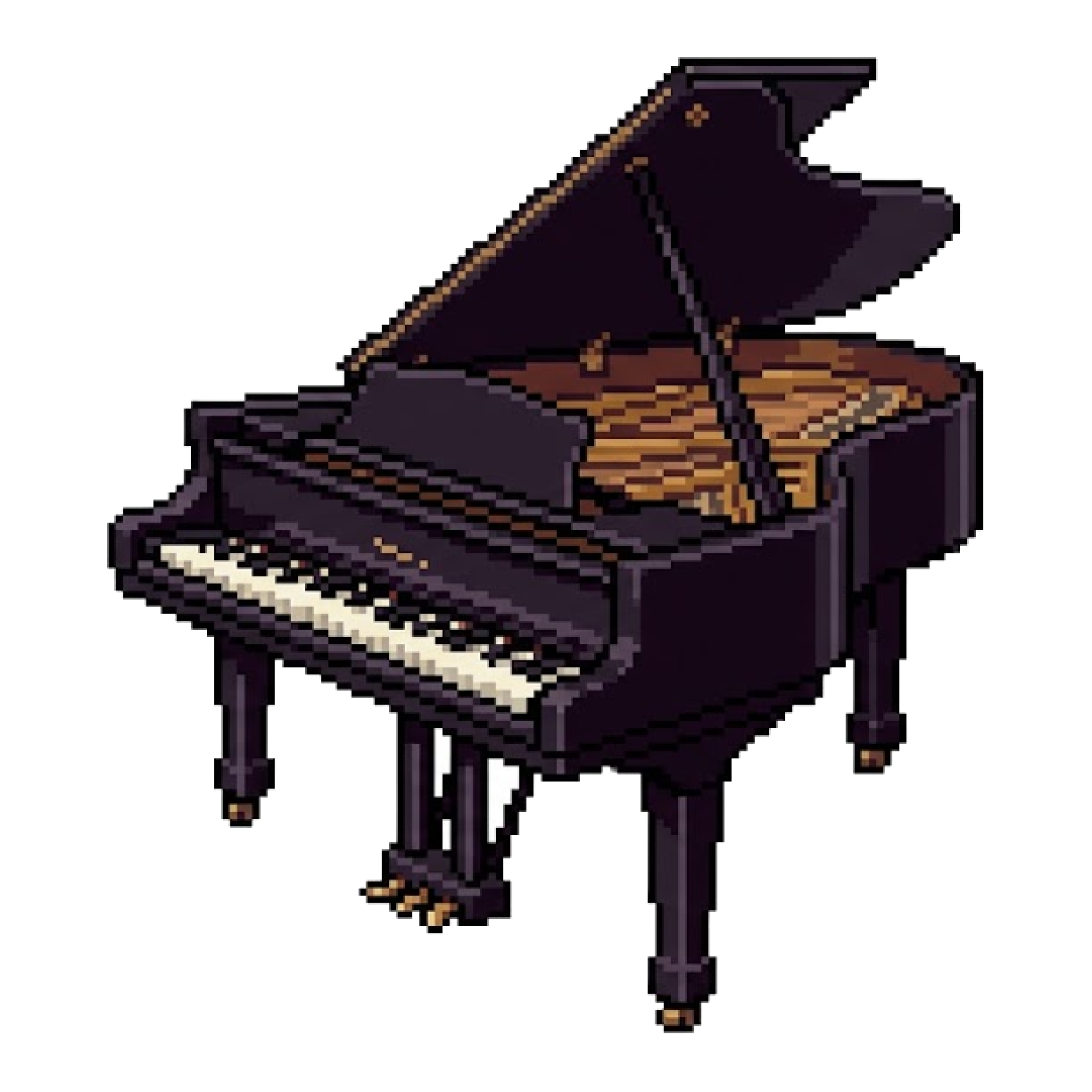
This is a pixel-art picture of a black grand piano. (Pixel art is a way of drawing with small square dots.) Seen from the side, a grand piano has a large body with a gentle curve like a wing. A black finish is also common on real grand pianos. The number of small parts, and the keys, legs, pedals and other details, are simplified into the simple shapes of pixel art, so they differ from the real thing. This is the artist's own style.
Fun facts
- Of the three surviving pianos by Cristofori, the oldest, from 1720, is held by the Metropolitan Museum of Art in the United States.
- The name piano is a short name made from "piano" (soft) and "forte" (loud) in the original long name.
- The standard today is 88 keys, but Cristofori's piano had 54 keys when it was made.
Quick quiz
Q. How is the sound of a piano made?
In a piano, pressing a key makes a hammer hit a string, and that makes the sound. Plucking with a claw is how the harpsichord, used before the piano, works.
References
- Metropolitan Museum of Art (The Met), "The Piano: The Pianofortes of Bartolomeo Cristofori (1655–1731)" (Cristofori, the 1700 record, the 1720 piano, the three surviving pianos)
- 『日本大百科全書(ニッポニカ)』「ピアノ」(コトバンク掲載) (Nipponica, "Piano," on Kotobank: how it works, history, kinds)
- 『世界大百科事典』「ピアノ」(コトバンク掲載) (World Encyclopedia, "Piano," on Kotobank: hammer action and dampers, history of improvements)
- Metropolitan Museum of Art collection data "Grand Piano, 1720, Bartolomeo Cristofori" (materials, how the museum came to hold it)
Accounts may differ between sources and regions, and facts or figures can change with new research or rules. This page was translated from the Japanese original.
Download the pixel art
- Free
- No registration
- Commercial use OK
- Edits OK
- Credit optional
- No usage report needed
Please read the terms of use before using it.