



Science Encyclopedia No.017
Mars
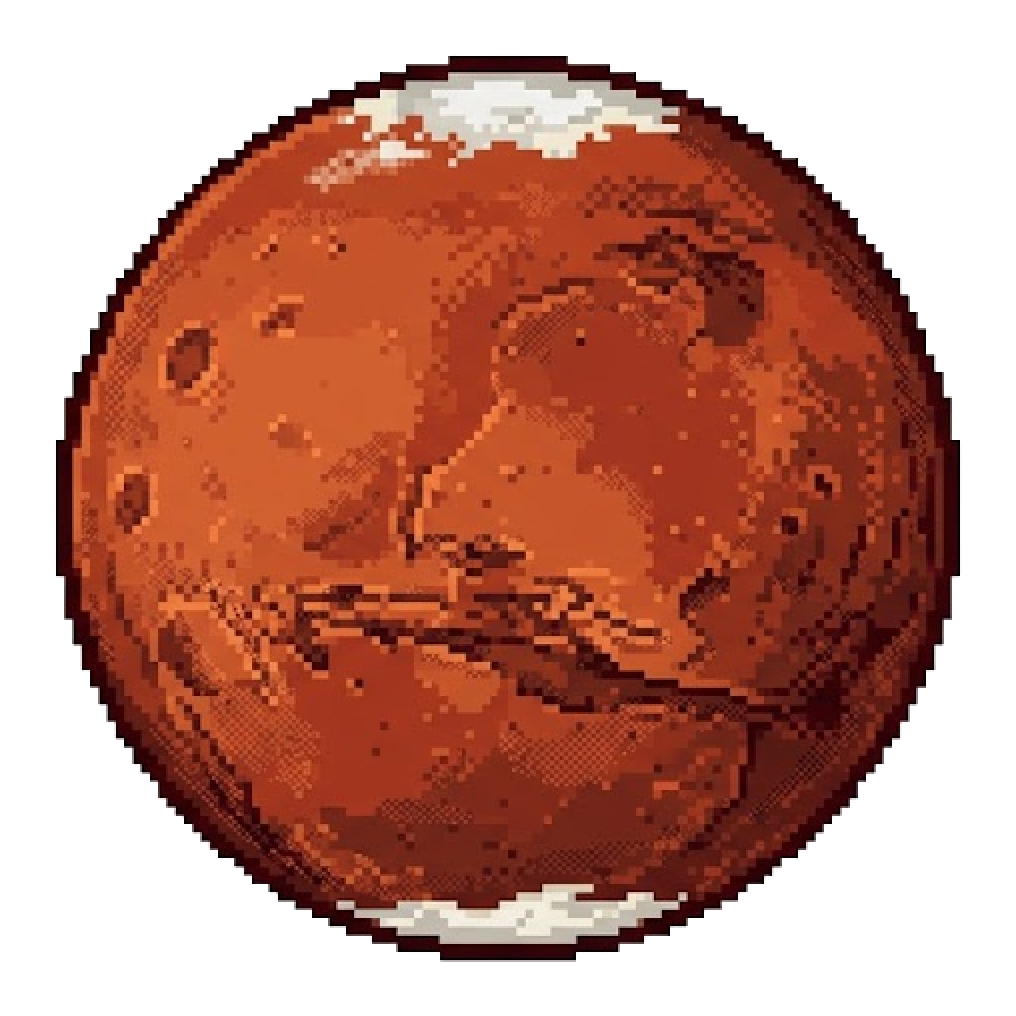
Solar systemA rocky planet (terrestrial planet)The fourth planet from the Sun
A planet with reddish-brown ground, just outside Earth's orbit. It has the tallest volcano and a huge canyon in the solar system, and icy caps (polar caps) at its poles.
Key facts
| Type | A planet of the solar system (a rocky, terrestrial planet) |
|---|---|
| How it works (in brief) | Its air is thin and it is cold. The iron in its ground is said to rust, which makes it look reddish. |
| Radius | About 3,390 km (about half of Earth's) |
| Average distance from the Sun | About 228 million km (about 1.5 astronomical units; one astronomical unit is the average distance between Earth and the Sun) |
| Orbital period (time to go around the Sun once) | About 687 days (counted in Earth days) |
| Length of a day | About 24.6 hours (very similar to Earth's) |
| Surface temperature | Highest about 20°C, lowest about minus 153°C |
| Atmosphere | Very thin, mainly carbon dioxide, nitrogen and argon |
| Moons | Two (Phobos and Deimos). It has no rings. |
What kind of planet is it?
Mars is the fourth planet from the Sun. It travels just outside Earth's orbit. Its radius is about 3,390 km, about half the size of Earth.
It is made of rock, and its ground looks reddish-brown. So it stands out in the night sky as a reddish star. A day on Mars is about 24.6 hours long, very similar to a day on Earth.
The red color and the thin air
Mars looks red because its ground has many rocks and soils that contain iron, and the iron is said to have rusted.
The air (atmosphere) of Mars is very thin and is mostly carbon dioxide. It cannot hold heat well, so Mars is a cold planet. The surface temperature is about 20°C in the warmest places and about minus 153°C in the coldest. People cannot breathe on Mars unless they bring air with them.
The biggest volcano and canyon in the solar system
Mars has landforms on a giant scale. Olympus Mons is the largest volcano in the solar system. Its height is given as about 22 km to about 25 km (when seen from the flat land around it), depending on how it is measured. That is much taller than the highest mountain on Earth (Mount Everest).
Valles Marineris is one of the largest canyons in the solar system. Its length is said to be about 4,000 km, but the numbers differ from source to source (some NASA materials give about 3,870 km). Compared with the size of Mars, you can see that it is a very long canyon.
Polar caps and the mystery of water
At the north and south poles of Mars, there are white polar caps (large masses of ice). They are made of ice, and their size changes with the seasons.
Near the poles, there is also water ice just under the ground. Landforms that look like traces of flowing water have also been found from long ago. Mars today is cold and dry, but it is thought that long ago the conditions were different from now, and research continues.
Two small moons and exploration
Mars has two moons, Phobos and Deimos. Both are small bodies shaped like potatoes. They may have started as asteroids (small lumps of rock that travel around the Sun) and been caught by the gravity of Mars (accounts differ).
Mars is also the only planet that is being explored by rovers (vehicles that drive across the surface). Rovers such as Curiosity and Perseverance study its rocks and soil.
About this illustration
A pixel-art picture of Mars, with reddish-brown ground and white polar caps. It shows the features of Mars: a reddish planet and white icy parts. The way the colors are painted and the level of detail are the artist's way of drawing, and are different from a real photograph.
Fun facts
- A day on Mars is about 24.6 hours, almost the same length as a day on Earth.
- Mars has a volcano taller than the highest mountain on Earth.
- Mars is the only planet explored by rovers driving on its surface (according to NASA materials).
Quick quiz
Q. Which statement about Mars is correct?
Mars has many rocks and soils with iron, and they are said to look reddish because they have rusted. Mars has two moons, Phobos and Deimos, it has no rings, and its atmosphere is very thin.
References
- NASA Science『Mars Facts』 (supports radius, distance from the Sun, orbital period, length of a day, temperature, atmosphere, moons, rings, Olympus Mons, Valles Marineris and rovers)
- ESA (European Space Agency) materials on the Mars Express orbiter (supports Mars landforms, volcanoes and canyons)
- NASA Science『Phobos』『Deimos』 (supports the features and sizes of Phobos and Deimos)
- Encyclopaedia Britannica『Mars』『Olympus Mons』 (supports Mars landforms and the height of Olympus Mons)
- 国立天文台『理科年表』 (National Astronomical Observatory of Japan, Chronological Scientific Tables; supports basic planet data)
Accounts may differ between sources and regions, and facts or figures can change with new research or rules. This page was translated from the Japanese original.
Download the pixel art
- Free
- No registration
- Commercial use OK
- Edits OK
- Credit optional
- No usage report needed
Please read the terms of use before using it.