



Science Encyclopedia No.016
Amethyst
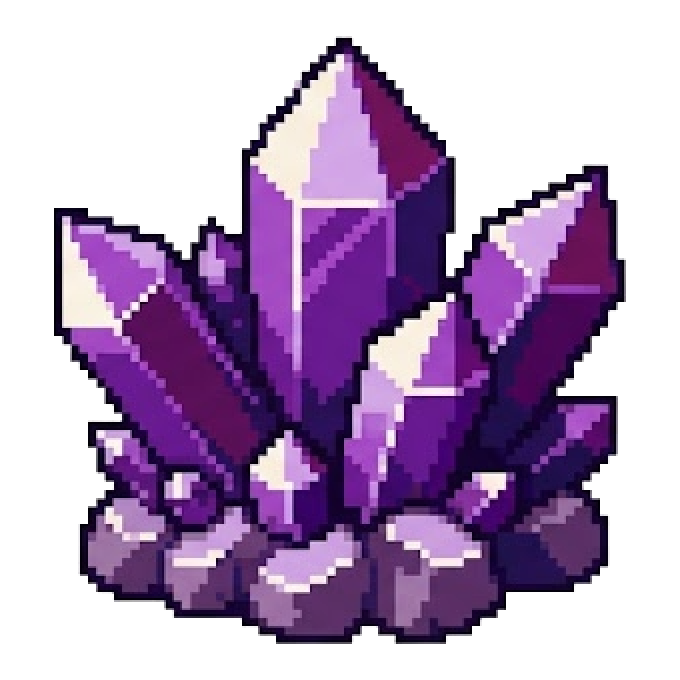
MineralA kind of quartzFebruary birthstone
Amethyst is a purple kind of quartz (rock crystal). Its color is said to come from a little iron inside it and natural radiation. People have treasured it as a gem for a long time.
Key facts
| Classification | A mineral. A purple variety of quartz (silicon dioxide) |
|---|---|
| Japanese name | Murasaki-suishō ("purple crystal") |
| How it works (in short) | It is said to turn purple through a little iron mixed into the crystal and the power of natural radiation |
| Chemical formula | SiO₂ (made of silicon and oxygen) |
| Hardness | 7 on the Mohs scale (the same as rock crystal) |
| Range of colors | From pale lilac to deep reddish purple |
| Birthstone | February birthstone |
| Familiar examples | Gems in rings and necklaces, and decorative stones |
| Origin of the name | Said to come from a Greek word meaning "not drunk" (accounts differ) |
What kind of stone is it?
Amethyst is a kind of rock crystal. Rock crystal is the clear form of quartz, a mineral made of silicon and oxygen. (A mineral is a solid that forms in nature and has a set makeup.) A purple one is called amethyst.
Its color varies from pale lilac to deep reddish purple. In Japanese it is called "murasaki-suishō," which means "purple crystal." Its hardness is 7 on the Mohs scale (a scale from 1 to 10 for how hard a stone is to scratch), the same as ordinary rock crystal. Among gems, it is fairly hard and strong.
The secret of the purple color
Ordinary rock crystal is clear and has no color. Amethyst turns purple because a very small amount of iron is mixed into its crystal. (A crystal is a collection of tiny pieces lined up in a neat pattern.)
It is explained like this: natural radiation (weak, invisible energy) from the rocks around it hits that iron for a long time. This creates the source of the color, and the stone looks purple. The color appears only when both iron and radiation are there.
When amethyst is heated, it can turn yellowish, and sometimes greenish. It is also said that the color can fade if the stone sits in strong light for a long time. So when you use it as a gem, it is said to be best to take care where you keep it.
Where does it form?
Amethyst forms when crystals slowly grow in gaps in rock or inside cavities (holes in rock that were filled with air). A cavity packed with purple crystals on its inner walls is called a geode. It looks like a cave made of stone.
Countries in South America, such as Brazil and Uruguay, are known as major places where amethyst is found. It is also found in many other places around the world.
Name and history
The name "amethyst" is said to come from a Greek word meaning "not drunk." It is said that people long ago believed that wearing this stone, or drinking wine from a cup made of it, would keep them from getting drunk. This effect has not been confirmed by science.
Purple has long been seen as a color fit for important people (a noble color). It is said that kings, nobles and clergy (people who do religious work) liked it. It is known that amethyst became the February birthstone when it was put on a list set by a group of American jewelers in 1912. The list has been reviewed several times since then, but February is still amethyst.
How it is used in daily life
Amethyst is often used as a gem in rings, necklaces, brooches and more. Unpolished crystals and geodes are also popular as decorations and as mineral specimens.
Some purple stones sold in shops are said to be quartz that contains iron and has been given color by artificially exposing it to radiation. Natural and artificial stones are both still quartz.
About this illustration
This is a pixel-art picture of an amethyst. It is drawn as a purple gem and can be used as a picture for a treasure, an ore or an item in a shop. The shape, the tones and the way the sparkle is shown are the artist's pixel-art style, and they are different from the shape and color of a real crystal.
Fun facts
- Amethyst belongs to the same quartz family as clear rock crystal. The difference in color comes from the action of a little iron and other things mixed in.
- When heated, it can change to a yellowish color.
- Purple crystals can grow inside a geode that looks like a cave made of stone.
Quick quiz
Q. Which of these is explained in the text as the reason amethyst is purple?
It is said that natural radiation hitting a little iron mixed into the crystal makes the stone purple. Both iron and radiation are needed.
References
- GIA (Gemological Institute of America) 'Amethyst' gem description (supports that it is a variety of quartz, the cause of its color, its hardness, and color change by heat)
- American Gem Society 'Amethyst' and 'February Birthstone' (supports the stone's features, history and its place as the February birthstone)
- Jewelers of America 'Birthstones' (supports the start of the 1912 birthstone list)
- minerals.net 'Amethyst' (supports its nature as a quartz variety and where it is found)
- Wiktionary 'ἀμέθυστος' and Dictionary.com 'amethyst' (support the origin of the name, said to come from a Greek word meaning "not drunk")
Accounts may differ between sources and regions, and facts or figures can change with new research or rules. This page was translated from the Japanese original.
Download the pixel art
- Free
- No registration
- Commercial use OK
- Edits OK
- Credit optional
- No usage report needed
Please read the terms of use before using it.