



Science Encyclopedia No.014
Mortar and pestle
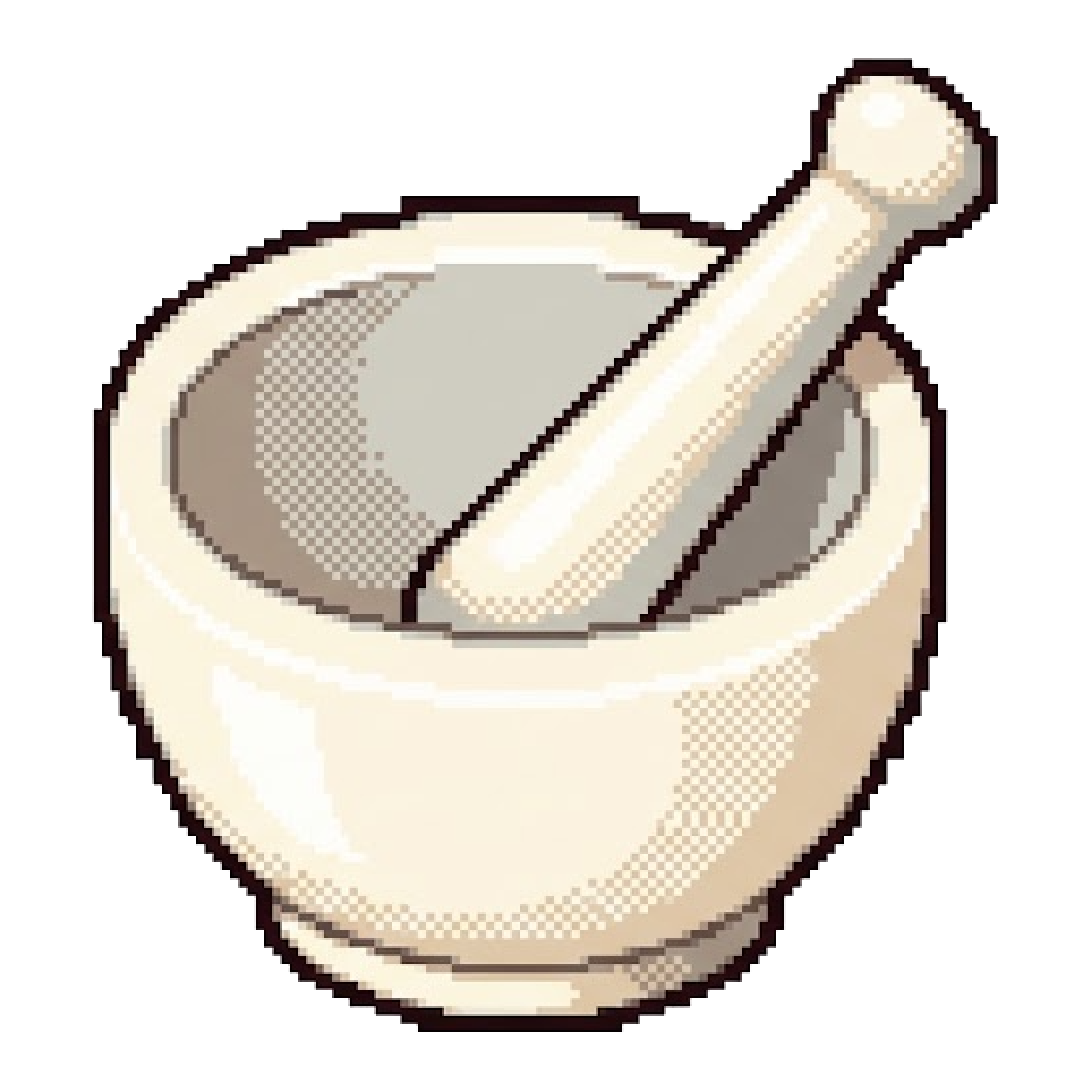
Lab toolTool for grindingA tool used since long ago
This tool turns hard things into powder or mixes several things together. You put things in the bowl, called the mortar, and press them with a stick, called the pestle.
Key facts
| Type | A tool for grinding and mixing, used in experiments and cooking |
|---|---|
| How it works (in one line) | Put things in the hollow of the bowl, press them with the stick, and grind them |
| Materials | Porcelain (a hard pottery baked at a high temperature), glass, metal, agate and more |
| Everyday examples | Making powder in a science room or laboratory; grinding sesame seeds and spices in the kitchen |
| Basic way to use it | Add a little at a time and press the stick in circles along the inside of the bowl |
| History | A very old tool. It even appears in an ancient Egyptian medical text from around 1550 BCE (the Ebers Papyrus) |
| Safety note | Follow the instructions of a teacher or an adult when using chemicals, and wear safety goggles |
What kind of tool is it?
A mortar is a bowl with a hollow in it, shaped like a dish. A pestle is the stick used to press things inside it. The two are always used as a set.
They do two main jobs. One is to turn hard grains into fine powder. The other is to mix two or more things evenly. They have been used since long ago, in science rooms and in kitchens.
How it works, in more detail
Using it is very simple. First, put a small amount of something in the bowl. Next, press and rub with the pestle, drawing circles along the inside of the bowl. The grains slowly get finer and turn into powder.
If you put in a lot at once, it does not grind well. Bits can also fly out around the bowl. So the trick is to add a little at a time.
For experiments, porcelain (a hard pottery baked at a high temperature) is often used. There are also ones made of glass, of metals such as stainless steel, and of a stone called agate. Agate ones are said to wear down less and to be less likely to mix impurities (unwanted things) into what you grind.
History
The mortar and pestle is a very old tool. It is explained as a tool for pounding and crushing, and as one of the earliest ways to make grain (such as rice and wheat) into flour.
Among old written records, this tool appears in an ancient Egyptian medical text from around 1550 BCE (the Ebers Papyrus). However, it is not clear when the oldest surviving real one was made. Some stories give dates such as "tens of thousands of years ago," but the evidence is not solid, so we do not include them here.
How it is used in everyday places
In science classes and laboratories, it is used to turn solids into fine powder and to mix two or more things together.
In the kitchen, it is known as a tool for grinding sesame seeds and spices. In Japanese-style painting, the mortar and pestle are used to grind earth pigments and gofun (a white paint made from shells) into fine powder.
There are also machines that do the motion of a mortar and pestle in place of human hands.
Using it safely
What you need to be careful about depends on what you are grinding. When you use chemicals in a science experiment, always follow the instructions of a teacher or an adult. This is because some combinations must never be mixed.
Also, wear safety goggles so that flying powder does not get into your eyes or mouth. Porcelain and glass ones break if dropped, so hold them carefully with both hands. When you finish, wash it well and let it dry properly for the next person.
About this illustration
This is a pixel-art picture (a picture made of tiny squares) of a white ceramic mortar and pestle. Its main feature is the white bowl together with the stick. The colors and the fine details of the shapes are just ways of showing the tool clearly, and they are not facts. It may differ in small ways from a porcelain mortar used in a laboratory.
Fun facts
- The mortar and pestle are always used as a set. With only one of them, you cannot grind anything.
- It is said that a mortar and pestle appear in an ancient Egyptian medical text from around 1550 BCE.
- Mortars come in many materials, such as porcelain, glass, metal and agate.
Quick quiz
Q. Which is the right way to use a mortar and pestle?
Add things a little at a time and crush them by pressing with the pestle in circles along the inside of the bowl. If you add too much, it is hard to crush and bits can fly out. The mortar and pestle are used as a set.
References
- Encyclopaedia Britannica, "mortar and pestle" (supports: an old tool for grinding grain, and the record in an ancient Egyptian medical text)
- Musashino Art University, "MAU Art & Design Glossary," entry on the mortar and pestle (supports: the mortar used to crush earth pigments and gofun in Japanese-style painting)
- Avantor Sciences Japanese catalog, "Mortars" (supports: uses of laboratory mortars)
Accounts may differ between sources and regions, and facts or figures can change with new research or rules. This page was translated from the Japanese original.
Download the pixel art
- Free
- No registration
- Commercial use OK
- Edits OK
- Credit optional
- No usage report needed
Please read the terms of use before using it.