



Science Encyclopedia No.013
Moon
Earth's satelliteA body made of rockThe brightest object in the night sky
The Moon is the one large satellite that goes around Earth. Its surface is covered with craters. It always shows the same side to Earth, and its shape seems to change a little each day.
Key facts
| Category | A satellite of Earth (a natural one) |
|---|---|
| How it works (in a word) | The part lit by the Sun looks different depending on the viewing angle, so the Moon seems to wax and wane |
| Radius | About 1,740 km (less than one third of the width of Earth) |
| Average distance from Earth | About 384,400 km |
| Orbital period (time to go once around Earth) | About 27 days (about 27.3 days) |
| Cycle of phases | About 29.5 days (from one new moon to the next) |
| Rotation | It turns once in the same time as one orbit, so the same side always faces Earth |
| Surface temperature | About 127°C in sunlight and about minus 173°C in shade |
| Gravity | About one sixth of Earth's |
What kind of body is it?
The Moon is a satellite (a body that goes around a planet) that circles Earth. Its radius is about 1,740 km, which is a little less than one third of the width of Earth.
It is made of rock, and its surface has many round holes called craters. Craters were made when asteroids and meteorites (lumps of rock flying in from space) hit it. A crater named Tycho is at least about 85 km wide.
The Moon is about 384,400 km from Earth on average. It moves along an oval (stretched-round) path, so it comes closer and then moves farther away.
It always shows the same face
The Moon goes around Earth once in about 27 days. In fact, the time it takes to spin once on its own axis (rotation) is almost the same. So from Earth, we can only ever see the same side.
The pattern that looks like a rabbit pounding rice cakes is on this side that we can see. The dark parts are called "seas." They are not seas of water. They are wide, flat places where melted rock (lava) flowed long ago and then hardened. They are said to have formed between about 4.2 billion and about 1.2 billion years ago.
The far side, which cannot be seen from Earth, was photographed for the first time in 1959, when a probe from the former Soviet Union (a country that included today's Russia and others) passed nearby.
The secret of the phases
The Moon does not shine by itself. It shines because it reflects (bounces back) sunlight. The Moon is shaped like a ball, so only the half facing the Sun is bright at any time.
As the Moon goes around Earth, the shape of the bright part that we can see from Earth changes. This is what we call the phases. It takes about 29.5 days on average from one new moon to the next. The actual number of days varies between about 29.3 and 29.8.
This is longer than the Moon's trip around Earth of about 27 days, because during that time Earth also moves along its path around the Sun.
Hot by day, cold by night
The Moon has almost no air. It has only a very thin atmosphere (called an exosphere), and people cannot breathe there. There is no air to hold heat, so the difference in temperature between sunlight and shade is very large.
It is about 127°C in sunlight and about minus 173°C in shade. Also, gravity is about one sixth of Earth's. On the Moon, your body would feel lighter.
How did it form? The history of exploration
The Moon is thought to have formed when a body about the size of Mars hit the newly formed Earth, and the pieces that flew off gathered together. This was several billion years ago, and research on the details is still going on (the giant impact theory).
People landed on the Moon during the Apollo program of the United States. The astronauts brought back about 382 kg of rocks and sand to Earth. Researchers around the world still study these samples today.
The Moon is moving away from Earth very slowly, by about 3.8 cm a year (about 1.5 inches).
About this illustration
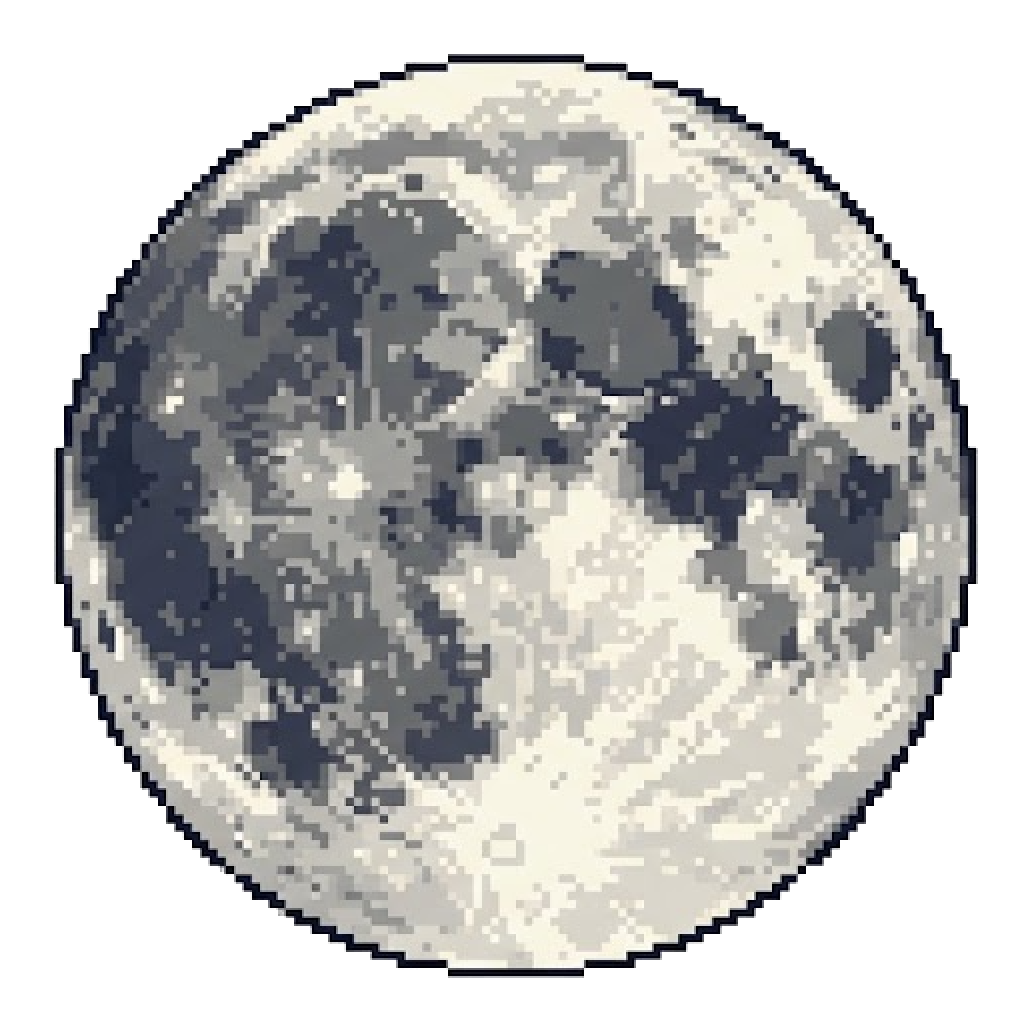
This is a pixel-art picture of a full moon with craters. It can be used for night scenes. On the round surface of the Moon, you can see patterns like craters, big and small. The colors and the placement of the patterns are the artist's own way of drawing, and they are not the same as the patterns on the real Moon.
Fun facts
- The Moon is slowly moving away from Earth, by about 3.8 cm a year (about 1.5 inches).
- The far side of the Moon cannot be seen from Earth. In 1959, a probe photographed it for the first time.
- The Moon's gravity is about one sixth of Earth's.
Quick quiz
Q. Which statement about the Moon is correct?
The Moon takes almost the same time to spin once as to go around Earth once, so the same side always faces Earth. The Moon shines by reflecting sunlight. It has a very thin atmosphere, and the temperature difference between day and night is large.
References
- NASA Science『Earth's Moon: Facts』 (radius, distance, orbit, rotation, temperature, gravity, origin, craters, seas, and samples brought back by Apollo)
- 国立天文台 暦Wiki『月の満ち欠け』 (National Astronomical Observatory of Japan, Calendar Wiki: the phase cycle of about 29.5 days and how much it varies)
- 名古屋市科学館『太陽系データ』 (Nagoya City Science Museum: the Moon's diameter, nearest and farthest points, and orbital period)
Accounts may differ between sources and regions, and facts or figures can change with new research or rules. This page was translated from the Japanese original.
Download the pixel art
- Free
- No registration
- Commercial use OK
- Edits OK
- Credit optional
- No usage report needed
Please read the terms of use before using it.