



Monster Encyclopedia No.009
Karasu-tengu
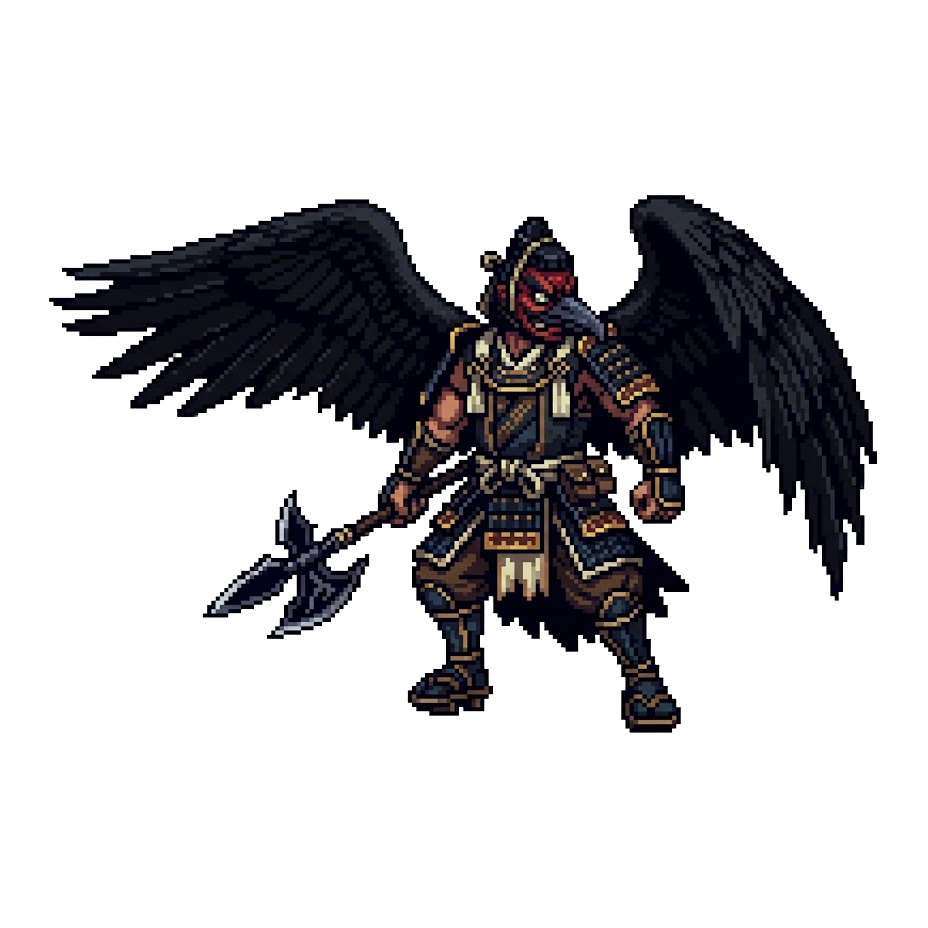
JapanYokai from Japanese folkloreA kind of tengu
A kind of tengu, told of as having a bird-like beak and wings. It lives in the mountains. It is often described as a lower-ranking tengu who serves a great tengu, but how tengu are sorted differs from source to source.
Key facts
| Category | A yokai (a spirit or monster) from Japanese folklore; a kind of tengu |
|---|---|
| Where it is told of | Japan (the stories are linked to mountain and forest beliefs) |
| Appearance | Often drawn with a bird's head, a beak and wings. |
| Origin of the name | "Karasu" means crow. It is said to be called this because of its dark, crow-like bird shape (accounts differ). |
| Family and connections | Sometimes explained as a lower-ranking tengu who serves a great tengu with a long nose. |
| Other names | Some sources explain it as the same as, or very similar to, the "konoha-tengu" (leaf tengu) or "ko-tengu" (small tengu). Other sources describe the konoha-tengu separately, as a tengu with a human-like body, wings and a long nose. How they are divided differs by source. |
| Closely linked places | Mountains where tengu tales are told, such as Mount Kurama in Kyoto. |
What kind of tengu is it?
Tengu are Japanese yokai that people have long believed live in the mountains. A tengu with a bird-like look is called a karasu-tengu.
Its main features are a sharp beak and wings on its back. A great tengu has a red face and a long nose. Compared with that, the karasu-tengu is drawn looking more like a bird.
But the way tengu are sorted is not always the same. Some books treat the karasu-tengu and the konoha-tengu as the same. Others treat them as different. Some sources also see the ko-tengu as the same as the karasu-tengu. It is safest to think "accounts differ."
Its link to the great tengu
The great tengu (dai-tengu) has a red face and a long nose. It is told of as looking close to a human. There is also a story that it stirs up wind with a fan made of feathers.
The karasu-tengu is sometimes explained as a kind of helper to the great tengu. Picture a tengu that works in the mountains, following its master tengu.
Also, Inoue Enryo, a scholar of the Meiji era, is sometimes said to have explained tengu by dividing them into great tengu and small, bird-like konoha-tengu. But this way of dividing them does not match other sources exactly, either.
Myths and folk tales 1: The tengu of Mount Kurama
On Mount Kurama in Kyoto, there is a legend that a great tengu named Sojobo lives there. Sojobo is sometimes called the head (the top one) of the Eight Great Tengu, eight tengu said to be especially powerful.
The names of the Eight Great Tengu are also said to appear in the Noh play "Kurama Tengu." Noh is an old Japanese stage art that tells stories with song and dance. A famous tale says a tengu taught sword skills to the boy Ushiwakamaru, who later became Minamoto no Yoshitsune.
However, this tale does not appear in the "Gikeiki." In the "Gikeiki," the person who teaches Ushiwakamaru the art of war is Kiichi Hogen. Some point out that the story of a tengu teacher was added in a later age. The karasu-tengu is said to have been drawn in pictures and plays as a kind of retainer in such tengu stories.
Myths and folk tales 2: Tengu in pictures
Toriyama Sekien, an artist of the Edo period, is known for his yokai picture book "Gazu Hyakki Yagyo" (published in 1776, Anei 5). His yokai series has four works in all. "Konjaku Gazu Zoku Hyakki" came out in 1779 (Anei 8) and is the second work in the series.
In the Edo period, picture books like these and ukiyo-e (bright pictures printed from wood blocks) spread the looks of yokai and tengu among many people.
It is not clear in which book the karasu-tengu was first told of. This encyclopedia writes only what can be said clearly.
How games and stories commonly use it
In games and stories, the karasu-tengu often appears as a quick swordsman with black wings and a beak, or as a warrior who guards the mountains. It also often appears as a subordinate of a great tengu.
These are uses in modern stories. They are not the old folk tales just as they were. Strength and personality differ from story to story.
About this illustration
This is a pixel-art picture (a picture made of small squares) of a tengu with a black beak and black wings. The black beak and wings follow the features of the karasu-tengu. But the colors and fine shapes that pixel art uses are part of the illustration. They are not found in real things or in the old tales.
Fun facts
- Besides the red-faced, long-nosed great tengu, tengu with a bird's beak have also been told of.
- How the karasu-tengu, ko-tengu and konoha-tengu are told apart differs by source. It is not firmly decided.
- Sojobo, the tengu of Mount Kurama, is known from the Noh play "Kurama Tengu" and is listed as one of the Eight Great Tengu.
Quick quiz
Q. Which is a feature of the karasu-tengu's look?
The karasu-tengu is a tengu that is often drawn with a bird's head, a beak and wings. Its look is different from the great tengu, which has a red face and a long nose.
References
- 『日本国語大辞典』 (Nihon Kokugo Daijiten), entry "天狗" (supports the general meaning of tengu)
- Japanese Architecture and Art Net Users System (JAANUS), "tengu 天狗" (supports the explanation of karasu-tengu and konoha-tengu)
- Yokai.jp (妖怪ジャパン), "Tengu" and "Kurama Sojobo" (support how tengu are sorted and the Sojobo of Mount Kurama)
- 国立国会図書館サーチ (National Diet Library Search), bibliographic record for Toriyama Sekien's 『今昔画図続百鬼』, published in 1779 (supports the book's details)
- 国立国会図書館 NDLイメージバンク コラム「鳥山石燕の妖怪画」 (National Diet Library NDL Image Bank column; supports the introduction to Sekien's yokai picture series)
- 『妖怪学とは何か 井上円了精選』 (講談社学術文庫) (supports Inoue Enryo's study of yokai)
Accounts may differ between sources and regions, and facts or figures can change with new research or rules. This page was translated from the Japanese original.
Download the pixel art
- Free
- No registration
- Commercial use OK
- Edits OK
- Credit optional
- No usage report needed
Please read the terms of use before using it.