



Monster Encyclopedia No.007
Lernaean Hydra
Ancient GreeceMonster of Greek myth (water serpent)One of the labors of Heracles
A water-serpent monster with many heads from Greek myth. It lived in a marsh and is known as the opponent in the second of the twelve labors (hard tasks) of the hero Heracles.
Key facts
| Type | Monster of Greek myth (a giant serpent that lives by water) |
|---|---|
| Region and culture | Ancient Greece. The story is set in a marshland called Lerna on the Peloponnese peninsula. |
| Earliest source | Hesiod, Theogony (about 700 BCE) |
| Family and ties | Its father is the monster Typhon. Its mother is Echidna, who is a woman above the waist and a snake below (Theogony). It is said to have been raised by the goddess Hera. |
| Appearance | A snake with many heads. The number of heads differs by source. Many tales say nine, but one poet says fifty (accounts differ). |
| Origin of the name | The Greek word "Hydra" means "water snake." It is the source of the English word hydra. |
| Its form in the sky | Said to have become the constellation Hydra, the Water Snake (accounts differ). |
What kind of monster?
The Hydra was a water-serpent monster that lived in a marsh in a place called Lerna, in southern Greece. The Greek word that gave it its name means "water snake."
In Hesiod's Theogony, it is the child of Typhon and Echidna. The goddess Hera did not like the hero Heracles, so the story says she raised this Hydra.
The number of heads depends on who tells the tale. The poet Alcaeus is said to have written nine, and Simonides fifty. The traveler Pausanias thought, "It had only one head at first, and later poets made the story bigger by giving it many heads."
Myth and legend 1: The second labor of Heracles
Heracles took on twelve hard tasks (labors) by order of King Eurystheus. Defeating the Hydra was the second one.
He went to Lerna on a chariot driven by his nephew Iolaus. Apollodorus, in the Bibliotheca, says the Hydra lived on a hill beside a spring called Amymone.
When Heracles cut off one head, new heads grew back, and he struggled. So Iolaus burned the cut with a torch so that no head could grow. In this way the two worked together and defeated the Hydra.
Myth and legend 2: The deathless head and the labor that did not count
According to the Bibliotheca, one of the Hydra's heads, the middle one, was "deathless" and could not die. Heracles is said to have cut it off and buried it under a big rock by the road.
But King Eurystheus did not count this task among the labors, because Heracles had help from Iolaus. So another task was added later, and it is said to have made twelve labors.
Hesiod's Theogony also briefly tells that Heracles defeated the Hydra with the help of Iolaus, who had been advised by the goddess Athena.
Myth and legend 3: The crab and the constellations
There is one more tale about the fight with the Hydra. A giant crab helped the Hydra and bit Heracles' foot, but Heracles defeated it. According to Apollodorus, the goddess Hera lifted this crab into the sky, and it became the constellation Cancer.
In later sources, the Hydra too is said to have become the constellation Hydra, the Water Snake. There are several stories about where the constellations came from, so accounts differ.
How it is usually treated in stories and games
The giant serpent with many heads often appears in stories and games as a strong enemy living in a swamp or by the water. The trait of "cut off a head and more keep growing" is sometimes used just as it is.
The English word "hydra" is also sometimes used as a figure of speech for "new problems keep appearing, and it never seems to end."
About this illustration
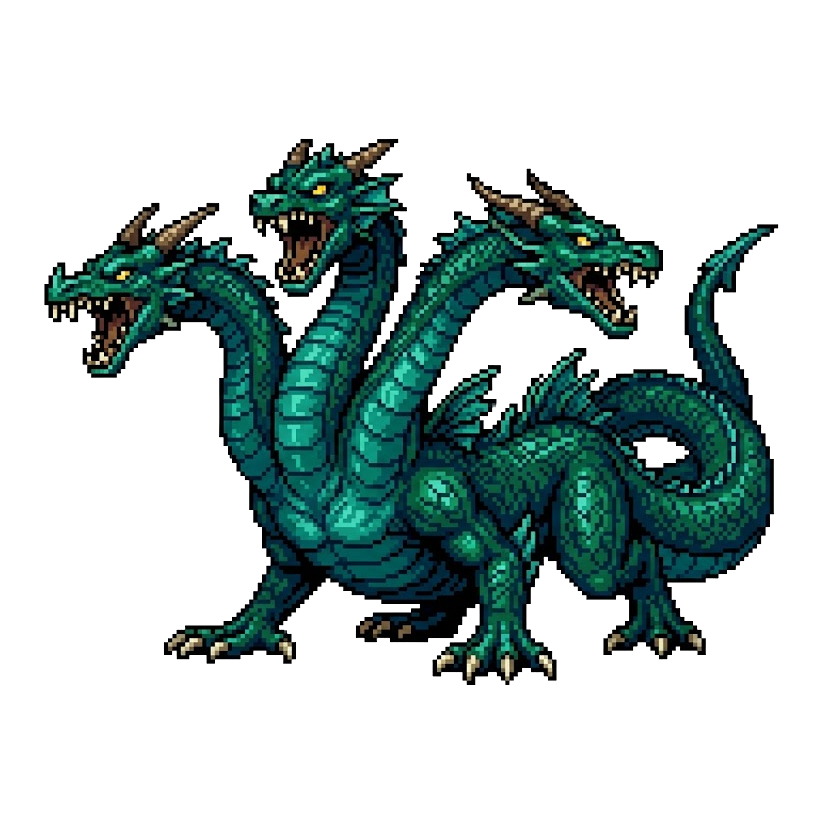
A pixel-art picture of a green giant serpent with three heads. The three heads side by side are a simple way for the picture to show it. In myth sources the number of heads is often nine or so, so three heads and the green color do not come from the sources. This is an artist's own picture and differs from the real thing.
Fun facts
- The Greek word "Hydra" means "water snake," and it is the root of the English word hydra.
- The number of the Hydra's heads differs by source. Besides nine, one poet says fifty.
- The Hydra is said to have become the constellation Hydra, and the crab that bit Heracles' foot the constellation Cancer.
Quick quiz
Q. Who helped Heracles when he fought the Hydra?
Heracles was helped by his nephew Iolaus. It is said that Iolaus burned the cut with a torch so that no head could grow back. For that reason, the king did not count this task among the labors.
References
- Hesiod, Theogony (supports the birth of the Hydra and the help of Iolaus)
- Apollodorus, Bibliotheca (Greek mythology), Book 2, Chapter 5 (supports the second labor of Heracles, the deathless head and the crab tale)
- Pausanias, Description of Greece (supports his view on the number of the Hydra's heads)
- Encyclopaedia Britannica, "Hydra (Greek mythology)" (supports the overview of the Hydra)
- Theoi Greek Mythology, "Hydra" (supports the list and explanation of ancient sources)
Accounts may differ between sources and regions, and facts or figures can change with new research or rules. This page was translated from the Japanese original.
Download the pixel art
- Free
- No registration
- Commercial use OK
- Edits OK
- Credit optional
- No usage report needed
Please read the terms of use before using it.