



Monster Encyclopedia No.021
Cyclops (plural: Cyclopes)
Ancient Greece and Ancient RomeOne-eyed giants of Greek myth
In Greek myth, the Cyclopes are giants with just one eye in the middle of the face. They are told about in two ways: as craftsmen who made thunder weapons, and as shepherds who lived in a cave.
Key facts
| Type | Giants of Greek myth (a one-eyed people) |
|---|---|
| Where the stories were told | Ancient Greece and Ancient Rome |
| Old sources | Hesiod's Theogony (around 700 BCE) and Homer's Odyssey (around the 8th to 7th century BCE). Both are old poems, and they are seen as early sources that include the Cyclopes. |
| Family and connections | In the Theogony, they are children of Uranus, the sky god, and Gaia, the earth goddess. There are three of them: Brontes, Steropes and Arges. Polyphemus in the Odyssey is said to be a son of Poseidon, the sea god. |
| Appearance | In the Theogony, they look like the gods, but they have just one round eye in the middle of the forehead. In the Odyssey, we can tell Polyphemus has one eye from the scene about his eye. The eyes of the other Cyclopes are not clearly described. |
| Origin of the name | The Greek word Kyklops is often explained as meaning "round eye" or "circle eye." The Theogony also says they got this name because of their one round eye. But there are other ideas about how the word was formed, so accounts differ. |
| Their work | In the Theogony, they are craftsmen who gave Zeus his thunder weapons. In the Odyssey, they are a people who keep sheep in caves. |
What kind of giants are they?
A Cyclops is a giant (a person who is very, very big) with just one eye in the middle of the face. The name is said to mean "round eye."
In Greek myth, there are at least two pictures of the Cyclopes. One is of craftsmen who make tools for the gods. The other is of shepherds who live in caves. How these two pictures connect is not clear, and scholars disagree.
In myths and legends 1: The craftsmen who made thunder
The poet Hesiod, who lived around 700 BCE, introduces the Cyclopes in the Theogony as three brothers. Their names are Brontes (thunder), Steropes (lightning) and Arges (brightness).
They made weapons of thunder and lightning and gave them to Zeus. The story says these weapons helped in the battles of Zeus and his side. The three are shown as skilled in smithing (the work of hammering metal into tools). In stories from later times, they are sometimes said to work in the workshop of Hephaestus, the god of smithing.
In myths and legends 2: Polyphemus and Odysseus
In Book 9 of Homer's Odyssey, the hero Odysseus is on a sea voyage and lands on the island of the Cyclopes. The Cyclopes here are not craftsmen. They have no councils to make rules. They are a rough people who keep sheep in caves.
Polyphemus is the most famous of them, known as a son of Poseidon. Odysseus and his men are trapped in his cave. Odysseus says, "My name is Nobody," and makes Polyphemus fall asleep with wine. Then he uses his wits to escape, and he and his men sail away from the island. The story is known as a tale of facing a foe you cannot beat with strength by using cleverness instead.
In myths and legends 3: Later stories
The story of Polyphemus was told again and again in later times. In the 5th century BCE, the playwright Euripides wrote a play based on it, called Cyclops. It is the only satyr play that has survived in complete form. (A satyr play is a funny play with satyrs, who are part goat.)
Around the 3rd century BCE, the poet Theocritus wrote poems in which Polyphemus falls in love with Galatea, a sea nymph. The Roman poet Virgil linked the Cyclopes with Mount Etna (a volcano) on the island of Sicily.
How they are usually shown in games and stories
A big one-eyed giant often appears in stories and games as a strong enemy.
But the Cyclopes in myth are not only strong. They are craftsmen who make thunder weapons, and they also lose a contest of wits. They have many sides.
About this illustration
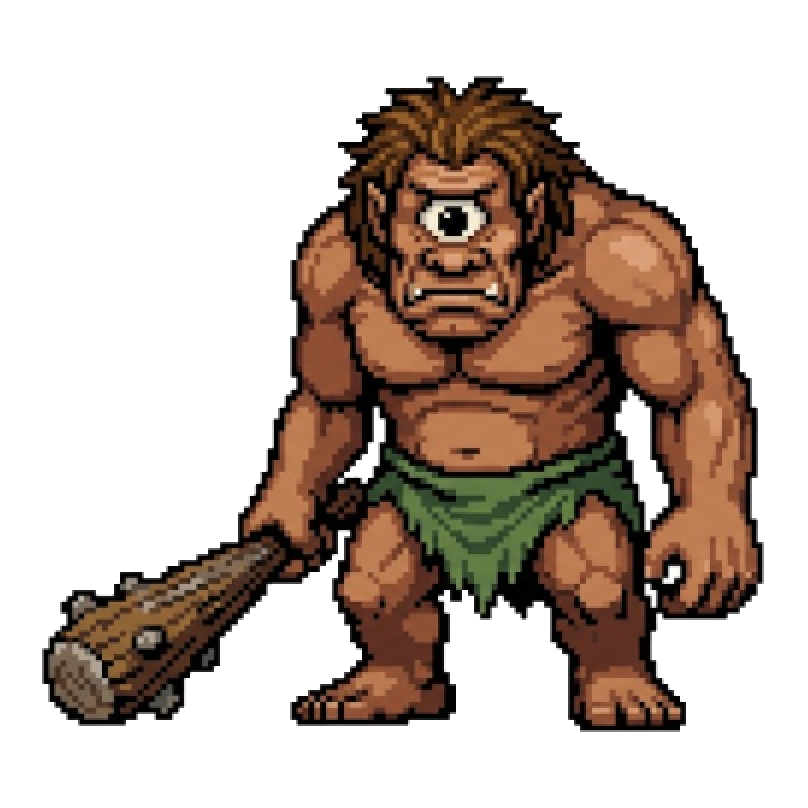
A pixel-art picture of a big one-eyed giant standing with a large club in hand. In the myths, there is a scene where Polyphemus holds a thick wooden staff. But the club, and small details like colors, clothes and decorations, are not written in the myths. They are the artist's own ideas.
Fun facts
- There is a term, "Cyclopean walls." The ancient Greek traveler Pausanias wrote that the huge stone walls at Mycenae and Tiryns were built by the Cyclopes. People wondered how such big stones were carried, so the walls got this name.
- In the Odyssey, Polyphemus cried out for help and said that "Nobody" was attacking him. So the other Cyclopes nearby did not come to help.
- Some ancient Greek vase paintings that show scenes of Polyphemus have survived.
Quick quiz
Q. In the Theogony, what did the Cyclopes make for Zeus?
In Hesiod's Theogony, the Cyclopes are skilled smiths. They give Zeus weapons of thunder and lightning.
References
- Hesiod, Theogony (the birth and names of the Cyclopes, making the thunder weapons, the explanation of their name)
- Homer, Odyssey, Book 9 (the story of Polyphemus and Odysseus)
- Euripides, Cyclops (Polyphemus in a satyr play)
- Pausanias, Description of Greece (the walls at Mycenae and Tiryns and the Cyclopes)
- World History Encyclopedia, "Cyclops (Creature)" (explains the two traditions about the Cyclopes)
- Wiktionary, "cyclops" (word origin: Greek Κύκλωψ, "round eye")
Accounts may differ between sources and regions, and facts or figures can change with new research or rules. This page was translated from the Japanese original.
Download the pixel art
- Free
- No registration
- Commercial use OK
- Edits OK
- Credit optional
- No usage report needed
Please read the terms of use before using it.