



Monster Encyclopedia No.022
Nue
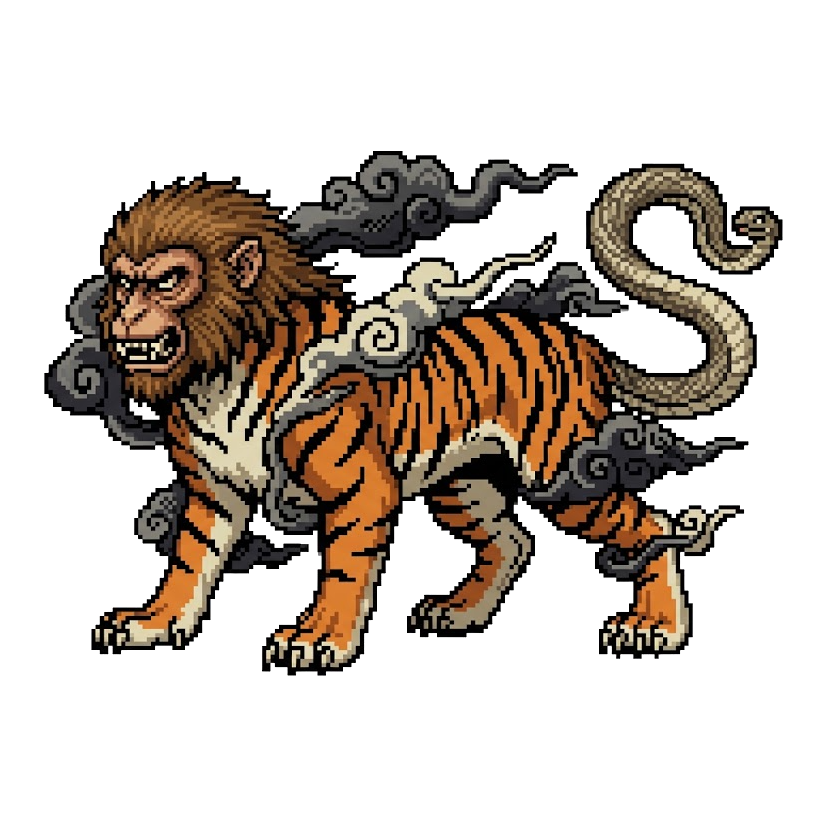
Japanese tale from the Heian periodA monster in the Tale of the Heike
In the Tale of the Heike, the Nue is a mysterious monster said to have been defeated by Minamoto no Yorimasa. It is known for a body that mixes a monkey, a raccoon dog, a tiger and a snake. Its name originally comes from a bird with an eerie cry.
Key facts
| Type | A monster (yokai) from Japanese folk tales |
|---|---|
| Region / culture | Japan. The story is set in the imperial court (where the emperor lived) near the end of the Heian period. |
| Source texts | The Tale of the Heike (a war tale said to have been put together in the Kamakura period). It is also told in the Genpei Josuiki. |
| Who defeated it | Minamoto no Yorimasa, a master archer |
| Appearance | In the Tale of the Heike, it has a monkey's head, a raccoon dog's body, a snake's tail and a tiger's arms and legs. Its look differs from source to source. |
| Cry | In the Tale of the Heike, its cry is said to have sounded like the "nue," the Japanese name of the Siberian thrush. |
| Origin of the name | "Nue" was first the name of a bird (the Siberian thrush). It is said the monster got the name because the cries sounded alike (accounts differ). |
What kind of being is it?
The Nue is a monster of unknown nature that appears in old Japanese stories. It is said to have come to the imperial court at night and troubled the emperor.
The most famous image is of a body made from several animals. But the look is not the same in every source. It changes a little from text to text, so it is good to know that this is how one story tells it.
Originally a bird's name
The word "nue" was first the name of a bird. It is an old name for the Siberian thrush, and other names such as "nuedori" and "nuetsugumi" still remain. The Siberian thrush sings with a lonely voice at night from spring to early summer, so people long thought of it as an eerie bird.
The Manyoshu (one of the oldest collections of poems in Japan, made in the Nara period) also has the phrase "nue ko-dori" in its first volume, and this bird is sung about there.
Myth and tale, part 1: Yorimasa defeats the Nue
According to the Tale of the Heike, in the time of Emperor Konoe (who reigned from 1141 to 1155), black clouds covered the palace late at night, and the emperor suffered from an illness with no known cause. So Minamoto no Yorimasa, known as a master archer, was called.
Yorimasa shot an arrow into the clouds, and something fell down. His retainer, Inoha no Hayata, is said to have finished it off. It is described as having a monkey's head, a raccoon dog's body, a snake's tail and a tiger's arms and legs, with a cry like the "nue" (the Siberian thrush).
Myth and tale, part 2: The reward sword
The emperor was pleased with Yorimasa's work. He is said to have given him a tachi (a long sword) named "Shishio." This story is known as an event that made Yorimasa's name famous.
Different looks in different sources
The Nue's look changes from source to source. In the Genpei Josuiki, it has a monkey's head, a tiger's back, a fox's tail and a raccoon dog's legs, which is a different mix from the Tale of the Heike (the details differ between books). In another source, the Yorimasa-ki, it has a monkey's body, a raccoon dog's face, a fox's tail, a snake's belly and a cat's legs.
So the "monkey, raccoon dog, tiger and snake" shape is famous, but it is not the one and only version. We can see that people long ago described something they could not identify by comparing it to many animals.
How it is usually treated in games and stories
In stories and games today, the Nue often appears as a strong enemy or a strange yokai in a Japanese-style world. A body that mixes several animals looks striking, so it is easy to make into a character.
Also, the phrase "like a Nue" is used for a person or a matter that is hard to pin down.
About this illustration
This is a pixel-art picture of a creature that mixes several animals, such as a monkey, a raccoon dog, a tiger and a snake. The mixed animal features are based on how the tales describe it. However, the colors, the pixel-art style, and the small shapes and patterns are the artist's own, and differ from the real animals and from the tales.
Fun facts
- "Nue" was first the name of a bird. It is an old name for the Siberian thrush, and other names such as "nuedori" are still used today.
- The phrase "like a Nue" is used for a person who is hard to read, or for something unclear.
- The sword that Yorimasa is said to have received from the emperor is named "Shishio."
Quick quiz
Q. What did the word "nue" first mean?
"Nue" was first an old name for the Siberian thrush, a bird. It is said the monster got the name from the eerie cry heard at night.
References
- National Archives of Japan, digital exhibition "The Tale of the Heike" (supports the Nue story in Emperor Konoe's time and the look given in the Yorimasa-ki)
- "Nihon Kokugo Daijiten" (Shogakukan), entry "nue" (supports the meanings as a bird's name and as a monster)
- "The Tale of the Heike," Book 4, "Nue" (supports Yorimasa's defeat of the Nue)
- "Genpei Josuiki" (supports the differences in the Nue's look)
- "Manyoshu," Book 1 (supports the use of the phrase "nue ko-dori")
Accounts may differ between sources and regions, and facts or figures can change with new research or rules. This page was translated from the Japanese original.
Download the pixel art
- Free
- No registration
- Commercial use OK
- Edits OK
- Credit optional
- No usage report needed
Please read the terms of use before using it.