



Monster Encyclopedia No.016
Chimera
Ancient GreeceMonsters of Greek MythTales from Lycia
A monster from Greek myth, said to have the body parts of a lion, a goat and a snake, and to breathe fire. It is known from the story of how the hero Bellerophon defeated it.
Key facts
| Category | A monster of Greek myth (a creature made of parts of several animals) |
|---|---|
| Region and culture | Ancient Greece. The tale is linked to Lycia, a region of Asia Minor (around present-day Turkey). |
| Earliest writings | Homer's Iliad (said to have been put together around the 8th century BCE). It also appears in Hesiod's Theogony (a poem about the births of the gods). |
| Family and connections | In the Theogony, the mother is called only "she." Many people think this means Echidna (scholars disagree). Later writers Apollodorus and Hyginus name Typhon as the father and Echidna as the mother. The Chimera is told of as part of a family of monsters, together with the Lernaean Hydra, Cerberus, Orthrus and others. |
| Appearance | In the Iliad, the front is a lion, the back is a snake, and the middle is a goat. It breathes fierce fire. |
| Meaning of the name | It comes from an ancient Greek word meaning "female goat." |
| Hero who defeated it | Bellerophon (said to have been helped by the winged horse Pegasus) |
What kind of monster is it?
The Chimera is a monster in Greek myth made of parts of several animals. Homer's Iliad says the front is a lion, the middle is a goat, and the back is a snake. It is said to breathe fierce fire.
In Hesiod's Theogony, it is told of as having three heads: a lion, a goat and a snake. The Iliad says the Chimera was "not human, but of the race of the gods."
Myth and legend 1: Homer's Iliad and Bellerophon
Book 6 of the Iliad tells the story of the hero Bellerophon. The king of Lycia ordered Bellerophon to kill the Chimera. The Chimera was a tough enemy, so the king thought Bellerophon would not come back alive.
But Bellerophon trusted the signs from the gods, faced the Chimera and defeated it. This is one of the oldest writings about the Chimera.
Myth and legend 2: Pegasus and a battle from the sky
In later writings, such as Apollodorus's Bibliotheca, Bellerophon rode the flying horse Pegasus and shot arrows down from above to defeat the Chimera. Hesiod's Theogony also says that Pegasus and Bellerophon defeated the Chimera.
The small details of this story differ a little from source to source.
Myth and legend 3: Family and the one who raised it
In Hesiod's Theogony, the Chimera appears as part of a family of monsters. The mother is called only "she." Many people think this means Echidna, but some think it is someone else. In later writings, the father is Typhon and the mother is Echidna.
Also, Book 16 of the Iliad says that a man named Amisodarus raised the Chimera. Sources differ on which land this man was from.
The name and how the word spread
The name Chimera comes from an ancient Greek word meaning "female goat."
The name is still widely used today. For example, a creature that seems to be a mix of several animals, or something made by mixing different kinds of things, is sometimes called a "chimera." Also, among chimaeras (fish of the deep sea), there is a genus named after this monster (the genus Chimaera, a group in the classification of living things).
How it is usually shown in games and stories
In stories and games, it often appears as a strong monster with a lion's head, a goat's head and a snake's tail. Many of them can breathe fire. They are often shown as tough enemies met in caves or deep in the mountains.
About this illustration
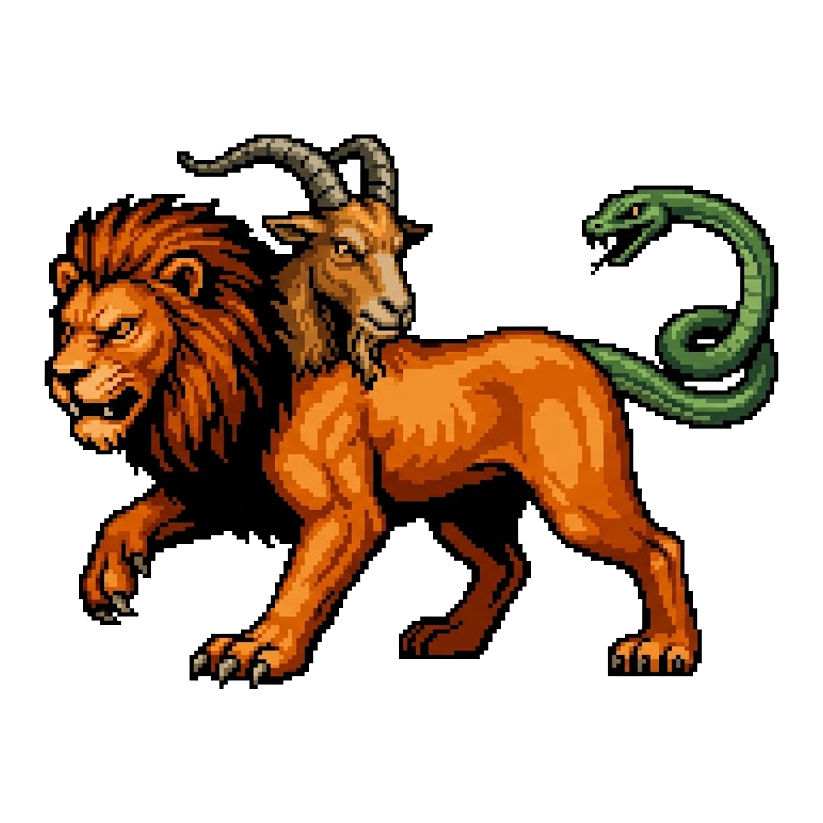
This is a pixel-art picture of a Chimera with a lion's head, a goat's head and a snake's tail. It is drawn in a form that works well as a strong monster. The body shape, colors and pose are special to this picture. The old stories do not set one fixed look. It is an artwork, different from the real thing.
Fun facts
- In the Iliad's description, the order of the body parts is "lion in front, goat in the middle, snake behind."
- The name Chimera means "female goat" in ancient Greek.
- In Lycia there is a place where fire burns out of the ground (Mount Chimaera, now called Yanartas in Turkey). It is sometimes linked to the tale of the Chimera (accounts differ).
Quick quiz
Q. Who was the hero who defeated the Chimera?
The Chimera was defeated by the hero Bellerophon. The story is in the Iliad. In Hesiod and later writings, it is said that he defeated it with the help of Pegasus.
References
- Homer, Iliad, Books 6 and 16 (the Chimera's appearance, the story of Bellerophon, Amisodarus)
- Hesiod, Theogony (the Chimera's appearance, birth, and Pegasus and Bellerophon)
- Apollodorus, Bibliotheca (Greek mythology; Bellerophon and Pegasus, the Chimera's parents)
- Hyginus, Fabulae (a collection of myths; the Chimera's parents)
- Theoi Greek Mythology, "Khimaira" (a website that gathers ancient sources on myths)
Accounts may differ between sources and regions, and facts or figures can change with new research or rules. This page was translated from the Japanese original.
Download the pixel art
- Free
- No registration
- Commercial use OK
- Edits OK
- Credit optional
- No usage report needed
Please read the terms of use before using it.