



Living Things Encyclopedia No.004
Tyrannosaurus (T. rex)
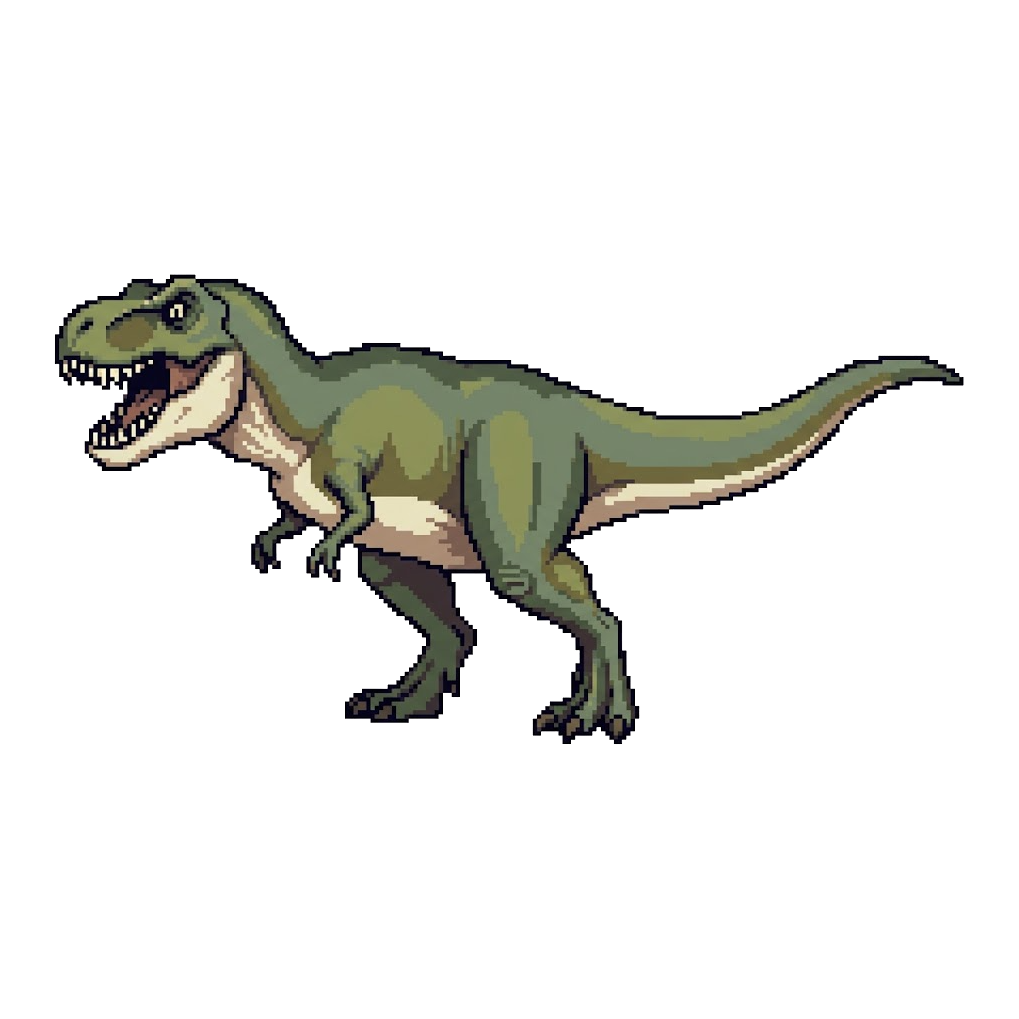
Dinosaur, theropod (meat-eating group)Late Cretaceous, North America
A big meat-eating dinosaur that lived in North America about 68 to 66 million years ago. It is known for its thick teeth, strong jaws and tiny two-fingered arms. Its name means "tyrant (a cruel, violent ruler) lizard."
Key facts
| Classification | Animals, chordates, reptiles (in a broad sense), saurischians ("lizard-hipped" dinosaurs), theropods, tyrannosaurids (scientific name: Tyrannosaurus rex) |
|---|---|
| When it lived | The end of the Cretaceous Period, said to be about 68 to 66 million years ago |
| Size | Body length up to around 12 meters. Weight estimates vary by study, from several tons to a little over 8 tons |
| Home and range | Western North America (the United States and Canada). Fossils have been found in this region |
| Food | Meat-eater (carnivore). It is thought to have attacked other dinosaurs and also eaten dead animals |
| Features | Big head, thick and strong teeth, powerful jaws, small arms (two fingers), long and thick tail |
| Growth | One study says it grew fast at around 14 to 18 years old and reached adult size at about 20. The oldest individual was estimated to be about 28 |
| Origin of the name | "Tyranno" means tyrant, "saurus" means lizard, and "rex" means king. It was named in 1905 by the American researcher Osborn |
What kind of animal is it?
Tyrannosaurus was a meat-eating dinosaur that lived in the last part of the Mesozoic Era (about 250 million to 66 million years ago), when dinosaurs flourished. It belongs to a group called theropods, which walked on two hind legs.
Its fossils have been found in rock layers in the western United States and Canada. In 1902, a fossil hunter named Barnum Brown found a famous fossil in the state of Montana in the United States. The one who gave it its name was a researcher named Osborn, in 1905.
The species name "rex" means "king," so the whole name means something like "king of the tyrant lizards."
Body and features
The head was very large, and thick, strong teeth lined the mouth. It is said that some teeth, counting the part inside the jaw, were about 30 cm long.
The jaws are also thought to have been very powerful. A 2017 study estimated that an adult's bite force was about 8,500 to 34,500 newtons (a unit that shows how strong a force is). That is strong enough to crush hard bone.
On the other hand, the front limbs (arms) were very small, with two fingers. They were short compared with the body, but what they were used for is still not clear.
The long, thick tail is thought to have helped keep the body balanced.
How it lived
Tyrannosaurus ate meat. There is evidence that suggests it attacked other dinosaurs, and it is also said to have eaten the meat of dead animals.
Scientists study how it grew by looking at stripes in a cross-section of bone, which are like the growth rings of a tree. A 2004 study found that at around 14 to 18 years old there was a period when it gained about 2 kg of weight per day, and it is thought to have reached adult size at about 20. The oldest individual is estimated to have been about 28.
However, the numbers differ a little from study to study. Please think of them as "about this much."
What we do not know
We cannot tell the colors or the calls of dinosaurs from fossils. This is true for Tyrannosaurus too, so the colors in picture books and illustrations are imagined.
It is also not clear whether Tyrannosaurus had feathers on its body. Some of its very close relatives have been found with feathers. But some of the skin fossils found for Tyrannosaurus had a scale-like pattern.
It is part of the fun of studying dinosaurs that new discoveries can change our ideas.
Connections with people
Tyrannosaurus is especially famous even among dinosaurs, and its skeletons are on display in museums around the world.
The Field Museum of Natural History in Chicago, in the United States, has a very well-preserved fossil called "Sue." It was found in 1990 in the state of South Dakota.
In Japan, too, fossils and reconstructions of Tyrannosaurus relatives have been shown in places such as the dinosaur displays of the National Museum of Nature and Science (Tokyo). Fossils are important clues to what the Earth was like long ago.
About this illustration
This is a pixel-art picture (a picture made of tiny squares) of Tyrannosaurus. It shows a big head, thick hind legs and a long tail. The body color and patterns are just the artist's way of drawing it and differ from the real animal. The true colors of dinosaurs are not known.
Fun facts
- "Tyranno" in the name means "tyrant," and "saurus" means "lizard."
- The arms were small and had two fingers.
- "Sue," at the Field Museum in Chicago, is a fossil found in 1990 and is famous around the world.
Quick quiz
Q. How many fingers did Tyrannosaurus have on each front limb (arm)?
Tyrannosaurus had small arms with two fingers. What they were used for is still not clear.
References
- Britannica, entry "tyrannosaur" (supports: the tyrannosaur group, size and growth)
- Field Museum (Chicago), introduction page for "SUE" (supports: the discovery and display of the fossil "Sue")
- American Museum of Natural History (AMNH), explanation of T. rex (supports: lifespan and growth)
- Erickson et al. 2004, Nature, "Gigantism and comparative life-history parameters of tyrannosaurid dinosaurs" (supports: the study of growth speed and age)
- Gignac & Erickson 2017, Scientific Reports, "The Biomechanics Behind Extreme Osteophagy in Tyrannosaurus rex" (supports: the study of bite force)
- National Museum of Nature and Science, dinosaur exhibition information (supports: displays in Japan)
Accounts may differ between sources and regions, and facts or figures can change with new research or rules. This page was translated from the Japanese original.
Download the pixel art
- Free
- No registration
- Commercial use OK
- Edits OK
- Credit optional
- No usage report needed
Please read the terms of use before using it.