



Living Things Encyclopedia No.003
Dog (Shiba Inu)
Mammal, dog familyJapanese dog breed, petSmall dog
The dog is one of the animals that has lived with people for the longest time. The Shiba Inu is a small dog born in Japan. It is one of the Japanese dog breeds named as national natural monuments.
Key facts
| Classification | Animal kingdom, chordates, mammals, carnivores, dog family. Dogs are thought to have been domesticated from wolf-like animals. (Domesticated means people took care of them and they came to live near people.) |
|---|---|
| Ancestor | Thought to be a kind of gray wolf. When and where dogs became domestic animals is still being studied, and accounts differ. |
| Size (Shiba Inu) | Weight is about 7 to 10 kg. Height at the shoulder (from the ground to the shoulder) is about 35 to 41 cm. These are rough guides. They differ by male or female, by each dog, and by source. |
| Coat color (Shiba Inu) | Red (brown), black, white, and sesame (a color where black mixes in at the tips of the hairs), and others. |
| Food | Dogs can eat both meat and plants (close to omnivores). Pet dogs should be fed food made for dogs. |
| Features (Shiba Inu) | Pointed, upright triangle ears, a tail curled up over the back, and a fluffy double coat (short soft undercoat and longer outer coat). |
| Role | Long ago, they worked in the mountains as hunting dogs that found small prey. (Hunting dogs help people hunt.) Today they are mostly kept as family pets. |
| Distribution | Dogs live beside people all over the world. The Shiba Inu comes from Japan (its original home) and is kept in other countries too. |
What kind of animal is it?
Dogs are animals that have lived together with humans. They belong to the dog family, and their ancestor is thought to be a kind of gray wolf.
When and where dogs began living with people is still being studied, and accounts differ. Some studies estimate that the ancestors of wolves and dogs split about 20,000 to 40,000 years ago. But researchers explain that this is not the same as the time when dogs began to be kept by people.
The Shiba Inu is a small dog that has lived in Japan for a long time. Six Japanese breeds are named national natural monuments: the Hokkaido, Akita, Shiba, Kai, Kishu and Shikoku. The Shiba is the smallest of them.
Body and features
The Shiba Inu is a small dog. It weighs about 7 to 10 kg and stands about 35 to 41 cm tall at the shoulder. These numbers are only a guide, and they differ a little by source. Males tend to grow a little bigger.
Like other dogs, it has a very good sense of smell. Its ears stand up in a triangle shape, which makes it easy to hear small sounds. Its tail curls up over its back.
Its coat has two layers. The soft, short hair keeps the body warm. The hard, long hair keeps out rain and dirt. The coat is shed heavily around spring and autumn. The colors include red (brown), black, white and sesame.
How it lives
Dogs are thought to have become domestic animals from animals that lived in packs (groups of friends), like wolves. So dogs like to be with their family and watch people closely.
Long ago, the Shiba Inu worked in the mountains as a hunting dog that found small animals and birds. One idea says the name "Shiba" means a low bush, because these dogs ran around in the bushes (accounts differ).
Even as a pet, a Shiba Inu needs to move its body through walks and play. Daily exercise and practice learning rules help it live happily.
Dogs and people
Groups such as the Nihon Ken Hozonkai have worked to protect the look and character of Japanese dogs. Some Japanese dogs are named national natural monuments. (A natural monument is something the country protects as important nature or culture.) The Shiba is said to have been named in 1937 (Showa 12), but sources do not always write the year the same way.
A gene study (genes are like a body's blueprint) published in 2024 reported that the Japanese wolf, which once lived in Japan, was the closest to dogs among the gray wolves studied. It also showed that dogs in East Asia, including the Shiba Inu, carry a small amount of genes from the Japanese wolf. However, other researchers think this may be the result of dogs and wolves mating. More study is needed to make clear where dogs came from.
When you keep a dog, you are responsible for caring for this living family member to the end.
About this illustration
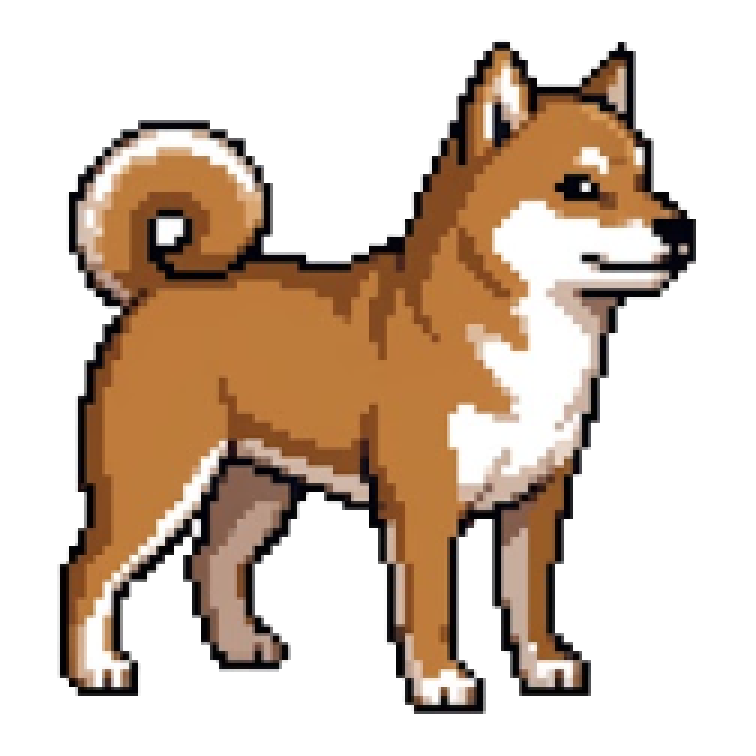
A pixel-art picture of a brown and white Shiba Inu standing and facing sideways. The brown fur and the white patches show the coat colors of a Shiba Inu well. Because it is pixel art (a picture made of small squares), the fluffy look of the fur is the picture's own style and differs from a real dog.
Fun facts
- Among the six Japanese dog breeds named national natural monuments, the Shiba Inu is the smallest.
- A dog's sense of smell is far better than a person's. This is why dogs also help people search for things.
- A 2024 study reported that the Japanese wolf was the closest to dogs among the gray wolves studied.
Quick quiz
Q. Which body feature of the Shiba Inu was explained in the text?
The Shiba Inu is a small dog with upright triangle ears and a curled tail. Its weight is about 7 to 10 kg as a guide.
References
- Nature Communications (2024), Terai et al., paper on the Japanese wolf genome (genome study of the Japanese wolf and its closeness to dogs) https://www.nature.com/articles/s41467-024-46124-y
- Smithsonian Magazine, "Ancient Japanese wolves may be the closest wild relative of modern dogs" (article explaining the Japanese wolf and dog study)
- 文化庁「文化遺産オンライン」 (Agency for Cultural Affairs, Cultural Heritage Online: information on Japanese dogs as national natural monuments)
- 公益社団法人日本犬保存会 (Nihon Ken Hozonkai: breed standards and features of Japanese dogs and the Shiba Inu)
- 三重県の資料 (Mie Prefecture materials: explanation of the Kishu and Japanese dogs being named national natural monuments)
Accounts may differ between sources and regions, and facts or figures can change with new research or rules. This page was translated from the Japanese original.
Download the pixel art
- Free
- No registration
- Commercial use OK
- Edits OK
- Credit optional
- No usage report needed
Please read the terms of use before using it.