



Living Things Encyclopedia No.005
Chicken
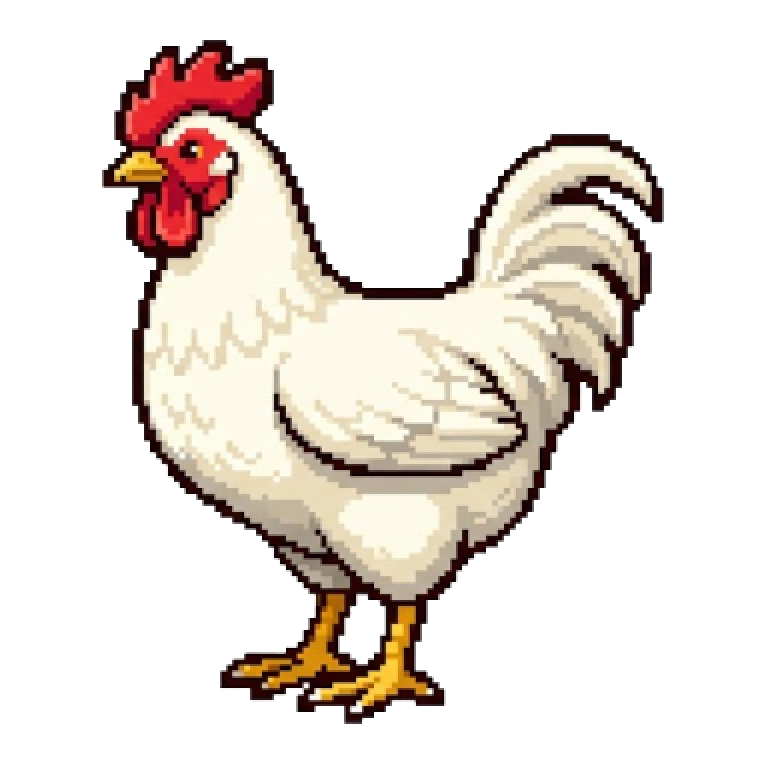
Birds · pheasant familyPoultry (birds raised by people)Farm and village animal
The chicken is a bird that people have raised for eggs and meat. It is thought to have become a farm animal from the wild red junglefowl. Today it is kept all over the world.
Key facts
| Classification | Kingdom Animalia, phylum Chordata, class Aves (birds), order Galliformes, family Phasianidae (scientific name: Gallus gallus domesticus) |
|---|---|
| Ancestor | Thought to be the wild red junglefowl, which lives in forests in Southeast Asia, southwestern China and nearby areas |
| Size | Varies a lot by breed. Some small breeds weigh less than 1 kg, and some large breeds weigh more than 5 kg |
| Food | Eats grains, grass seeds, insects and small animals (an omnivore) |
| Features | A comb on top of the head, wattles under the chin, wings that are not good at long flights, and a gizzard (part of the stomach) that grinds up food |
| Eggs | A hen raised for eggs starts laying about 5 months after hatching. She lays the most eggs at about 7 months. She lays about 300 eggs in one year (from materials of the Ministry of Agriculture, Forestry and Fisheries) |
| Distribution | Found all over the world as a bird kept by people |
| When it became a farm animal | Studies give different answers. Gene studies estimate that chickens split from wild junglefowl about 9,500 to 3,300 years ago. In studies of bones from ancient sites, bones from a site in Thailand, dated to about 3,300 to 3,600 years ago, are considered the earliest certain example of domestic chickens (accounts differ) |
What kind of animal is it?
The chicken is a bird in the pheasant family. People have raised chickens for eggs and meat. A bird raised by people like this is called poultry.
Its ancestor is thought to be the wild red junglefowl, which lives in forests in Southeast Asia, southwestern China and nearby areas. Chickens and red junglefowl are very close relatives.
Today chickens are kept all over the world, and there are many breeds (different groups within the same kind of animal). Size, color and feather shape differ from breed to breed.
Body and features
A chicken has a red comb on top of its head. It also has red wattles under its chin (hanging folds of skin). In many breeds, the comb grows bigger on males.
A chicken is a bird, but it is not good at flying for a long time. It can flap its wings to fly a short way or to hop up to a high place.
Chickens have no teeth in their mouths. Instead, they grind up food in the gizzard, a strong, muscular part of the stomach. Small stones that the chicken swallows are said to help with the grinding.
How chickens live
Chickens peck at the ground and eat grains, grass seeds, insects and more. They are omnivores (they eat both plants and animals).
At night, they like to rest on high perches. This is thought to be because their wild ancestors slept up in trees.
Males are known for crowing in the morning. But they also crow at other times of the day. Their calls are said to tell their flock and other chickens about their group and their territory.
Eggs and raising chickens
Hens lay eggs. A hen raised for eggs starts laying about 5 months after hatching. At about 7 months, she is laying the most eggs.
According to materials of the Ministry of Agriculture, Forestry and Fisheries, a hen lays about one egg a day, though there are days when she does not lay. Over one year, that comes to about 300 eggs. The number changes with the surroundings and the breed.
Hens lay eggs even without a male. But a chick hatches only from an egg that has been fertilized (when the start of a chick is added to the egg) after the hen meets a male.
Chickens and people
It is still not clear when people began keeping chickens. Gene studies estimate that chickens split from wild junglefowl about 9,500 to 3,300 years ago. In studies of bones found at ancient sites, bones of domestic chickens from a site in Thailand, dated to about 3,300 to 3,600 years ago, are considered the earliest certain example. Because the results differ by research method, accounts differ.
A study published in 2022 suggested the following idea. As farming of grains such as rice spread, wild junglefowl gathered near people. Little by little, they came to live near people.
After that, chickens are thought to have spread with people from Asia to other regions. Today, chickens are a very familiar bird, and their eggs and meat are common foods.
About this illustration
This is a pixel-art picture of a white chicken standing with a red comb on its head. It is drawn as a farm and village animal. A white body is a real color for one breed of chicken, but the small details of shape and color in this picture are the artist's own style and are different from a real chicken.
Fun facts
- The red junglefowl, thought to be the ancestor of the chicken, still lives in forests in Southeast Asia and nearby areas.
- Chickens have no teeth in their mouths, so they grind up food in the gizzard.
- A hen raised for eggs starts laying about 5 months after hatching and lays about 300 eggs in one year (from materials of the Ministry of Agriculture, Forestry and Fisheries).
Quick quiz
Q. Which wild bird is thought to be the ancestor of the chicken?
Chickens are thought to have come to be raised by people from the wild red junglefowl, which lives in forests in Southeast Asia and nearby areas.
References
- 農林水産省『aff(あふ)2024年4月号』特集 (Ministry of Agriculture, Forestry and Fisheries magazine, April 2024 issue, feature; supports how hens go from hatching to laying and the number of eggs per year. https://www.maff.go.jp/j/pr/aff/2404/spe1_03.html)
- Peters, J. et al. (2022) 'The biocultural origins and dispersal of domestic chickens' PNAS 119(24) (supports the dating of bones from the Ban Non Wat site in Thailand and the idea about the link with rice farming)
- Wang, M.-S. et al. (2020) '863 genomes reveal the origin and domestication of chicken' Cell Research 30 (supports the study of the ancestor junglefowl and the timing of domestication, using the genomes of 863 birds)
Accounts may differ between sources and regions, and facts or figures can change with new research or rules. This page was translated from the Japanese original.
Download the pixel art
- Free
- No registration
- Commercial use OK
- Edits OK
- Credit optional
- No usage report needed
Please read the terms of use before using it.