



Food Encyclopedia No.017
Daikon (Japanese radish)
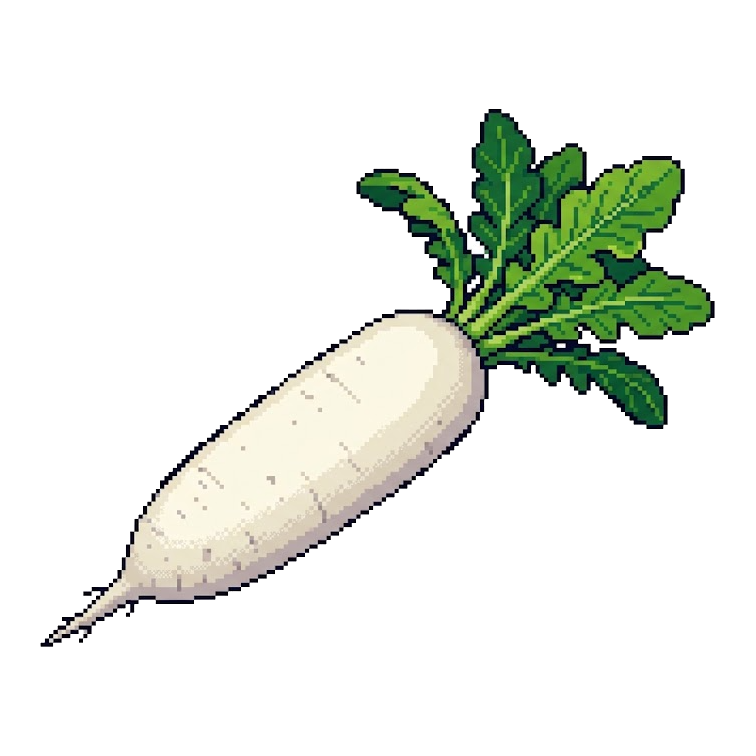
A vegetable in the mustard familyWe eat the rootSold all year round
Daikon is a vegetable in the mustard family. We eat its thick, white root. It is said to come from the Mediterranean coast to Central Asia. In Japan it appears even in a song in the Kojiki, so it has been a familiar vegetable for a very long time.
Key facts
| Group | A vegetable in the mustard family. We eat the thick, white part that swells underground. The leaves can be eaten too. |
|---|---|
| Homeland (where it began) | Often explained as the Mediterranean coast to Central Asia. Sources differ, and some give other places, such as southern China. Accounts differ. |
| Arrival in Japan | Said to have come from China. Some say it was in the Yayoi period, and others say around the 8th century. It is not clear. |
| Oldest record in Japan | It is said that the oldest record is a song in the Kojiki, completed in 712, where daikon appears under the name "suzushiro." |
| Main growing areas (Japan) | Chiba Prefecture and Hokkaido are well known. The growing area changes with the season, so daikon is shipped all year round. |
| Best season | It tastes best in winter. According to a Chiba Prefecture document, the best season for daikon from Chiba is about December to March. |
| Varieties | It is said there are more than 100 kinds. Today the "Aokubi daikon" (green-necked daikon) is the most common. There are also local varieties that have been grown for a long time, such as Nerima daikon and Miura daikon. |
| Ways to eat it | Grated daikon, oden, furofuki daikon (simmered daikon with sauce), miso soup, pickles, salads, and as the garnish served with sashimi (raw fish). |
| How to store it | Cut off the leaves, wrap the root in newspaper or similar paper, and put it in the vegetable drawer of the fridge. Keep the leaves separate, because they draw water out of the root. |
What kind of vegetable is it?
Daikon belongs to the mustard family of plants. It is in the same group as cabbage, broccoli and mustard greens. The white part we usually eat is the part that grew thick underground.
Daikon comes in many shapes and sizes. Some are long, some are round, some are small, and some are very thick. There are many varieties. The "Aokubi daikon," which you often see in shops today, has a slightly green top. It is said to be quite sweet, and good both raw and cooked. The green part at the "neck" is the part that stuck out of the soil and got sunlight. It tastes sweet.
You can enjoy the leaves as well as the root. If you see daikon sold with its leaves, try using the leaves too, so nothing goes to waste.
Homeland and history
Daikon is often said to come from the Mediterranean coast to Central Asia. But there are other ideas too, such as southern China, and nothing is settled.
The time it reached Japan is also uncertain. Some say it was in the Yayoi period. Others say it came from China around the 8th century. We do not know for sure.
As for old written records, daikon appears in a song in the Kojiki, completed in 712, under the name "suzushiro." This shows that people in Japan have been familiar with it for a very long time.
After that, different regions of Japan began to grow varieties that suited their own land. Nerima daikon and Miura daikon are well known.
Why can we eat it all year?
You can find daikon in shops at any time of the year. This is because the growing area and the variety change with the season.
By shipping time, daikon is divided into spring daikon (about April to June), summer daikon (about July to September), and autumn-winter daikon (about October to March). A document from the Ministry of Agriculture, Forestry and Fisheries (for the 2024 harvest, Reiwa 6) explains that Chiba Prefecture has a high share in spring and autumn-winter, and Hokkaido has a high share in summer. Daikon is grown in cool places in summer and in warm places in winter. Places are used wisely this way.
Harvest numbers change every year because of the weather and other things. You can check the newest numbers in the Ministry's announcements.
Tips for enjoying it
It is said that daikon tastes different depending on the part. The upper part, near the leaves, is sweet and soft. It is perfect for salads and grated daikon. The middle part is good for simmered dishes and oden. The tip has a stronger spicy taste. It is said to suit miso soup and pickles.
The spicy taste is said to come from a substance called isothiocyanate. When daikon is grated or cut, its cells break, and the spicy taste appears. This spiciness fades easily as time passes. So if you want to enjoy the spiciness, grate the daikon just before eating.
When choosing, look for one that is white, shiny and firm, and heavy for its size. To store it, cut off the leaves, wrap the root in newspaper or similar paper, and put it in the vegetable drawer of the fridge. If the leaves stay on, they draw water out of the root.
About the body and nutrition
It is said that daikon root contains diastase (amylase). This is an enzyme, a substance that breaks things down in our bodies and in food. Diastase breaks down starch, which is plentiful in rice and potatoes. It is explained that this enzyme is weak against heat, so daikon is often used in dishes eaten raw.
The leaves are rich in nutrients and are sometimes counted as green and yellow vegetables (deeply colored vegetables). The root is mostly water.
It is important to eat many kinds of food in a good balance. Daikon alone does not make the body healthy.
About this illustration
This is an illustration of a long, white daikon drawn in pixel art (tiny square dots). It can be used for scenes about cooking, vegetable shops or fields. It is based on the real color and shape. But because it is a simple picture made of dots, details such as the thin hairy roots and the jagged edges of the leaves are shown differently from the real thing. That is how the illustration is drawn.
Fun facts
- It is said that the oldest record of daikon in Japan is a song in the Kojiki, completed in 712. There it is called "suzushiro."
- It is said that there are more than 100 varieties of daikon.
- The green part at the neck of a daikon is the part that stuck out of the soil and got sunlight. It is said to taste sweet.
Quick quiz
Q. Why is it better not to leave the leaves on when you store daikon?
If the leaves stay on, they draw water out of the root, and the root wilts easily. It is better to cut off the leaves, wrap the root in newspaper or similar paper, and put it in the vegetable drawer of the fridge. The leaves can be eaten too.
References
- 千葉県「ちばの野菜図鑑 だいこん」(Chiba Prefecture's vegetable guide to daikon: varieties, growing areas in the prefecture, best season, how to choose and store it. Updated April 2025, Reiwa 7)
- 農畜産業振興機構(ALIC)の野菜に関する資料 (Materials on vegetables from the Agriculture & Livestock Industries Corporation: origin of daikon, arrival in Japan, the Kojiki)
- 農林水産省「令和6年産指定野菜の作付面積、収穫量及び出荷量」(Ministry of Agriculture, Forestry and Fisheries, planted area, harvest and shipments of designated vegetables for 2024, in an explanatory document from the Aomori office of the Tohoku Regional Agricultural Administration Office: spring, summer and autumn-winter daikon, and the features of Chiba and Hokkaido)
- 農林水産省「野菜生産出荷統計」(Ministry of Agriculture, Forestry and Fisheries, vegetable production and shipment statistics: daikon harvest and more. The latest numbers can be checked here)
- 『古事記』(The Kojiki, 712: the song that is said to be the oldest record of daikon in Japan)
Accounts may differ between sources and regions, and facts or figures can change with new research or rules. This page was translated from the Japanese original.
Download the pixel art
- Free
- No registration
- Commercial use OK
- Edits OK
- Credit optional
- No usage report needed
Please read the terms of use before using it.