



Food Encyclopedia No.005
Cucumber
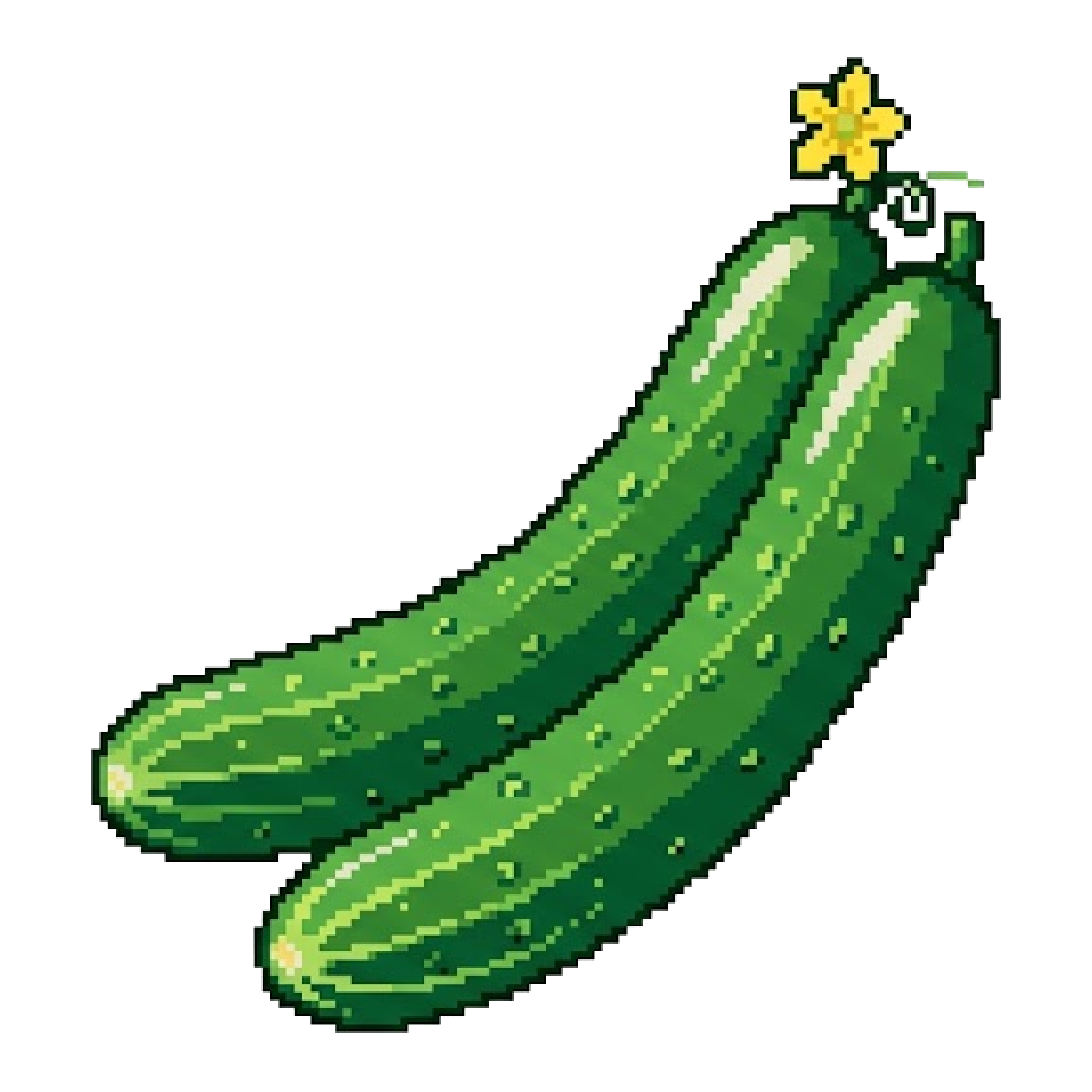
A vegetable of the gourd familyA fruit vegetable (we eat the fruit)A classic summer vegetable
The cucumber is a vegetable that grows as a fruit on a climbing vine of the gourd family. It is said to come from the foot of the Himalayas in India. It came to Japan from China long ago. It is mostly water, and people love its crisp crunch.
Key facts
| Classification | An annual plant of the gourd family, genus Cucumis (a plant that grows, bears fruit and dies within one year). Its vine stretches as it grows, and we eat the fruit, so it is called a "fruit vegetable" (scientific name: Cucumis sativus). |
|---|---|
| Home region | Said to be the foot of the Himalayas in India. |
| Main growing areas (Japan) | According to materials from the Ministry of Agriculture, Forestry and Fisheries, Miyazaki Prefecture ranked first in Japan for shipment volume (the amount sent from farms to markets and other places) for the 2024 harvest (Reiwa 6). Gunma, Saitama and Fukushima prefectures are also known as growing areas. (Rankings and numbers change from year to year.) |
| Season | Cucumbers grown outdoors in fields (open-field growing) are in season in summer, around July to September. Today, greenhouse growing (growing in a space covered with vinyl or similar material) has also spread, so cucumbers are sold all year round. |
| Main nutrients | Mostly water. It is said to contain small amounts of potassium and other nutrients. For detailed numbers, you can check the Standard Tables of Food Composition in Japan from the Ministry of Education, Culture, Sports, Science and Technology. |
| Arrival in Japan | Some explanations say it came from China around the 6th century (about 1,500 years ago). Accounts differ on the timing, and some sources say it was in the Heian period. |
| Ways to eat it | Salads, vinegared dishes, lightly pickled cucumbers, rice-bran pickles, sandwiches, and as a topping on chilled Chinese-style noodles. |
| How to store it | Cucumbers do not like cold temperatures, so be careful not to chill them too much. Put them in a plastic bag, keep them in the vegetable drawer of the refrigerator, and eat them soon. |
What kind of vegetable is it?
The cucumber is a vegetable of the gourd family. It belongs to the same group as watermelon, pumpkin and bitter melon, and it grows by stretching out a vine. After a yellow flower blooms, a long, thin fruit forms, and that is the part we eat.
Most of the fruit is water. It is known for its crisp bite and light taste. It is a must-have on the summer table, and you can eat it raw or pickled.
The surface has small bumps. It is said that cucumbers with firm, upright bumps are fresh.
Home and history
The cucumber is said to come from the foot of the Himalayas in India. It has been grown for a very long time. From there, it spread west to Europe and east to China.
Some explanations say it came to Japan from China around the 6th century. However, some sources say it came around the Heian period, so it is not clear exactly when it arrived.
In the late Edo period, plant breeding (making better kinds of a plant by choosing good traits) moved forward. It is said that the crunch and the taste got better, and the cucumber became a popular vegetable.
The mystery of the name
In Japanese, "kyuri" can be written with the characters for "foreign gourd" or "yellow gourd." "Kiuri," written with the characters for "yellow gourd," means "yellow melon-like fruit."
It is said that in old Japan, people ate cucumbers after they had grown and turned yellow. Some explanations say that is why the name means "yellow gourd." Eating the young green fruit, as we do today, came in a later age.
Where are many grown?
In materials from the Ministry of Agriculture, Forestry and Fisheries (2024 harvest), Miyazaki Prefecture is ranked first in Japan for cucumber shipment volume (the amount sent from farms to markets and other places). One source says that for cucumbers shipped from winter to spring, it makes up about 20 percent of the whole country. Gunma, Saitama and Fukushima prefectures are also famous growing areas.
In warm places like Miyazaki, which stay mild even in winter, farmers use greenhouses to grow cucumbers from winter to spring. In summer, cucumbers are also grown in fields in cooler regions. Because growing areas take turns like this, cucumbers are in stores all year round.
These numbers and rankings change every year, depending on the weather and how well the plants grow. You can check the latest numbers in the statistics of the Ministry of Agriculture, Forestry and Fisheries.
Tips for tasty cucumbers and how to store them
To pick a tasty cucumber, look for one with an even thickness that feels heavy and firm in your hand. It is said that a cucumber with white prickles at the cut end, or with firm, upright bumps, is fresh.
The cucumber is a summer vegetable, so it is a little weak against the cold. If you chill it too much, it can spoil more easily. Put it in a plastic bag, keep it in the vegetable drawer of the refrigerator, and eat it soon.
It is said that rubbing cucumbers with salt before cooking, a step called "itazuri," makes the color brighter and helps the flavor blend in.
Body and nutrition
A cucumber is made up of mostly water. It is also said to contain small amounts of potassium and other nutrients. Because it has so much water, it is a light, easy-to-eat vegetable in summer.
One food alone does not decide how your body feels. It is important to eat many kinds of foods in a good balance.
Also, people who have allergies to pollen or to fruits of the gourd family may feel itching in their mouth after eating cucumber. If you are worried, ask a medical clinic.
About this illustration
This is a pixel-art illustration of a cucumber (a picture drawn by putting small squares together). Its long, thin green fruit shape stands out. You can use it for cooking scenes, vegetable shops, fields, and picture-book materials. The depth of color, the fine patterns and the outlines are pixel-art style. They are an illustrator's way of drawing and differ from the real vegetable.
Fun facts
- The name "kyuri" is said to come from "kiuri," written with the characters for "yellow gourd," meaning "yellow melon-like fruit."
- It is said that in old Japan, people ate cucumbers that had turned yellow. Eating the young green fruit, as we do today, came in a later age.
- Because greenhouse growing has spread, cucumbers, a summer vegetable, can now be bought in stores all year round.
Quick quiz
Q. What kind of meaning is the name "kyuri" (cucumber) said to come from?
The name "kyuri" is said to come from "kiuri," meaning "yellow gourd." This is because people long ago ate the fruit after it had turned yellow.
References
- Ministry of Agriculture, Forestry and Fisheries, Tohoku Regional Agricultural Administration Office, "Kyuri" (きゅうり, in "Shokutaku wo Shirou" / Getting to Know the Dinner Table): supports where it comes from, its arrival in Japan, the origin of its name, plant breeding, and how to choose it
- Ministry of Agriculture, Forestry and Fisheries, Kyushu Regional Agricultural Administration Office, materials on Miyazaki Prefecture vegetables (2024 harvest): supports growing areas and shipment ranking
- Agriculture & Livestock Industries Corporation (alic), vegetable information: supports the explanation that cucumbers came in the Heian period, and growing and year-round shipping
- Ministry of Education, Culture, Sports, Science and Technology, 『日本食品標準成分表』 (Standard Tables of Food Composition in Japan): an official source for checking food components (nutrition)
Accounts may differ between sources and regions, and facts or figures can change with new research or rules. This page was translated from the Japanese original.
Download the pixel art
- Free
- No registration
- Commercial use OK
- Edits OK
- Credit optional
- No usage report needed
Please read the terms of use before using it.