



Food Encyclopedia No.004
Bread
A staple food made from wheat and other floursRises through fermentationEaten all over the world
Bread is a food made by mixing flour such as wheat flour with water, kneading it, and baking it. Pieces of bread baked about 14,400 years ago have been found. Bread came to Japan in the 16th century and became widespread in the Meiji era.
Key facts
| Type | A staple food (the main food of everyday meals) made from grain flour. Many kinds use wheat flour |
|---|---|
| Main ingredients | Wheat flour, water, salt and yeast are the basics. Some breads also have sugar, oil, milk or eggs |
| How it rises | Yeast breaks down sugar and gives off gas (carbon dioxide). A net of gluten, made from the protein in wheat flour, traps the gas, and the dough puffs up |
| Oldest example found | Pieces of flat bread baked about 14,400 years ago were found at a site in northeastern Jordan (announced in 2018. It is said to be the oldest direct evidence of bread) |
| Arrival in Japan | Said to have been brought by Portuguese people and others in the 16th century (accounts differ on the year and the route) |
| Word origin | Said to come from the Portuguese word "pão" (bread) |
| Ways to eat it | Plain, as toast, in sandwiches, or as savory breads and sweet breads such as bean-paste buns and curry buns |
| Storing it | If you won't eat it soon, wrap it in single portions and freeze it. It tends to keep longer. It is said to go hard more easily in the refrigerator |
| Allergies | Because bread uses wheat, people with a wheat allergy need to be careful. On food labels in Japan, wheat, egg, milk and some other foods must be listed |
What kind of food is it?
Bread is a food made by adding water to flour such as wheat flour, kneading it, and baking it. Like rice, it is a "staple food" (the main food of everyday meals) that fills your stomach, and it is eaten all over the world.
The basic way to make it is simple. You mix wheat flour, water, salt and yeast, knead it, let it rest and rise, and then bake it in an oven. Yeast is a living thing so small that you cannot see it. It is related to molds and mushrooms.
There are many kinds, with different shapes and textures. Some are soft and fluffy like sandwich loaf bread, some have a hard crust like French bread, and some are flat like pita and naan.
Why does it rise?
The secret of rising bread dough is a team of two workings.
The first is the protein in wheat flour. When you add water and knead, this protein links up and makes a stretchy, sticky material called gluten. Gluten works like the frame of the dough.
The second is the work of yeast. Yeast breaks down the sugar in the dough and gives off gas (carbon dioxide). The gas collects inside the net of gluten, and the whole dough puffs up. When it is baked, it sets in that puffed-up shape.
A flour often used for bread is bread flour. It has more protein and is more sticky and strong.
History and origins
Bread began a very long time ago. A study announced in 2018 reported pieces of flat bread baked about 14,400 years ago at a site (a place where people lived long ago) in what is now northeastern Jordan. This was at least about 4,000 years before farming began. It is thought to have been made with wild grains and other plants.
Bread is also thought to have been made later in places such as ancient Egypt. Accounts differ on when bread made with fermentation first appeared.
Bread then spread to Europe and the rest of the world. It changed into many forms to suit the flours and tastes of each place.
Bread in Japan
Bread is said to have come to Japan in the 16th century, when Portuguese people and other foreigners began to visit. The word "pan" is also said to come from the Portuguese word "pão." However, accounts differ on the exact time and route.
After that, bread did not spread easily for a while. But from the end of the Edo period through the Meiji era, it began to be made again.
A shop founded in 1869 (Meiji 2) took a hint from sake buns, a sweet familiar to Japanese people. It made dough with a yeast unique to Japan, called sake starter, and wrapped sweet bean paste inside. This was the bean-paste bun. It is said that on April 4, 1875 (Meiji 8), the shop presented a cherry-blossom bean-paste bun to the Meiji Emperor. That is why April 4 is "Bean-Paste Bun Day."
Tips for eating and storing it
Bread is one of the foods that tastes best fresh from the oven, but it gets harder as time passes. If you can't finish it soon, wrapping it in single portions in plastic wrap and freezing it is said to help it keep longer. Be careful, because the refrigerator tends to make it harder.
When you eat it, toast it straight from the freezer or after thawing it a little (letting the ice melt). It will be crisp outside and soft inside.
If bread has mold, do not eat it. The mold can spread to parts that do not show on the surface.
Allergies and the body
Bread is made mainly from wheat flour, so people with a wheat allergy must be careful before eating it. Under Japan's food labeling rules, wheat, egg, milk and some other foods are ones that easily cause allergies, so they must be listed if used. ("Must" means it is required.) When you buy bread, check the label on the bag.
There is also bread made with rice flour, but much of it also has wheat added. So it is just as important to check the label.
As for nutrition, bread made with wheat flour is said to have a lot of carbohydrates (the part of food that gives your body energy to move). How balanced your meal is depends on what you eat with it.
About this illustration
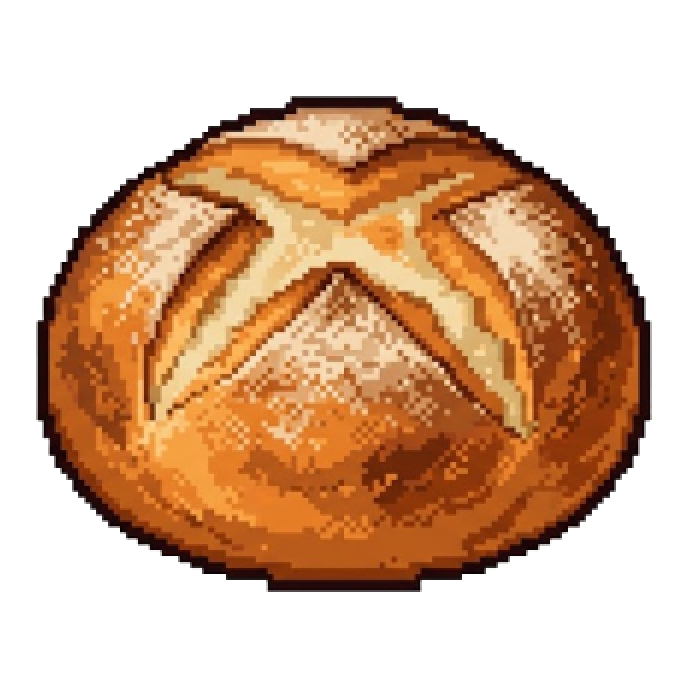
A pixel-art picture of a round loaf of bread, baked golden brown. (Pixel art is a picture drawn with small squares.) You can use it as a food icon. Real bread comes in many shapes, such as sandwich loaves, French bread and bean-paste buns. This picture shows just one example.
Fun facts
- A study announced in 2018 said that the oldest evidence of baked bread is at least 4,000 years older than the start of farming.
- The Japanese word "pan" is said to come from the Portuguese word "pão."
- April 4 is "Bean-Paste Bun Day." It comes from the story that a bean-paste bun was presented to the Meiji Emperor in 1875 (Meiji 8).
Quick quiz
Q. When bread dough rises, what gives off the gas that puffs up the dough?
Yeast breaks down the sugar in the dough and gives off gas. The net of gluten, made from the protein in wheat flour, traps that gas, and so the dough rises.
References
- A research paper published in PNAS (Proceedings of the National Academy of Sciences of the USA) in 2018 (Arranz-Otaegui et al.), and a press release from the University of Copenhagen (supports the discovery of bread about 14,400 years old)
- Materials on wheat from Japan's Ministry of Agriculture, Forestry and Fisheries (support the features of bread flour and gluten)
- Japan's Consumer Affairs Agency, Food Labeling Standards and allergen labeling materials (support the labeling requirement for wheat, egg, milk and others)
- Materials on the history of the shop Kimuraya Sohonten (support the birth of the bean-paste bun and the origin of April 4)
- Nihon Kokugo Daijiten (a large Japanese dictionary; supports the origin of the word "pan")
Accounts may differ between sources and regions, and facts or figures can change with new research or rules. This page was translated from the Japanese original.
Download the pixel art
- Free
- No registration
- Commercial use OK
- Edits OK
- Credit optional
- No usage report needed
Please read the terms of use before using it.