



Food Encyclopedia No.015
Cabbage
Vegetable of the mustard familyA "heading vegetable" with leaves that wrap into a ballSold all year round
Cabbage is a vegetable of the mustard family whose leaves wrap tightly into a round ball. It is said to come from the seaside of Europe, and it reached Japan in the Edo period. Aichi Prefecture ranks first in Japan for planted area and Gunma Prefecture ranks second (Reiwa 6, or 2024, harvest).
Key facts
| Group | A vegetable of the mustard family, in the genus Brassica. Its leaves wrap inward into a ball, so it is called a "heading vegetable" (scientific name: Brassica oleracea var. capitata). |
|---|---|
| Where it comes from | It is said to come from the coasts of Europe, from the Mediterranean Sea to the Atlantic Ocean. The original wild plant is said to have looked like kale, whose leaves do not wrap. |
| Main growing areas (Japan) | For the Reiwa 6 (2024) harvest, Aichi Prefecture ranked first in Japan with about 5,570 hectares of planted area (the size of the fields), and Gunma Prefecture ranked second with about 4,090 hectares (according to the Agriculture & Livestock Industries Corporation; the numbers change from year to year). |
| Season | It is shipped all year by changing growing areas and varieties. In winter and spring it comes mainly from places like Aichi Prefecture. In summer and autumn it comes mainly from highland areas such as Gunma Prefecture. |
| Main nutrients | The Standard Tables of Food Composition in Japan 2020 (Eighth Revised Edition) says 100 g of raw cabbage has about 41 mg of vitamin C and about 1.8 g of dietary fiber. Most of it is water. |
| Arrival in Japan | It came in the Edo period and was first grown for looking at. It is said to have become widely eaten as food from the Meiji period onward. |
| How to eat it | Shredded, in salads, stir-fried, simmered, in soup, in okonomiyaki (a savory pancake), as stuffed cabbage rolls, as pickles, and more. |
| How to store it | For a whole head, cut out the core, fill the hole with wet paper towel, wrap it in paper, and put it in the vegetable drawer of the fridge. Wrap cut cabbage tightly in plastic wrap. |
What kind of vegetable is it?
Cabbage is a vegetable of the mustard family. It belongs to the same species as broccoli, cauliflower and kale. People are thought to have grown and chosen plants in different ways to make vegetables with many different shapes.
Its best-known feature is that its leaves wrap inward again and again into a round ball. This is called "heading." The outer leaves are deep green. The leaves become whiter and softer toward the middle.
Spring cabbage, sold in spring, has loosely wrapped, soft leaves. Winter cabbage is wrapped tightly and feels heavy, so it is good for simmered dishes.
Its home and history
Cabbage is said to come from the seaside of Europe, from the Mediterranean Sea to the Atlantic Ocean. The original wild cabbage did not wrap into a ball like today's. Its leaves spread out loosely.
Over a long time, people grew it and kept choosing plants whose leaves wrapped. It is thought that this is how the round cabbage came about. The detailed history is explained differently in different sources, so only the big picture is given here.
Cabbage in Japan
Cabbage came to Japan in the Edo period through Dutch people and was called "kanran." At first it was grown to look at, like ornamental kale.
It spread as food from the Meiji period onward. It is explained that from the end of the Meiji period into the Taisho period, pork cutlets became popular. Shredded cabbage was served with them because it goes well with the light taste, and more people began eating it raw.
After that, varieties were improved in Japan. Cabbage went from a Western vegetable to a vegetable that is widely eaten in Japan.
Where is a lot of it grown?
According to the Agriculture & Livestock Industries Corporation, for the Reiwa 6 (2024) harvest, Aichi Prefecture ranked first in Japan for cabbage planted area, at about 5,570 hectares. Gunma Prefecture came next, ranking second at about 4,090 hectares.
Aichi is known for winter and spring cabbage, and Gunma for summer and autumn cabbage. Summer cabbage grows in cool highlands and winter cabbage grows in warm areas. By swapping them well, cabbage can be in shops all year.
These numbers change every year with the weather and other things. You can check newer numbers in the Ministry of Agriculture, Forestry and Fisheries' "Statistics on Vegetable Production and Shipments."
Tips for eating it well, and storing it
When you buy cabbage, pick one that feels heavy and has shiny leaves. For spring cabbage, look for fluffy leaves. For winter cabbage, look for leaves that are wrapped firmly.
To store a whole head, cut out the core with a knife and fill the hole with a paper towel wet with water. Wrap it in paper, put it in a plastic bag, and keep it in the vegetable drawer. It is said that if the core is left in, the cabbage keeps growing and uses up water from the leaves. Cover the cut side of cut cabbage tightly with plastic wrap.
Shredded cabbage becomes crisp when soaked in water. But if you leave it in water too long, its taste and nutrients can escape easily.
Body and nutrition
Cabbage contains vitamin C and dietary fiber. The Standard Tables of Food Composition in Japan 2020 (Eighth Revised Edition) says there is about 41 mg of vitamin C per 100 g of raw cabbage. Vitamin C dissolves easily in water and is easily lost by heat. If you make soup, you can also take in the part that dissolved out.
Cabbage is mostly water, with many nutrients in small amounts. It is important to eat it with other vegetables as part of balanced daily meals.
About this illustration
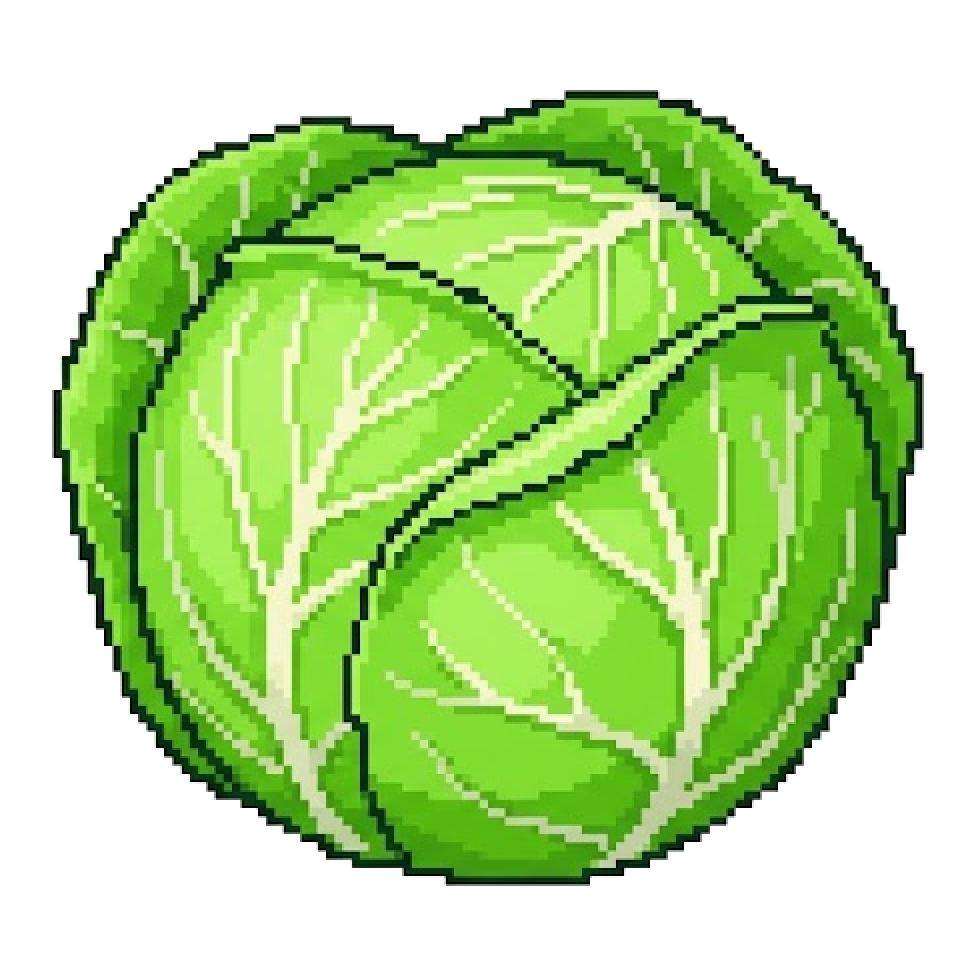
This is a picture of a round green cabbage drawn in dots (tiny squares). It shows the outer leaves and the lines of the wrapped leaves. Pixel art itself is a style of picture, different from the real thing. The depth of color and the shapes are made simple so they are easy to see.
Fun facts
- Cabbage, broccoli, cauliflower and kale are all vegetables from the same species (Brassica oleracea), made by growing it in different ways.
- In the Edo period in Japan, cabbage was called "kanran," and at first it was grown to look at.
- Gunma Prefecture has long been first in Japan for shipments of summer and autumn cabbage. For the Reiwa 6 (2024) harvest, it was announced as first for the 55th year in a row.
Quick quiz
Q. In the Edo period, when cabbage came to Japan, how was it mainly grown?
Cabbage that came in the Edo period was first an ornamental plant, like ornamental kale. It spread as food from the Meiji period onward. It is explained that the habit of eating it raw as a side for pork cutlets spread then.
References
- 農畜産業振興機構(alic)『野菜情報』キャベツの記事・「今月のやさい:キャベツ」— Agriculture & Livestock Industries Corporation (alic), "Vegetable Information" cabbage articles and "Vegetable of the Month: Cabbage": supports the arrival in Japan, its use as an ornamental plant, its spread from the Meiji period, and planted area by prefecture (Reiwa 6 harvest).
- 農林水産省 東北農政局「食卓まるかじり:キャベツ」— Tohoku Regional Agricultural Administration Office, Ministry of Agriculture, Forestry and Fisheries, "Eat the Whole Table: Cabbage": supports the Edo-period arrival, its ornamental use, and variety breeding in Japan.
- 群馬県の公式発表(群馬県ホームページ)— Official announcement from Gunma Prefecture (its website): supports first place in summer and autumn cabbage shipments for 55 years in a row (Reiwa 6 harvest).
- 文部科学省『日本食品標準成分表2020年版(八訂)』— Ministry of Education, Culture, Sports, Science and Technology, Standard Tables of Food Composition in Japan 2020 (Eighth Revised Edition): supports the vitamin C, dietary fiber and other values for raw cabbage.
- 農林水産省『野菜生産出荷統計』— Ministry of Agriculture, Forestry and Fisheries, Statistics on Vegetable Production and Shipments: supports statistics on cabbage planted area, harvest and shipments.
Accounts may differ between sources and regions, and facts or figures can change with new research or rules. This page was translated from the Japanese original.
Download the pixel art
- Free
- No registration
- Commercial use OK
- Edits OK
- Credit optional
- No usage report needed
Please read the terms of use before using it.