



Periodic Table Encyclopedia No.022
Titanium
Transition metalMetalGroup 4, Period 4
Atomic number 22, symbol Ti. It is a silvery-white metal that is much lighter than iron, yet strong and slow to rust. It is used in eyeglasses, golf clubs, airplanes and more.
Key facts
| Atomic number / Symbol | 22 / Ti |
|---|---|
| Type | Metal (transition metal) |
| Place on the periodic table | Group 4, Period 4 |
| State at room temperature | Solid (a shiny, silvery-white metal) |
| Atomic weight | About 47.867 (a value that compares the weight of atoms; the IUPAC standard atomic weight, as of the 2020s) |
| Melting point (the temperature at which it melts) | About 1670 °C (about 1943 kelvin) (from the element data of the Royal Society of Chemistry in the UK; some sources give 1668 °C) |
| Density (weight for the same volume) | About 4.5 g/cm³ (a little more than half the weight of iron) |
| Discovery | In 1791, Gregor, an English minister who knew a lot about minerals, found it in a mineral from Cornwall. In 1795, Klaproth of Germany found a similar oxide (a substance joined with oxygen) in a mineral called rutile and gave the element its name. The years and the details differ a little between sources, and accounts differ. |
| Origin of the name | Named after the Titans of Greek myth, the children of the earth goddess |
What kind of element is it?
Titanium is a metal with the symbol Ti and atomic number 22. Its color is a silvery white, and it is shiny.
Its biggest feature is that it is light but strong. It weighs only about 60 percent as much as iron of the same size. Even so, it can stand up to very strong forces. It also does not rust easily, which is another big plus.
In the Earth's crust (the layer of rock that makes up the Earth's surface), titanium is common even among metals. Sources say it is the 9th most plentiful element in the crust. You might think of it as a "rare metal," but it is actually found in large amounts in rocks and sand.
The history of its discovery
In 1791, in Cornwall, England, a minister (a Christian religious leader) named Gregor was studying a black, sand-like mineral found nearby. He noticed that it contained a metal nobody knew yet.
A few years later, in 1795, the German chemist Klaproth found an oxide of a new metal in a mineral called rutile, too. Klaproth named the metal titanium, after the Titans of Greek myth. Later, people learned that it was the same element Gregor had found. The year and the details of the discovery differ a little between sources, so accounts differ.
Still, people at that time could not yet take out the pure metal itself. The first nearly pure titanium metal is said to have been made in an experiment by Hunter in 1910. After that, a method using magnesium, devised by a person named Kroll in the 1930s, was studied. Later it came into use in industry, and it became possible to make a lot of titanium.
Everyday uses
One everyday use is the frames of eyeglasses. They are light and strong, so you get tired less easily even after wearing them for a long time. They also do not rust easily, so they are not easily damaged even when sweat gets on them.
Titanium alloys (materials made by mixing metals) are also used for the head, the tip of a golf club. Because the head can be made light, even a large one is easy to swing.
Titanium is also used in parts for airplanes and rockets, and in the equipment of ships and of plants that turn seawater into fresh water. It gets along well with the body, so it is also used for the bases of artificial teeth and for joint parts.
The secret of its properties
Titanium does not rust easily because a very thin oxide layer (a film joined with oxygen) forms on its surface and protects the metal inside. Thanks to this film, it is a metal that stands up well to seawater.
Its melting point (the temperature at which a metal starts to melt) is high, about 1670 °C, so it is also strong against heat.
Another important thing is a white powder called titanium dioxide. This powder is used as a pigment (a powder that adds color) to make paint, paper and plastic white. It is also found in sunscreen.
Metal titanium is said to be unlikely to harm the body in ordinary use. But for care with powders or when the metal is being worked on, check the details with information from public agencies.
Titanium on Earth and in space
On Earth, titanium is not found as a metal by itself. It is found inside minerals (natural rock materials) joined with oxygen. Typical ones are the minerals rutile and ilmenite.
Taking the metal titanium out of these minerals takes a lot of work and money. So titanium products can cost more than ordinary iron products.
In this way, titanium is "a metal that is plentiful on Earth but hard to take out." Thanks to its lightness, strength and resistance to rust, it is an element that will find even more uses in the future.
About this illustration
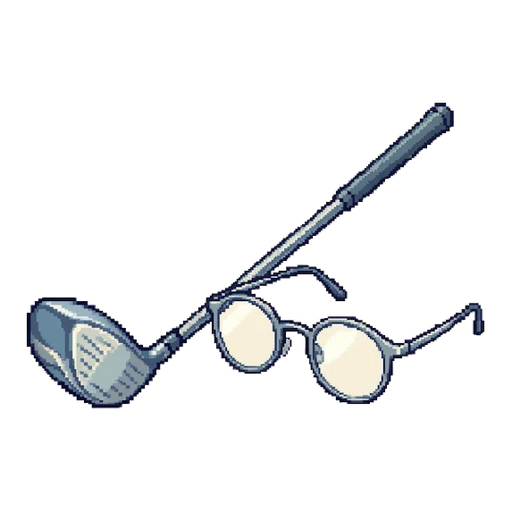
This is an illustration of light titanium eyeglasses and a golf club. It shows eyeglasses with thin, shining silver frames and the head of a golf club, which is made with a titanium alloy. The colors of the eyeglasses, the shape of the club and the background are artistic choices to make the picture easy to see, and they may differ from the real things.
Fun facts
- The name titanium comes from the Titans of Greek myth, the children of the earth goddess.
- A white powder called titanium dioxide is used in paint, paper, sunscreen and more.
- There is a lot of titanium on Earth, but it is hard to take out as a metal. So it tends to cost more than iron.
Quick quiz
Q. Which of these describes titanium, as explained in the text?
Titanium weighs only about 60 percent as much as iron, yet it is strong. A thin film on its surface keeps it from rusting easily. That is why it is used in eyeglasses and golf clubs.
References
- 英国王立化学会(Royal Society of Chemistry)「Periodic Table: Titanium」 (supports melting point, density, atomic weight, uses and origin of the name)
- IUPAC(国際純正・応用化学連合)の標準原子量表 (supports the atomic weight value)
- 国立天文台編『理科年表』丸善出版 (supports the properties and physical values of elements)
- WebElements「Titanium」 (supports property values and the story of its discovery)
- Encyclopaedia Britannica「Titanium」 (supports discovery, how it is made, and uses)
Accounts may differ between sources and regions, and facts or figures can change with new research or rules. This page was translated from the Japanese original.
Download the pixel art
- Free
- No registration
- Commercial use OK
- Edits OK
- Credit optional
- No usage report needed
Please read the terms of use before using it.