



Periodic Table Encyclopedia No.023
Vanadium
Transition metalMetalGroup 5, Period 4
Atomic number 23, symbol V. It is a silvery-gray metal. Mixed into steel, it makes the steel hard and tough. It is a star material for tools such as wrenches.
Key facts
| Atomic number / Symbol | 23 / V |
|---|---|
| Type | Transition metal (a kind of metal) |
| Place on the periodic table | Group 5, Period 4 |
| State at room temperature | Solid (a silvery-gray metal) |
| Atomic weight | About 50.94 (the IUPAC standard atomic weight, as of the 2020s) |
| Melting point (the temperature at which it melts) | About 1910 °C (some sources give slightly different values) |
| Density | About 6.0 g/cm³ (about 6 times the weight of water; some sources give a value of about 6.1) |
| Discovery | Found in 1801 by del Río (a mineral expert born in Spain who worked in Mexico), but he later took the claim back. Sefström of Sweden found it again in 1830. Some sources give the year as 1830 to 1831, so accounts differ. |
| Origin of the name | After Vanadis, a goddess of Norse myth (said to be another name for Freyja). It was named this because the colors of its compounds are so beautiful. |
What kind of element is it?
Vanadium is a metal with the symbol V and atomic number 23. It is silvery gray and is hard and tough.
It is not often used by itself. Its main job is as a supporting actor mixed into steel (a hard material made by adding a tiny bit of carbon and other things to iron). Even a small amount makes steel tougher and slower to wear down.
Also, compounds of vanadium (substances joined with other elements) come in many colors, such as blue, green, yellow and purple. This variety of colors led to the origin of its name.
The history of its discovery
The first person to notice the new element was del Río in 1801. He studied a lead ore (a stone containing lead) from a mine in Mexico and thought it held a new metal. A salt of this metal (a substance made when a metal joins with an acid) turned red when heated. So he named it "erythronium," after the Greek word meaning "red."
But a few years later, a French chemist said, "It's just chromium (a different metal)," and del Río took back his idea.
About 30 years later, in 1830, Sefström of Sweden found the same element in iron made from Swedish iron ore (a stone containing iron). He named it "vanadium." After that, Wöhler of Germany confirmed that it was the same element del Río had found.
The first person to take out the pure metal was Roscoe of England, in 1867. It is now known that what people had taken out before that was a different substance (a nitride).
Everyday uses
The biggest use is vanadium steel. Steel mixed with chromium and vanadium is perfect for tools that take a lot of force, such as wrenches (tools that turn bolts and nuts). This is because it does not bend easily and does not wear down easily.
Also, an alloy (a mix of metals) made by mixing aluminum and vanadium into titanium is light and strong, so it is used in airplane parts and more.
There are also large storage batteries (devices that store electricity) that use vanadium compounds. They are being studied and used to store electricity made from sunlight or wind. In chemical plants, vanadium is also used as a catalyst (a substance that helps a reaction) when making sulfuric acid (an acid widely used in industry).
The secret of its properties
Vanadium is a metal with a high melting point (the temperature at which a solid melts into a liquid), about 1910 °C. In air, a thin film forms on its surface, so the metal inside tends to stay protected.
The interesting part is that the colors of its compounds change. Depending on its surroundings, vanadium changes the number of its electrons (very tiny particles inside an atom). It is known that, when dissolved in water, it changes color from yellow to blue to green to purple.
Some vanadium compounds need careful handling. They are not for use at home. For detailed safety information, check materials from public agencies.
Vanadium on Earth and in space
Vanadium is found widely but thinly in the Earth's crust (the hard part that covers the Earth's surface). However, there are few ores in which vanadium alone is gathered in large amounts.
So it is also taken from the leftover waste made when iron is produced, and from things contained in oil and coal.
Also, some kinds of sea squirts (animals that live attached to rocks on the sea floor) are known to store a lot of vanadium inside the cells of their blood. Why they store it is still being studied.
About this illustration
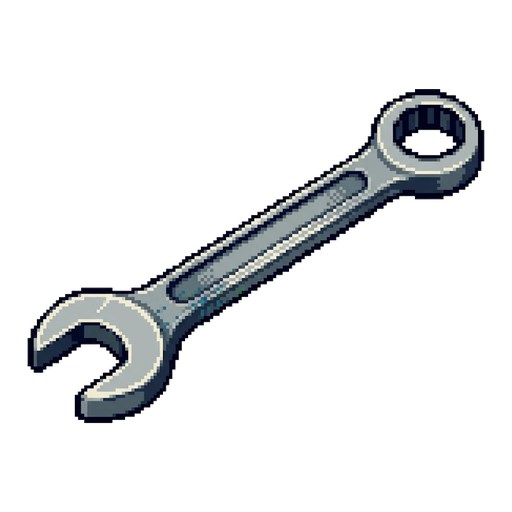
This is an illustration of a sturdy tool, a silver wrench (a tool that turns bolts and nuts). Vanadium is a metal added to the steel used for tools that take a lot of force, like wrenches. The detailed shape and shine of the wrench in the picture are artistic choices and may differ from a real one.
Fun facts
- Vanadium was first named "erythronium," after the Greek word meaning "red," but that name was taken back.
- Sefström, who found it again in 1830, named it after Vanadis, a goddess of Norse myth.
- An alloy of titanium mixed with vanadium and aluminum is light and strong, so it is used in airplane parts and more.
Quick quiz
Q. What is vanadium mainly important for?
When a tiny bit of vanadium is mixed into steel, the steel becomes tougher and slower to wear down. That is why it is used in tools such as wrenches.
References
- IUPAC 原子量・同位体存在度委員会(CIAAW)「Standard Atomic Weights」 (supports the standard atomic weight of vanadium)
- Encyclopaedia Britannica「Vanadium」 (supports the history of discovery, properties and uses)
- Jefferson Lab「It's Elemental – Vanadium」 (supports basic data, origin of the name and the discoverers)
- Royal Society of Chemistry「Periodic Table – Vanadium」 (supports properties, discovery and uses)
- 国立天文台編『理科年表』(丸善出版) (supports the numerical values of element properties)
Accounts may differ between sources and regions, and facts or figures can change with new research or rules. This page was translated from the Japanese original.
Download the pixel art
- Free
- No registration
- Commercial use OK
- Edits OK
- Credit optional
- No usage report needed
Please read the terms of use before using it.