



Periodic Table Encyclopedia No.012
Magnesium
Alkaline earth metalMetalGroup 2, Period 3
Atomic number 12, symbol Mg. A silvery-white, very light metal. When it burns, it gives off a dazzling white light. It is used in light alloys and is also essential to the green pigment in plant leaves.
Key facts
| Atomic number / Symbol | 12 / Mg |
|---|---|
| Category | Alkaline earth metal (a kind of metal) |
| Place on the periodic table | Group 2, Period 3 |
| State at room temperature | Solid (a silvery-white metal) |
| Atomic weight | About 24.305 (IUPAC standard atomic weight, as of the 2020s) |
| Density (weight for the same volume) | About 1.74 g/cm³. Lighter than iron (about 7.9) and aluminum (about 2.7) |
| Melting point / Boiling point | Melting point (temperature at which it melts) is about 650 °C. Boiling point (temperature at which it turns into gas) is about 1090 °C. |
| Discovery | In 1755, Black recognized that magnesium carbonate was a different substance from lime. Davy took out the metal in 1808 (but it was not pure). Sources explain this differently, so accounts differ. |
| Origin of the name | The Magnesia region of Thessaly in Greece. It is named after stones found in that area. |
What kind of element is it?
Magnesium is the element with the symbol Mg and atomic number 12. It is a silvery-white metal, and it is very light even among the metals we use in daily life.
On the periodic table, it is in Group 2 and is called an alkaline earth metal (a relative of calcium). It joins easily with other substances. So in nature it is not found as a pure metal. It exists as compounds (substances made when elements join together) in minerals (the materials that make up rocks and stones) and in seawater.
Compared at the same size, it weighs only about one quarter as much as iron.
The history of its discovery
In 1755, Black of Britain recognized that a white powder called "magnesia alba" (magnesium carbonate) was a different substance from lime.
Then, in 1808, Davy of Britain took out magnesium using a method that splits substances with electricity (electrolysis). However, it is said that mercury (a metal that is liquid at room temperature) was mixed in, so it was not a pure metal.
The name comes from the Magnesia region of Greece. Davy is said to have first thought of the name "magnium," but later "magnesium" came to be used. Who counts as the discoverer depends on the source (accounts differ).
Everyday uses
Because it is light and strong, alloys made by mixing magnesium with other metals (materials made by mixing metals) are used for the outer cases of computers and cameras, and for parts of bicycles and vehicles.
Its habit of giving off a bright light when it burns is also used in the whitish, dazzling light of fireworks.
In science class, magnesium shaped like a silver ribbon is sometimes used. Look at it only under your teacher's guidance, and never try to burn it by yourself.
Secrets of its properties
When magnesium is heated in air, it burns with a dazzling white light. As it burns, it joins with oxygen and becomes a white powder called magnesium oxide.
The light is very strong, so never stare straight at it while it burns. Also, burning magnesium is known to be hard to put out with water. It must be put out differently from an ordinary fire, so you need to be careful when handling it. For detailed safety information, check materials from schools or public organizations.
By the way, a solid lump does not catch fire easily. Fine powder and thin ribbon catch fire more easily.
Magnesium on Earth and in space
Magnesium is said to make up about 2 to 2.5% of the weight of Earth's crust (the layer of rock that forms the ground), though the number differs a little by source. So it is a fairly common element.
A large amount is also dissolved in seawater. For this reason, one method of getting magnesium is to take it out of seawater.
Magnesium is also an important element for plants. An atom of magnesium sits at the center of chlorophyll, the green pigment in leaves.
It is also one of the elements living things, including people, need. But for how much to take in, ask an expert such as a doctor.
About this illustration
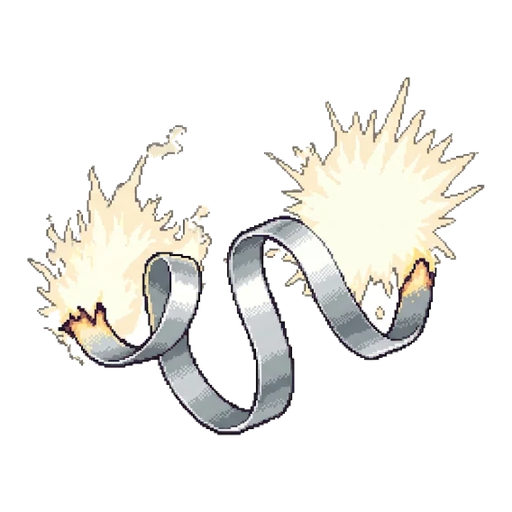
This is an illustration of magnesium burning with a dazzling white light. It shows a thin, silvery, ribbon-like piece of metal and white light spreading out as it burns. How the light spreads and its colors are the illustration's own way of making the scene easy to see, and differ from the real thing.
Fun facts
- Magnesium is the element at the center of chlorophyll, the green pigment in plant leaves.
- Compared with the same volume of iron, magnesium weighs about one quarter as much.
- The name comes from the Magnesia region of Greece.
Quick quiz
Q. Which is a feature of magnesium when it burns?
When magnesium burns, it gives off a dazzling white light and becomes a white powder called magnesium oxide. The light is strong, so never stare straight at it.
References
- IUPAC・原子量・同位体存在度委員会(CIAAW)「標準原子量」 (IUPAC Commission on Isotopic Abundances and Atomic Weights, "Standard Atomic Weights": the atomic weight value)
- 国立天文台編『理科年表』(丸善出版) (Chronological Scientific Tables, National Astronomical Observatory of Japan: density, melting point, boiling point and other properties)
- Royal Society of Chemistry「Periodic Table: Magnesium」 (history of discovery, properties, uses and abundance in Earth's crust)
- Encyclopaedia Britannica「Magnesium」 (how it was discovered, origin of the name and uses)
Accounts may differ between sources and regions, and facts or figures can change with new research or rules. This page was translated from the Japanese original.
Download the pixel art
- Free
- No registration
- Commercial use OK
- Edits OK
- Credit optional
- No usage report needed
Please read the terms of use before using it.