



World & Culture Encyclopedia No.018
Colosseum (Flavian Amphitheatre)
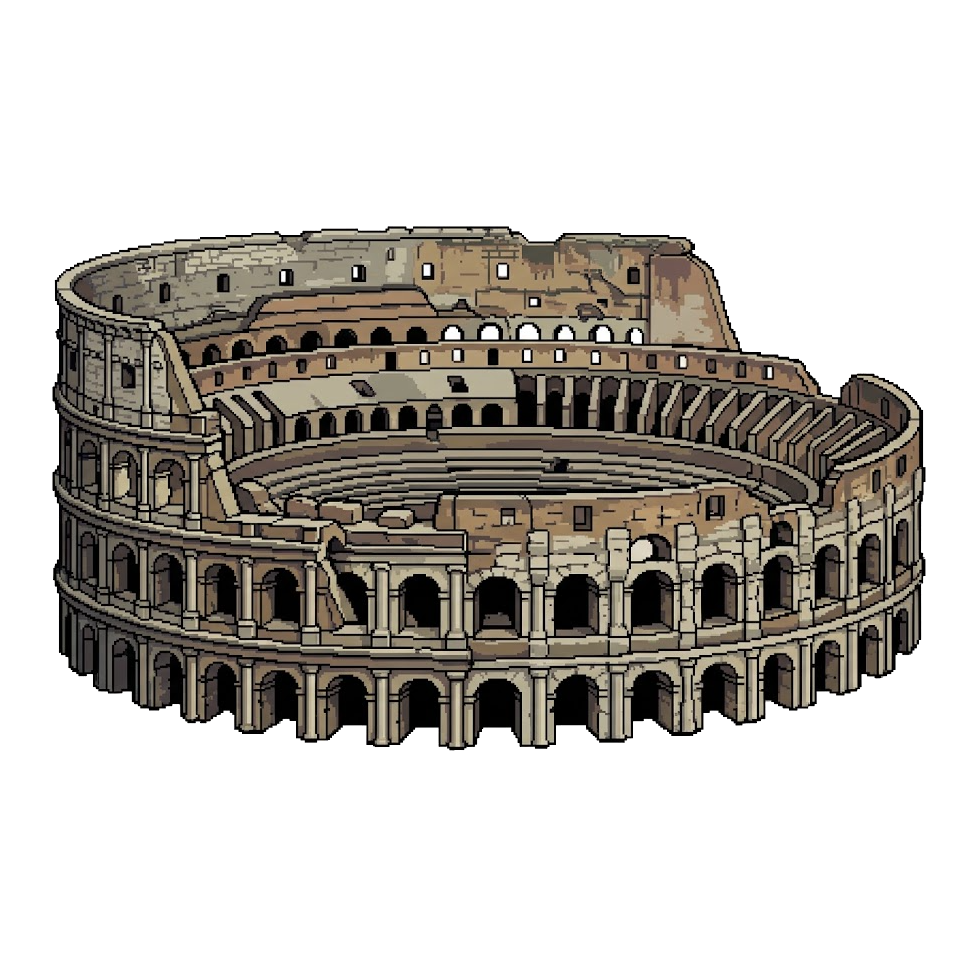
Rome, ItalyAncient Roman amphitheatrePart of the World Heritage site "Historic Centre of Rome"
This is a large, round building from ancient Roman times in Rome, the capital of Italy. It was built about 2,000 years ago, and many people gathered there to watch shows. Today it is still one of the most famous sights in Rome.
Key facts
| Type | An ancient Roman amphitheatre (a large building for putting on shows) |
|---|---|
| Location | In the center of Rome, Italy, near the Roman Forum (the central square of ancient Rome) |
| Beginning | Work began around the year 72 (some sources say 70). In 80, Emperor Titus held a ceremony to celebrate its completion. |
| Official name | The Flavian Amphitheatre. It comes from the family name of the emperors who built it, the Flavian family. |
| Size | The outside is an oval (a long, rounded shape) about 189 meters on the long side and about 156 meters on the short side. It is about 48 meters high (some sources give 45 to 50 meters). |
| Seating capacity | Said to be about 50,000. Sources differ, from 45,000 to 80,000, so accounts differ. |
| How it is built | Four stories. Stone and concrete are combined, and arches (half-round openings) line the walls. |
| World Heritage | In 1980 it was listed as a World Heritage Site (cultural heritage) as part of the "Historic Centre of Rome." |
What kind of place is it?
The Colosseum is a large ancient arena (a building where shows were held for people to watch) in the center of Rome, the capital of Italy. Seen from above, it has a rounded oval shape (a long, rounded shape).
On the outer wall, arches (half-round openings) line up in rows, one above another. Parts of the wall have fallen down, so you can see how the inside is built. This is also a special feature of the building.
It looks like a giant stadium. It is sometimes described as one of the models for today's stadiums.
History and origin
Work began around the year 72, in the time of Emperor Vespasian. The site was where Emperor Nero's artificial lake and gardens had once been. It is said that the water was drained from the lake before the building was put up.
In 80, his son, Emperor Titus, held a ceremony to celebrate its completion. It is said that the events went on for 100 days. Later, in the time of Titus's younger brother, Emperor Domitian, more work was added.
The official name is the "Flavian Amphitheatre." This is because all three emperors belonged to the same Flavian family. The name "Colosseum" is most likely from a huge statue of Nero (a colossus) that stood nearby. But there is another view that the name comes from the building being so huge.
Highlights and how it worked
The Colosseum has four stories and is about 48 meters high. In terms of a modern building, that is the height of more than ten floors.
It also had ways to let many spectators come in and out at the same time. There were many entrances, and stairs and passages were well arranged. It is explained that people could reach their seats in a short time.
It is thought that a large cloth awning (called a velarium) was stretched over the top to give shade. It is said that sailors, who were used to working with ships, moved the cloth on the roof.
Below the central floor (the arena) was an underground area with many rooms and passages. It is thought to have had systems for moving equipment and animals. Some parts of this underground area are said to have been added later, and research on the details still continues today.
The Colosseum after that
It is thought that shows were held here for more than 400 years. It is said that in 404, fights between gladiators (people who fought in matches in the arena) were banned, but accounts differ about the exact time.
After that, it was damaged many times by earthquakes. After the earthquakes of 422 and 508, it was repaired and used. It is said that in a big earthquake in 1231, part of the wall fell down.
In the Middle Ages (in Europe, about the 5th to 15th centuries), there was a time when it was used like a fortress (a building for defense). Also, fallen stones and metal fittings were carried away to be used as materials for building other buildings. The main reasons that only part of the Colosseum remains today are earthquakes and this removal of stone.
In the 18th century, there was a movement to forbid tearing it down. From the 19th century on, it has been strengthened (supported so that it does not break down) and repaired, and the work to protect it continues.
Cultural things to know
In 1980, the Colosseum was listed as a World Heritage Site as part of the "Historic Centre of Rome." It was not listed on its own. It was chosen as one of the places that tell the history of the city of Rome, which goes back to ancient times.
The ancient Romans were skilled at using arches and concrete. Their skill produced large, long-lasting buildings. The Colosseum is a leading example.
Today, many people visit from all over the world. When you visit, do not climb on the old stones or damage them. It is a site that people have protected for about 2,000 years.
About this illustration
This is a pixel-art illustration of an ancient arena with a rounded oval shape. The walls lined with arches, which are a feature of the Colosseum's outside, are drawn with small square dots. The real Colosseum is known for its walls that are partly fallen down. The colors and fine shapes are the artist's own ideas and differ from the real thing.
Fun facts
- The official name of the Colosseum is the "Flavian Amphitheatre," and the name "Colosseum" most likely comes from a huge statue that stood nearby.
- The outside is an oval about 189 meters on the long side and about 156 meters on the short side.
- It is explained that sailors, who were used to working with ships, moved the large cloth awning that gave shade.
Quick quiz
Q. In which country and city is the Colosseum?
The Colosseum is in the center of Rome, the capital of Italy. It is an ancient Roman amphitheatre where a ceremony to celebrate its completion was held in the year 80. In 1980 it was listed as a World Heritage Site as part of the "Historic Centre of Rome."
References
- World History Encyclopedia "Colosseum" (for the start of work in 72, the opening ceremony in 80 and 100 days of events, the size, the origin of the name, and earthquakes and later history)
- ユネスコ世界遺産センター "Historic Centre of Rome" (UNESCO World Heritage Centre; for the 1980 World Heritage listing)
- コロッセオ考古学公園 (Parco archeologico del Colosseo) official guide (for the building's history and visiting)
- Guinness World Records "Largest amphitheatre" (for the size, such as 189 meters long and 156 meters wide)
- Encyclopaedia Britannica "Colosseum" (for an explanation of it as an ancient Roman amphitheatre)
Accounts may differ between sources and regions, and facts or figures can change with new research or rules. This page was translated from the Japanese original.
Download the pixel art
- Free
- No registration
- Commercial use OK
- Edits OK
- Credit optional
- No usage report needed
Please read the terms of use before using it.