



World & Culture Encyclopedia No.019
The Pheasant, Companion of Momotaro
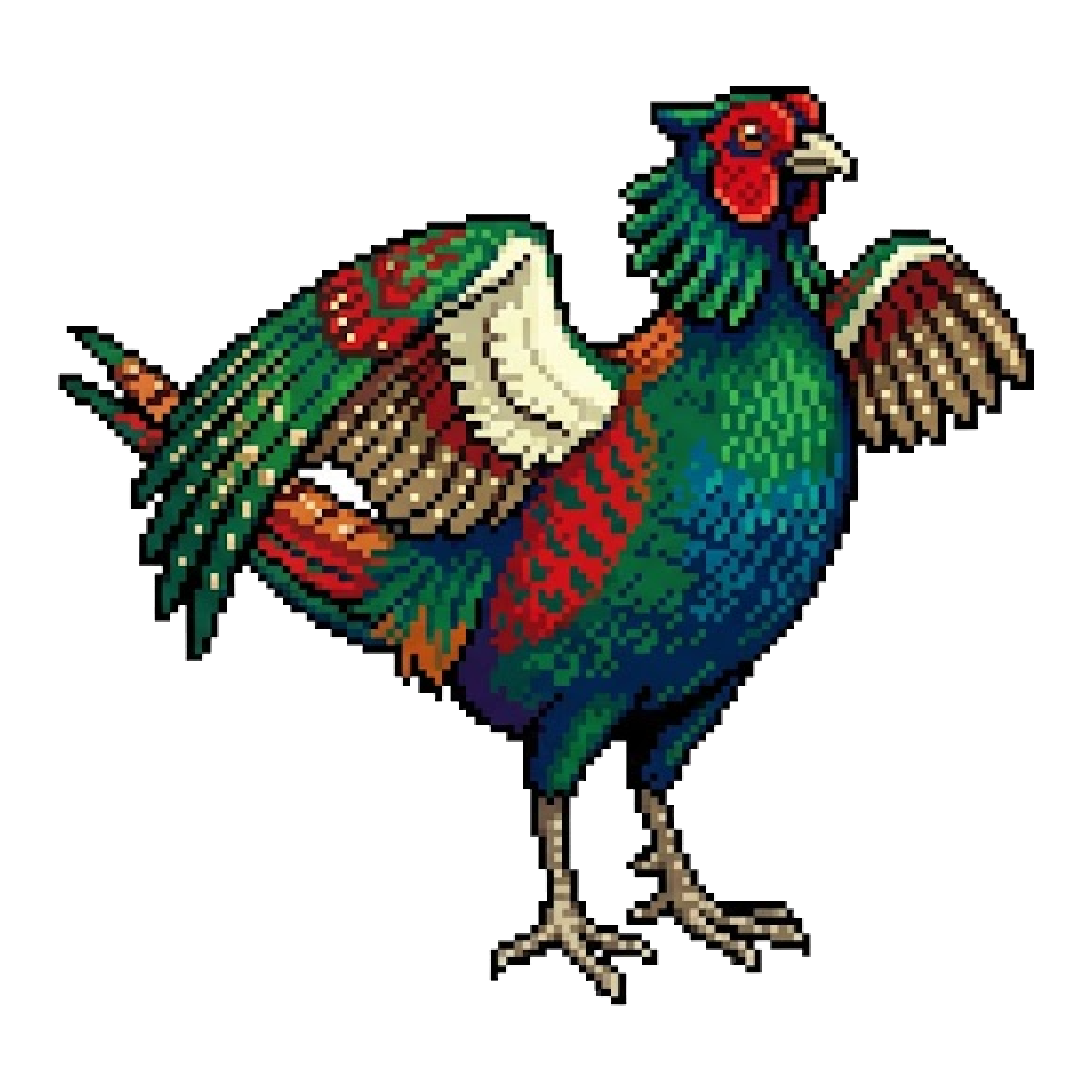
Japan, folktaleCompanion of MomotaroNational bird of Japan
The pheasant is known as one of Momotaro's companions. It is also a real bird and the national bird of Japan (a bird that stands for the country). This page looks at its role in the folktale and the life of the real pheasant.
Key facts
| Type | A character in a folktale / A real bird (pheasant family) |
|---|---|
| Role in the folktale | One of Momotaro's companions. The dog, the monkey and the pheasant, three animals in all, join his trip to Ogre Island. |
| Where the real pheasant lives | Lives all year round in Honshu, Shikoku, Kyushu and other areas. In Hokkaido, a close relative from the Asian mainland (the Korean pheasant) was brought in by people and now lives there. |
| Body size | Total length (from the beak to the tip of the tail) is said to be about 80 centimeters for males and about 60 centimeters for females. |
| Differences between male and female | The male has beautiful green and bluish feathers and a red patch on the face. The female is brownish and plain. |
| National bird | Said to have been chosen in 1947 by the Ornithological Society of Japan. It was not decided by law. |
| Why it became a companion | There are several accounts, such as one that uses the twelve zodiac animals and directions, and one based on place names. The answer is not settled (accounts differ). |
What is it?
In the folktale of Momotaro, three companions appear: a dog, a monkey and a pheasant. The pheasant receives a millet dumpling that Momotaro carries. Then it becomes a friend who goes with him to Ogre Island.
The pheasant is a bird that can fly. In some tellings, it uses its flying power to help. But the details of the tale differ from region to region and from book to book. The way the pheasant helps is told in many different ways.
What is the real pheasant like?
The pheasant lives in Honshu, Shikoku, Kyushu and other parts of Japan. You can see it near fields and farms and at the edges of woods.
The male has a large body. Its total length (the length from the beak to the tip of the tail) is about 80 centimeters. Its feathers are green and bluish, and it has a red patch on its face. The female is about 60 centimeters long and plain brownish. This color is thought to help her hide in the grass and protect her chicks.
In the spring breeding season (the time when birds raise young), the male calls out in a high voice, "Ken, ken." He sometimes also makes a "dodododo" sound by flapping his wings.
Why is the pheasant a companion?
There are several accounts of why the dog, the monkey and the pheasant were chosen.
One uses directions and the twelve zodiac animals. (The zodiac uses twelve animals, such as the rat and the ox, to show time and direction.) The northeast, the direction from which ogres were said to come, is called the "demon gate." The opposite direction matches the monkey in the zodiac. In the zodiac order, the rooster comes next after the monkey, and then the dog. So the idea is that the monkey, the pheasant and the dog were given the role of facing the ogre. But this is said to be an explanation added later, and there is no clear proof.
There are also tales told in Okayama, Kagawa and other prefectures. For example, in the Kinashi area of Takamatsu City, Kagawa Prefecture, a tale is tied to a place name, "Kijigatani." It cannot be said which one is correct.
The pheasant as Japan's national bird
The pheasant is said to have been chosen as the national bird in 1947 by the Ornithological Society of Japan (a society of people who study birds). A national bird is a bird that stands for a country. One reason given is that it has long been loved by the Japanese people.
It is explained that a national bird is not set by law.
The pheasant has also long been told of as a bird that cares for its young, as in the old saying "the pheasant in a burning field." It often appears in folktales and children's songs, so it is a familiar bird for people in Japan.
Cultural things worth knowing
The story of Momotaro has long been passed down in picture books, songs and more. The way the companions help, and the way the tale treats the ogre, differ a little with each author and era.
In some regions, the number of real pheasants is said to be falling. So catching female pheasants is banned across the country by national rules. This ban was extended from September 2022 to September 2027. (Korean pheasants and others living in Hokkaido are not covered.) It is an effort to protect the number of living things.
Learning about the pheasant in the folktale can also be a chance to look at the wild birds around you.
About this illustration
This is an illustration of Momotaro's pheasant drawn as pixel art (a picture made by lining up tiny squares of color). The colors, the pose, the decorations and other small details are not taken from the real bird or from any fixed rule of the folktale. They are the artist's own style.
Fun facts
- The pheasant is said to have been chosen as Japan's national bird in 1947. It was not decided by law.
- The male pheasant is about 80 centimeters long, which is bigger than the female.
- Why Momotaro's companions are a dog, a monkey and a pheasant is not clear. There is an account using the zodiac and one based on place names.
Quick quiz
Q. Which is true about the real pheasant?
The male pheasant is about 80 centimeters long, and the female is about 60 centimeters. The male has beautiful feathers, and the female is plain and brownish. The pheasant is said to have been chosen as the national bird in 1947.
References
- 日本鳥学会『日本鳥類目録』 (Checklist of Japanese Birds; for the pheasant's classification and range)
- 新潟県 環境対策課の鳥類解説ページ (Niigata Prefecture Environment Division bird page; for the pheasant's length and range)
- 環境省の報道発表資料 (Ministry of the Environment press release; for the five-year extension, from September 2022, of the ban on catching female copper pheasants and pheasants)
- 『日本大百科全書』などの百科事典 (Nihon Daihyakkazensho and other encyclopedias; for the pheasant entry and the national bird)
- 国立環境研究所 侵入生物データベース (National Institute for Environmental Studies Invasive Species Database; for the Korean pheasant in Hokkaido)
- 香川県高松市鬼無町などに伝わる桃太郎伝承についての各地の解説資料 (local explanatory materials on Momotaro legends, such as those of Kinashi, Takamatsu City, Kagawa; for the accounts of why the companions were chosen)
Accounts may differ between sources and regions, and facts or figures can change with new research or rules. This page was translated from the Japanese original.
Download the pixel art
- Free
- No registration
- Commercial use OK
- Edits OK
- Credit optional
- No usage report needed
Please read the terms of use before using it.