



Society Encyclopedia No.006
Airship
VehicleFloats with a gas lighter than air19th century: first powered flight, in France
An airship is a flying vehicle. It floats using a big bag filled with gas lighter than air, and it moves with propellers. The first powered flight is said to have taken place in France in 1852.
Key facts
| Type | A kind of aircraft that floats with gas lighter than air (a "lighter-than-air craft"). It is like a balloon that can be steered. |
|---|---|
| How it floats | A bag is filled with a gas lighter than air (hydrogen or helium). The craft floats because of the difference between the weight of the air it pushes aside and its own weight (Archimedes' principle). |
| How it moves | An engine turns propellers to move it forward, and rudders change its direction. |
| First powered flight | On September 24, 1852, Henri Giffard of France is said to have flown an airship with a steam engine (an engine run by steam from boiling water) and a propeller. The distance flown is said to be about 27 km. |
| Arrival of the rigid airship | The first craft (LZ1) developed by Count Zeppelin of Germany flew on July 2, 1900. It had an aluminum frame covered with a skin of cloth. |
| Types | Non-rigid (gas pressure keeps its shape), semi-rigid, and rigid (a frame keeps its shape) |
| How they are used now | A small number are used for advertising, sightseeing, observation and so on (as of 2026). |
What is it?
An airship is a vehicle that floats in the sky using a big bag filled with gas. The gas is lighter than the air around it. That is why it can float gently, like a balloon.
The biggest difference from a balloon is that an airship has an engine and propellers. A balloon is carried along by the wind, but an airship can choose which way to go. It is long and thin to reduce air resistance (the force that pushes back against it as it moves).
How it floats
Most of an airship is the bag that holds the gas (this is called a gas cell, a bag that holds gas). Hydrogen and helium have been used as the gas. Both are gases lighter than air.
An airship floats when it is lighter than the air it pushes aside. This is called Archimedes' principle (the rule about the upward push that objects feel in water or air). This lifting force comes without using the engine, and it does not change even when the airship is standing still.
Hydrogen lifts very well, but it burns easily if it catches fire. Helium does not burn easily and is safe, but it has the weakness of being expensive. Today's airships use helium for safety.
History: from balloons to Zeppelins
In 1852, Henri Giffard of France flew an airship whose propeller was turned by a steam engine. It is known as the first airship with power. It flew about 27 km near Paris, but it is said that the wind was strong and it could not return to its starting point. The craft was long and thin. The gas in its bag is said to be hydrogen in some sources and coal gas in others, so it is not clear.
Later, Count Zeppelin of Germany (1838–1917) built "rigid" airships, which keep their shape with a frame. His first craft, LZ1, flew on July 2, 1900, over Lake Constance (a lake in southern Germany). It had a big aluminum frame and was about 128 m long.
In 1928, the large rigid airship Graf Zeppelin made its first flight. Later it was also used for trips carrying passengers across the Atlantic Ocean.
After that, and today
In the 1930s, accidents continued, and people lost trust in airships. The 1937 accident of the Hindenburg was an especially big event. After that, airplanes gradually became the main way to travel by air.
Today's airships use safe helium and are active in advertising, sightseeing, and observing from the sky. Their strength is that they can stay in the sky for a long time, moving slowly. Most are non-rigid, keeping their shape with gas pressure, but there are also semi-rigid craft that have a frame inside.
Story "sky ships" and real airships
In stories, ships that travel through the sky often appear. In real life, there is no fixed vehicle with the name "sky ship." They are imagined from airships, balloons and other things.
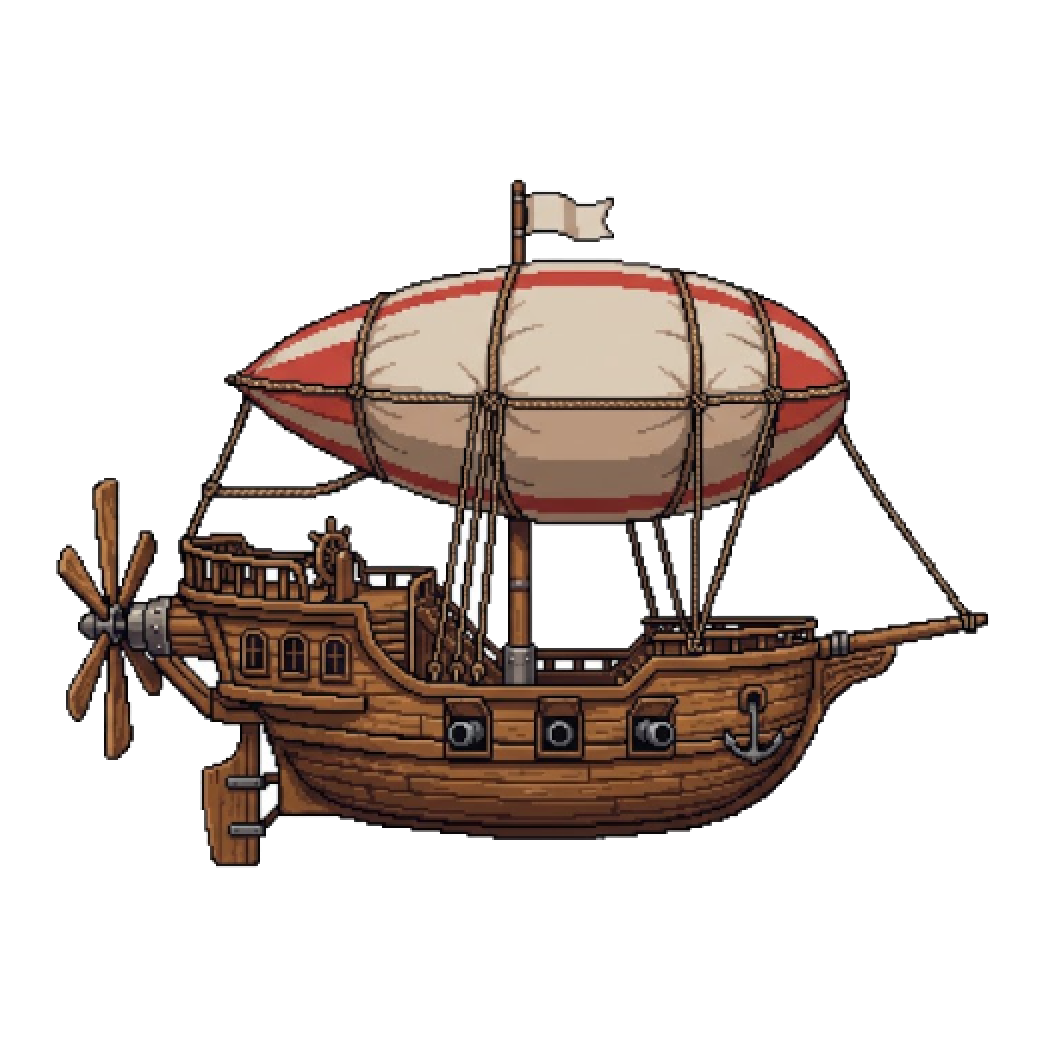
A real airship floats with a big bag filled with gas and moves with propellers. A picture like the one on this page, with a balloon and a propeller, copies features of a real airship. But the abilities and uses of a sky ship in a story can be different from those of a real airship.
About this illustration
This is a pixel-art picture (a picture made of tiny squares) of a sky ship with a big balloon-like bag and propellers. The balloon and propellers match features of a real airship. Small details such as colors and decorations are the artist's own ideas, not how the real thing looks.
Fun facts
- The English word "dirigible" comes from a root meaning "able to be steered."
- The 1852 airship of Giffard had a small steam engine of about 3 horsepower, so it was not strong against the wind.
- An airship's lifting force does not change even when it is standing still. This is different from an airplane, which runs forward to lift off.
Quick quiz
Q. Which is correct about the gas an airship uses to float in the sky?
An airship is filled with gas lighter than air, such as hydrogen or helium. It floats because of the difference from the weight of the air it pushes aside. Today, helium is used.
References
- 『ブリタニカ国際大百科事典』「飛行船」の項 (Britannica International Encyclopedia, "Airship" entry): supports the definition, history and types of airships
- Encyclopaedia Britannica, “airship” (explains the history and workings of airships)
- Britannica Kids, “airship” (a children's explanation of airships)
- EBSCO Research Starters, “Zeppelin Completes the First Flying Dirigible” (supports the development of Zeppelin's rigid airship)
Accounts may differ between sources and regions, and facts or figures can change with new research or rules. This page was translated from the Japanese original.
Download the pixel art
- Free
- No registration
- Commercial use OK
- Edits OK
- Credit optional
- No usage report needed
Please read the terms of use before using it.