



Society Encyclopedia No.005
Fire extinguisher
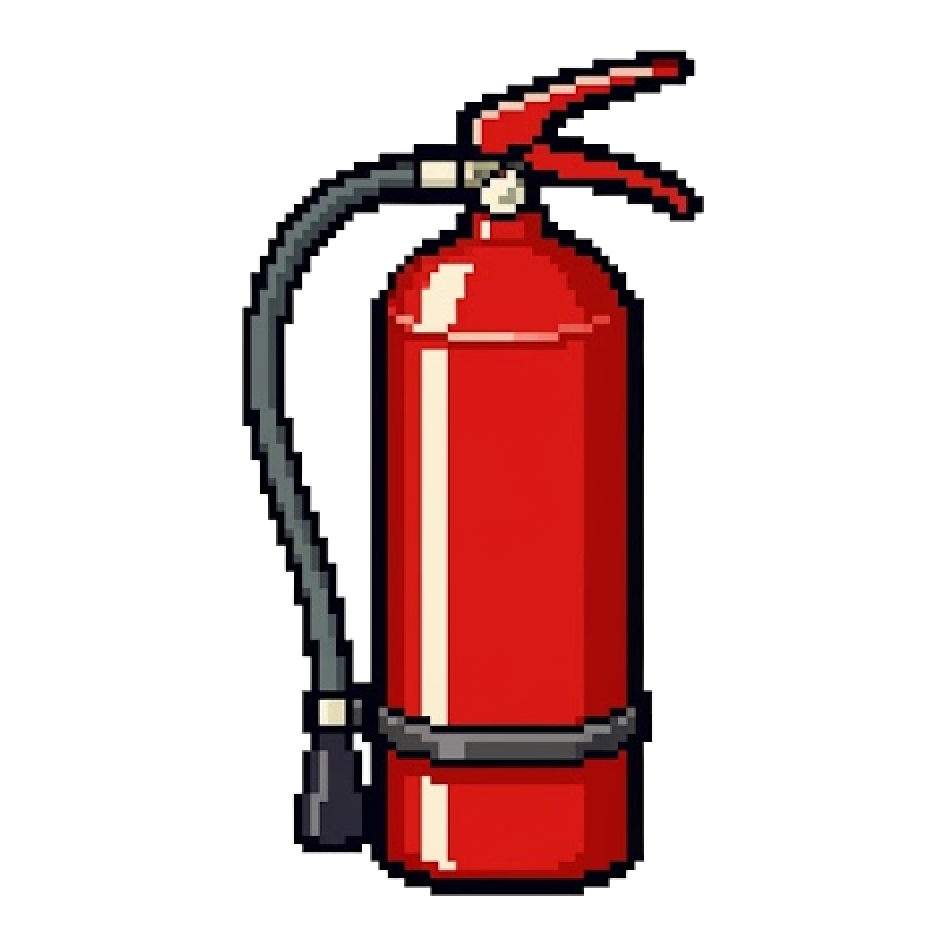
Disaster preventionA tool for first-stage firefighting (putting out a fire while it is still small)Kept in homes, schools, shops and more
A fire extinguisher is a tool for putting out a fire while it is still small. You pull the pin, point the hose at the base of the fire, and squeeze the lever. It has a use-by period, so checking it matters too.
Key facts
| Type | A disaster-prevention item. A tool for "first-stage firefighting," which means putting out a fire while it is still small |
|---|---|
| Role | To put out a small fire just as it starts, and stop it from growing into a big one |
| Kinds | There are commercial ones and home ones. For homes, an ABC powder extinguisher, which works on many kinds of fires, is said to be a good choice (according to Japan's Fire and Disaster Management Agency). |
| Basic way to use it | Pull the pin → point the hose at the fire → squeeze the lever (3 steps) |
| Use-by period (as of 2026) | Roughly 5 years for home ones and roughly 10 years for commercial ones (some guides say 8 to 10 years for commercial ones). The year of manufacture and the deadline are printed on the body. |
| Beginnings and history | The first fire extinguisher to come to Japan is said to be one shown from the United States at the Saikyo Exposition (in Kyoto) in 1872 (Meiji 5). The first one made and sold in Japan is said to be an acid-and-soda type (a type that mixes liquids to push out the spray) from around 1895. Sources explain this in different ways, so accounts differ. |
| Throwing it away | It cannot be put out with ordinary trash. Ask the shop where you bought it or a recycling service desk (a fee is charged). |
What is it?
A fire extinguisher is a tool for putting out a fire while it is still small, when a fire breaks out. Putting it out at this early stage is called "first-stage firefighting."
They are kept in many places, such as homes, schools, shops, buildings and parking lots. Red cylinders are the kind you often see. Inside is a substance that puts out fire (extinguishing agent). It shoots out with force when you squeeze the lever.
The important thing is that it is not meant for big fires. If the fire has spread to the ceiling, do not try to put it out. Run away right away.
Kinds and how they work
Fire extinguishers come in commercial and home types. Home types are small and light, and easy to use. But they hold less of the agent, so they suit fires that are still small.
There are several kinds of extinguishing agent. Some are powders, some are water-based, and some are gases. For homes, ABC powder extinguishers are said to be a good choice because they work on many kinds of fires.
There are ordinary fires (wood, paper and so on), oil fires and electrical fires. An extinguisher has picture symbols showing which fires it can be used on. Before using one, read the marks on the body and check. A fire put out with powder can sometimes start burning again. So it is important to spray all of the agent and then keep watching the fire.
How to use it
The basic way to use it is three steps.
1. Pull out the yellow safety pin.
2. Take off the hose and point its end at the fire.
3. Squeeze the lever hard.
Aim at the base of the fire, and sweep the spray from the near side, like sweeping with a broom. Outdoors, use it from upwind (the side the wind comes from). The spray lasts only a short time, and some sources say about ten-odd seconds. So get close to the fire first, and then start spraying. The body says how long it sprays and how far it reaches, so take a look at it ahead of time.
It is also important to decide your escape route first. If you feel it is dangerous, run away at once and call 119. There may also be training sessions where you can try it. For details, please check with a public office such as the fire station in your area.
History
In Japan, long ago, people used a pump-like tool that threw water by human power. It was called a "ryudosui."
According to materials from the Tokyo Fire Department, the first fire extinguisher to come to Japan was one shown from the United States at the Saikyo Exposition held in Kyoto in 1872 (Meiji 5). The first extinguisher made and sold in Japan is said to be an acid-and-soda type from around 1895. (This is a type that mixes liquids and uses their force to spray.) But some people think extinguishers were being made even before that. Sources explain it in different ways, so accounts differ.
After that, more kinds appeared, such as foam and powder types. Around 1965, ABC powder extinguishers began to be sold by many companies. They are said to be still widely used today.
Checking it, and when it gets old
A fire extinguisher has a period in which it can be used. As of 2026, it is roughly 5 years for home ones and roughly 10 years for commercial ones. Check the year of manufacture and the deadline on the label on the body. Home ones are built so that the agent cannot be refilled.
It is said to be good to look at it now and then, even before the deadline. Look at the safety pin, the lever, the pressure gauge (a dial that shows the pressure inside), and any dents or rust on the body. If it has rust or dents, replace it even if it is within its period.
Also, extinguishers made under the old rules (ones whose label for the fires they suit is in words only) can no longer be installed from 2022 on, and need to be replaced.
An old extinguisher cannot be put out with ordinary trash. Do not take it apart or empty it yourself, either. Ask the shop where you bought it or a recycling service desk. It may cost money. For details, please check with a public desk such as the Fire Extinguisher Recycling Promotion Center.
About this illustration
A pixel-art picture of a red fire extinguisher. It can be used as an image for a town background or for disaster-prevention notices. The colors and shapes are the artist's own style and differ in places from the real thing. The small parts and decorations in the picture are also the artist's own style and differ from the real thing.
Fun facts
- A fire extinguisher cannot be put out as ordinary trash. The rule is to ask the shop where you bought it or a recycling service desk.
- In a survey by the Japan Fire Extinguisher Association and others, about 1 in 4 (26%) of the extinguishers in homes were more than 10 years past manufacture.
- Long ago in Japan, a tool called a "ryudosui," which threw water by human power, was used against fires.
Quick quiz
Q. Which is the correct order for the basic way to use a fire extinguisher?
First pull out the yellow safety pin, point the hose at the fire, and last squeeze the lever. The key is to aim at the base of the fire.
References
- 消防庁「消防防災・震災対策 e-カレッジ」初期消火・消火器のページ (Fire and Disaster Management Agency: kinds, use and checking of fire extinguishers)
- 東京消防庁の消火器に関する案内資料 (Tokyo Fire Department guide: how extinguishers came to Japan, the start of domestic making, handling of home extinguishers)
- 一般社団法人日本消火器工業会/消火器リサイクル推進センターの案内 (Japan Fire Extinguisher Association / Fire Extinguisher Recycling Promotion Center guides: use-by guidelines, replacing old-standard extinguishers, disposal and recycling desks)
- 長崎市・名古屋市などの自治体の消火器の案内 (Guides from city governments such as Nagasaki and Nagoya: use-by periods for home and commercial ones, how to dispose of them)
- Impress Watch(家電Watch)「家庭内の消火器の保有実態に関する全国調査」の記事 (Article on a nationwide survey of extinguishers kept in homes: shares by year of manufacture)
Accounts may differ between sources and regions, and facts or figures can change with new research or rules. This page was translated from the Japanese original.
Download the pixel art
- Free
- No registration
- Commercial use OK
- Edits OK
- Credit optional
- No usage report needed
Please read the terms of use before using it.