



Science Encyclopedia No.010
Earth
The Solar SystemA rocky planet (terrestrial planet)A planet of oceans and living things
Earth is the third planet from the Sun, and it is where we live. About 70% of its surface is covered with water, mostly ocean. Because it has air and water, many living things live here.
Key facts
| Category | A planet of the Solar System (a rocky, terrestrial planet) |
|---|---|
| How it works (in a word) | It is at a good distance from the Sun, and it has air and oceans of water, so living things can live here. |
| Equatorial radius | About 6,378 km (the radius in the direction joining the North and South Poles, called the polar radius, is about 6,357 km) |
| Average distance from the Sun | About 150 million km (this is called 1 astronomical unit) |
| Orbital period (time to go around the Sun once) | About 365.26 days |
| Rotation period (time to spin once) | About 23 hours 56 minutes (one spin relative to the stars). A day relative to the Sun is about 24 hours on average. |
| Tilt of the axis (the line it spins around) | About 23.4 degrees |
| Share of the surface covered by water | About 70% (about 71%). Most of it is ocean. |
| Makeup of air (dry atmosphere) | By volume, about 78% nitrogen and about 21% oxygen |
| Age | About 4.6 billion years (an estimate, a rough figure) |
| Moons | One Moon |
What kind of planet is it?
Earth is the third planet from the Sun among the eight planets that go around it. It is made of rock, and its shape is nearly a ball. But it bulges out a little at the sides. The radius at the equator (the line that goes all the way around the middle of Earth) is about 6,378 km. The radius in the direction joining the North and South Poles is about 6,357 km.
About 70% of the surface is covered with water, and most of it is ocean. Seen from space, Earth looks blue, so it is also called the "water planet." It is surrounded by air (the atmosphere). It has one moon (a moon is a small body that goes around a planet), which is called the Moon.
Days, years and seasons
Earth spins around once a day. This is called rotation. A day relative to the Sun is about 24 hours on average.
Earth also goes around the Sun once in about 365.26 days. This is called revolution. A year is counted as 365 days, but it is not exactly 365 days. It is about 6 hours longer. So about once every 4 years, we make a year with 366 days (a leap year) to fix the gap.
Earth's axis (the line it spins around) is tilted about 23.4 degrees from the surface it travels along around the Sun. Because of this, the way sunlight hits Earth changes through the year. This creates the seasons: spring, summer, autumn and winter.
A planet with water and air
About 70% of Earth's surface is covered with water. Most of Earth's water is seawater, said to be about 96.5% of the total.
By volume, air is about 78% nitrogen and about 21% oxygen. The rest holds just small amounts of argon, carbon dioxide and other gases. Having oxygen for us to breathe, and a temperature where water can stay liquid, are two of the key reasons living things can live here.
Inside the Earth
The inside of Earth is thought to be divided into several layers. The outer part is made of rock: the crust and the mantle (a thick layer of rock under the crust). At the center is a core made of metals such as iron.
The ground (the crust) is not one single sheet. It is split into big slabs of rock called plates, and they move slowly. It is said that earthquakes and volcanoes are common in certain places because of the movement of these plates.
The history of Earth
Earth is thought to have been born about 4.6 billion years ago. This age was estimated by studying materials in old meteorites (rocks that fall from space). The oldest rocks found on Earth are said to be about 4 billion years old (accounts differ).
There was a time when people thought the ground was flat. But people came to know that Earth is round. For example, when a ship moves away, its hull disappears first. Also, during a lunar eclipse (when the Moon moves into Earth's shadow), the shadow of Earth on the Moon is round. Today, we can see Earth's round blue shape in photos from satellites and from space.
About this illustration
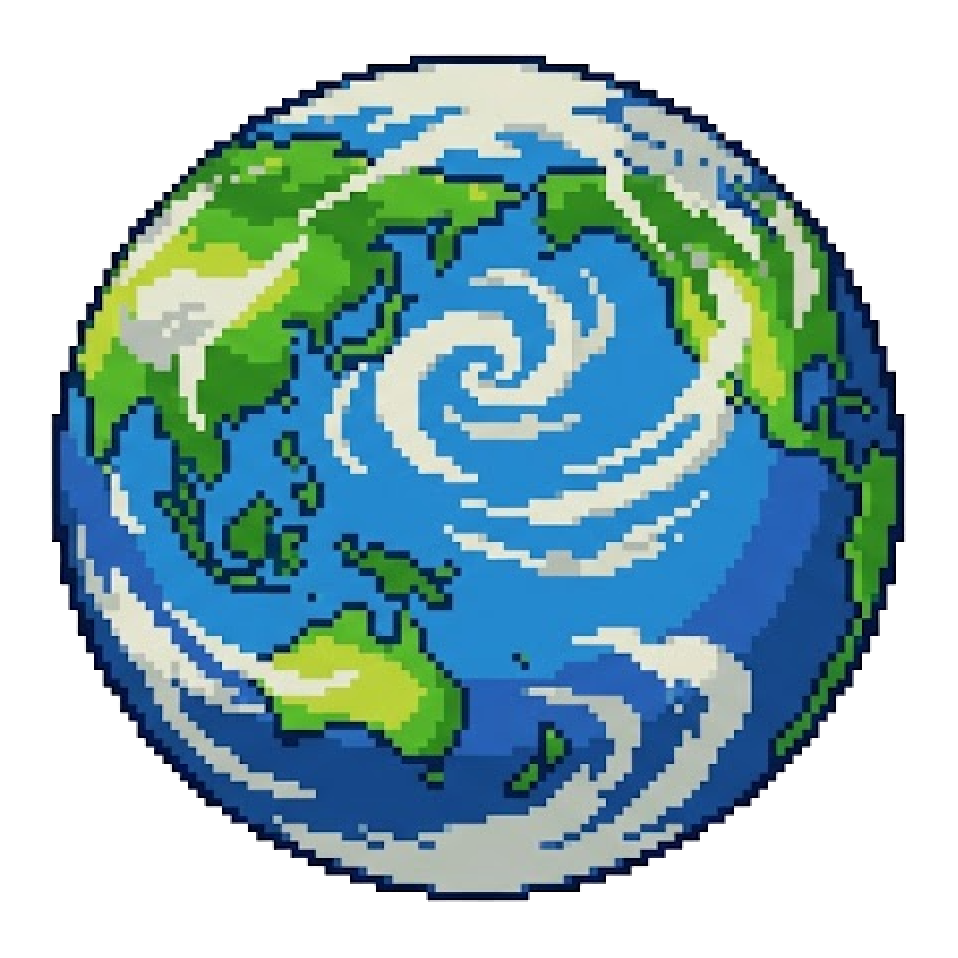
A pixel-art picture of Earth, with blue oceans, green continents and white clouds. On a round planet, the seas, land and clouds are shown with tiny squares. It does not copy the real shapes of the continents or the positions of the clouds. It is a simplified illustration.
Fun facts
- Earth bulges out a little at the sides. Its radius at the equator is about 21 km longer than its radius in the direction joining the North and South Poles.
- A day on Earth relative to the Sun is about 24 hours on average. But one spin relative to the stars takes about 23 hours 56 minutes.
- About 96.5% of the water on Earth is said to be seawater (salt water).
Quick quiz
Q. Which statement about Earth is correct?
About 70% of Earth's surface is covered with water, and most of it is ocean. Earth is the third planet from the Sun, and it has one moon.
References
- NASA "Earth Fact Sheet" (supports basic data such as radius, orbit, rotation and axis tilt)
- NASA Science "Earth Facts" (supports explanations of Earth's size, distance from the Sun and atmosphere)
- USGS (United States Geological Survey) "How much water is there on Earth?" (supports the share of the surface covered by water and the share that is seawater)
- USGS "Age of the Earth" (supports Earth's age, found from meteorites and other evidence)
- 国立天文台『暦Wiki』『理科年表』 (National Astronomical Observatory of Japan, "Reki Wiki" and "Rika Nenpyo" almanac: support basic data on Earth's radius, orbit and rotation)
- 『日本大百科全書』『世界大百科事典』 (Japanese encyclopedias: support Earth's age and inner structure)
Accounts may differ between sources and regions, and facts or figures can change with new research or rules. This page was translated from the Japanese original.
Download the pixel art
- Free
- No registration
- Commercial use OK
- Edits OK
- Credit optional
- No usage report needed
Please read the terms of use before using it.