



Science Encyclopedia No.007
Cloud
WeatherHow the air worksThe water cycle
A cloud is a group of tiny water drops or ice grains floating in the sky. Clouds are sorted into 10 kinds by height and shape. Some of them bring rain or snow.
Key facts
| Category | Water vapor in the air that has cooled and gathered as tiny water drops or ice grains |
|---|---|
| How it works (in short) | When air rises and cools, the water vapor turns into water drops or ice grains and becomes visible |
| Familiar examples | Cumulus ("cotton clouds"), cirrus ("streak clouds"), cumulonimbus ("thunderheads"), and so on |
| How clouds are sorted | By the height where they are (high, middle, low) and by their shape and how they grow |
| Number of kinds | By international rules, there are 10 basic forms (the ten cloud genera) |
| History of the names | In the early 1800s, Luke Howard of Britain thought up a way to sort clouds using Latin names |
| Rough heights | Low clouds are below 2 km, middle clouds are about 2 to 7 km, and high clouds are about 5 to 13 km (this differs a little by source) |
| Clouds that bring rain or snow | Mainly nimbostratus ("rain clouds") and cumulonimbus ("thunderheads") |
What is a cloud?
A cloud is a white or gray mass floating in the sky. Inside, it is made of very small water drops or ice grains. The grains are so small and light that they seem to float in the sky.
Water can change form into water vapor, which is water as a gas you cannot see. Water vapor is mixed into the air. When this water vapor cools, it turns into water drops. When the drops gather and become visible, we call it a cloud.
When the grains in a cloud grow bigger, they fall to the ground as rain or snow.
How is a cloud made?
For a cloud to form, it is important that air rises. In the sky, up to about 10 km above the ground, the higher you go, the colder it gets. When air goes up, the air pressure around it (the force of the air pushing) gets lower. The air spreads out, and its temperature drops.
When air cools, the amount of water vapor it can hold gets smaller. The vapor that the air can no longer hold turns into water drops, forming around tiny bits of dust in the air. High in the very cold sky, the water drops turn into ice grains.
There are several reasons why air rises. The sun may warm the ground. Air may hit a mountain. Cold air and warm air may meet. These are some examples.
The ten cloud genera (jisshu-unkei)
Clouds are sorted into 10 kinds by height and shape. The Japan Meteorological Agency also uses this system for its observations.
The high level (high sky) has cirrus ("streak clouds"), cirrocumulus ("scale clouds") and cirrostratus ("thin veil clouds"). The middle level has altocumulus ("sheep clouds"), altostratus ("hazy clouds") and nimbostratus ("rain clouds"). The low level has stratocumulus ("rolling clouds"), stratus ("fog clouds"), cumulus ("cotton clouds") and cumulonimbus ("thunderheads").
Cumulus and cumulonimbus form when air rises strongly. They grow big, tall and upright. Their bottoms are in the low level, but their tops can reach very high. Most other clouds spread out thin and wide. The numbers for heights differ a little by source, so think of them as rough guides.
History of the names
The first person to put the sorting of clouds in order was Luke Howard, a British pharmacist who also studied the weather. He is said to have come up with it and announced it in 1802, and to have written it up in 1803. Sources say either 1802 or 1803.
Howard sorted the basic cloud shapes into three. He also gave a name to clouds that bring rain. "Cirrus" comes from a Latin word meaning "a curl of hair." "Cumulus" comes from a Latin word meaning "a heap or pile." "Stratus" comes from a Latin word meaning "a spread-out layer."
These were combined to make names like cirrostratus and stratocumulus. "Nimbus" means a cloud that brings rain. This idea is still used around the world today, and the World Meteorological Organization (an international group that studies the weather) has gathered the clouds into 10 kinds.
Clouds in everyday life
Looking at clouds can sometimes give you a hint about changes in the weather. For example, when thin clouds spread high in the sky and you see a ring of light around the sun, clouds are coming to cover the sky.
In a summer afternoon, a tall, towering cumulonimbus can grow. It can bring thunder and heavy rain. If you see one, be careful about safety, for example by going inside a building.
Fog is like a cloud that touches the ground. When you climb a mountain, you may walk into a cloud, and it can look like fog.
About this illustration
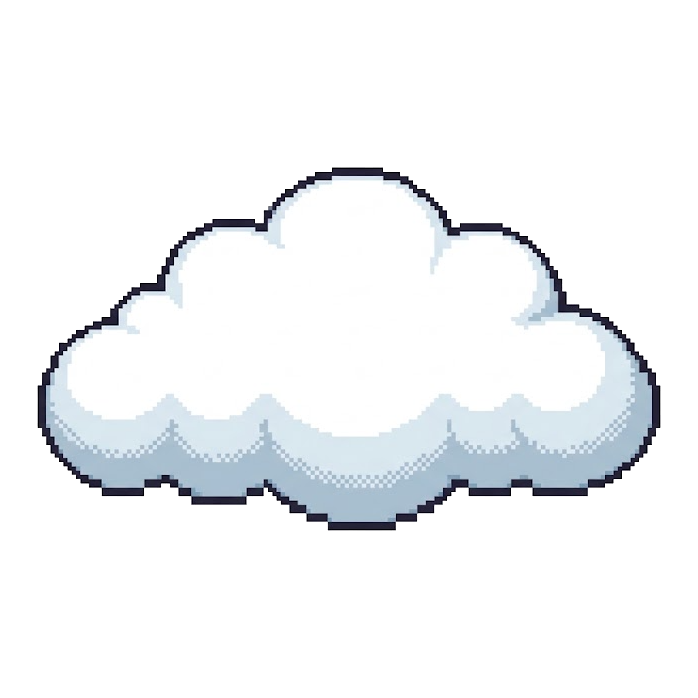
This is a picture of a white, fluffy cloud made of dots (small squares). It can be used to show the weather. The round, heaped shape, like a cotton cloud, is shown with dots. Because the number of colors is kept small, it differs from the fine shapes and shadows of a real cloud. That is part of the illustration's style.
Fun facts
- A cloud is a group of water drops, so it looks like it floats in the sky, but each single drop is very small.
- In Japan, clouds have many nicknames based on how they look, such as "sheep clouds," "scale clouds" and "thunderheads."
- Fog is said to be like a cloud that forms on the ground or on the sea.
Quick quiz
Q. Which statement about clouds is correct?
A cloud is a group of tiny water drops or ice grains, made when water vapor in the air cools. Clouds are sorted into 10 kinds by height and shape.
References
- 気象庁(札幌管区気象台)『いろいろな雲』 (Japan Meteorological Agency, Sapporo; supports the ten cloud genera and cloud names)
- 気象庁(沖縄気象台)『雲の観測』 (Japan Meteorological Agency, Okinawa; supports cloud observation and the sorting into 10 kinds)
- Met Office (UK), 『Cloud names and classifications』 (supports Luke Howard's system and the meaning of the Latin names)
- Royal Meteorological Society, 『Cloud types』 (supports cloud names and how clouds are sorted)
Accounts may differ between sources and regions, and facts or figures can change with new research or rules. This page was translated from the Japanese original.
Download the pixel art
- Free
- No registration
- Commercial use OK
- Edits OK
- Credit optional
- No usage report needed
Please read the terms of use before using it.