



Monster Encyclopedia No.018
Yamata no Orochi
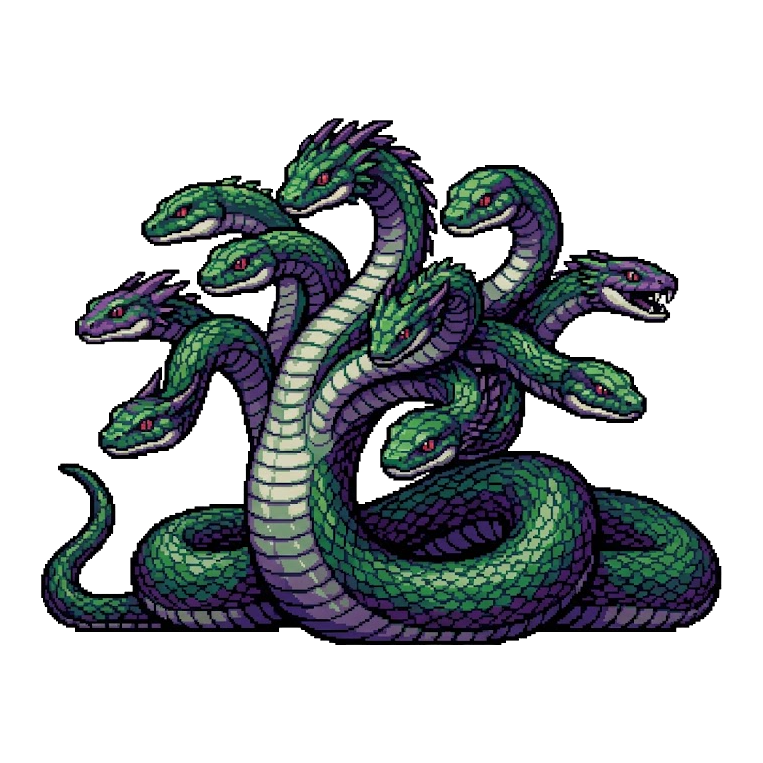
JapanMonster of Japanese myth (giant serpent)Izumo myths
In Japanese myth, Yamata no Orochi is a huge snake with eight heads and eight tails. The god Susanoo defeats it, and the story says the Kusanagi sword (one of the Three Sacred Treasures) was found in its tail.
Key facts
| Type | Monster of Japanese myth (giant serpent) |
|---|---|
| Where and which culture | Japan. The story is set in Izumo Province (now eastern Shimane Prefecture). |
| Earliest records | The Kojiki (712) and the Nihon Shoki (720) |
| Different spellings | The two books write the name with different Chinese characters. |
| Other names | The Kojiki also calls it "Koshi no Yamata no Orochi." "Koshi" is said to be an old place name for the Hokuriku area. |
| Appearance | It has eight heads and eight tails. Its body is so long that it stretches across eight valleys and eight hills. Moss and trees are also said to grow on its body (Kojiki). |
| Who defeated it | Susanoo. He later became the husband of Kushinada-hime. |
| Meaning of the name | "Yamata" is said to mean "split into eight." "Orochi" is said to be an old word for a big snake or monster. The exact origin of the name is not clear (accounts differ). |
What kind of monster is it?
Yamata no Orochi is the most famous giant serpent in Japan. It has eight heads and eight tails, and its body is huge. The Kojiki says moss, cypress trees and cedar trees grow on it, and that it is long enough to stretch across eight valleys and eight hills.
In the story, it comes to the village in Izumo every year and eats a girl from that land.
In the myth, part 1: Susanoo and Kushinada-hime
Susanoo was driven out of Takamagahara (the heavenly world where the gods live) and came down to the land of Izumo. By a river, he met an old couple, Ashinazuchi and Tenazuchi, and their daughter Kushinada-hime. They were all crying.
The couple had eight daughters. Every year the serpent ate one of them, and now only the last daughter was left. Susanoo promised, "If you give me that girl as my wife, I will defeat the serpent." (According to the Kojiki and the Nihon Shoki.)
In the myth, part 2: defeating the serpent
The Kojiki says Susanoo changed Kushinada-hime into a comb (a tool for holding hair) and put it in his own hair. Then he had the old couple prepare strong rice wine. He had them build a fence with eight gates and place eight tubs of wine inside it.
When the serpent came, it put each of its eight heads into a tub and drank the wine. It got drunk and fell asleep. Then Susanoo defeated it. (According to the Kojiki. The Nihon Shoki differs in some details.)
In the myth, part 3: the sword from the tail
The story says that when Susanoo cut into the serpent's tail, a splendid sword came out. He thought it was wonderful and offered it to Amaterasu (the sun goddess). The Kojiki gives the sword a name that is read "Kusanagi no Tachi," and it later came to be called Kusanagi no Tsurugi. In the Nihon Shoki, the main text says Kusanagi no Tsurugi. A note that records a different tradition also gives the name "Ame no Murakumo no Tsurugi."
The Kusanagi sword is counted as one of the Three Sacred Treasures (three treasures handed down in the imperial family), along with a mirror and a curved jewel called a magatama. It is said to be enshrined at Atsuta Shrine in Nagoya. The real object is not shown to the public.
In the myth, part 4: Susanoo afterward
The Kojiki says that after the fight, Susanoo built a palace at a place called Suga in Izumo and lived there with Kushinada-hime. He is said to have made a poem then. In romanized Japanese it begins "Yakumo tatsu, Izumo yaegaki..." It is sometimes called the first waka poem in Japan. (A waka is a traditional Japanese poem.)
What might it stand for?
People have long wondered what the serpent really was. A famous idea is that it stands for floods of the Hii River in Izumo, when the river water overflows. In this view, the eight heads and tails match how the river splits into many streams.
There are other ideas, such as a link to ironmaking. None of them is certain. Accounts differ.
How it is usually shown in games and stories
A big snake with eight heads often appears as a boss or a strong enemy in stories and games with a Japanese feel. Because it has eight heads, it is sometimes used in scenes where you defeat the heads one by one.
About this illustration
This is a pixel-art picture (a picture drawn with tiny square dots) of a giant serpent with eight heads. It has the feel of a boss in a Japanese-style story. The colors and small decorations are not written in the myth itself. They are the picture's own style, different from the real thing or the old stories.
Fun facts
- The Kojiki was completed in 712 and the Nihon Shoki in 720. They are very old history books of Japan.
- The Kusanagi sword is one of the Three Sacred Treasures. It is said to be enshrined at Atsuta Shrine (Aichi Prefecture).
- The story of Yamata no Orochi is sometimes linked to the Hii River, a real river (this is one idea).
Quick quiz
Q. Which sword is said to have come out of the tail of Yamata no Orochi?
The sword Susanoo found in the serpent's tail is said to be the Kusanagi sword. The Kojiki gives it a name read "Kusanagi no Tachi," and a note in the Nihon Shoki also calls it "Ame no Murakumo no Tsurugi." It became one of the Three Sacred Treasures.
References
- 『古事記』上巻(712年。八俣遠呂智の話、八塩折の酒、草那藝之大刀)— Kojiki, first volume (712): the Orochi story, the strong wine, and the sword.
- 『日本書紀』神代上(720年。八岐大蛇、草薙剣と、注にある天叢雲剣の別伝)— Nihon Shoki, Age of the Gods, first part (720): the Orochi, the Kusanagi sword, and the note with another tradition of the Ame no Murakumo sword.
- 熱田神宮の公式案内 — Official guide of Atsuta Shrine: explains it as the shrine that enshrines the sacred Kusanagi sword.
- 國學院大學デジタル・ミュージアム「神道事典」— Kokugakuin University Digital Museum, "Shinto Encyclopedia": entries on Yamata no Orochi and the Kusanagi sword.
- 『日本古典文学大系 日本書紀』『新編日本古典文学全集 古事記』— Nihon Koten Bungaku Taikei: Nihon Shoki, and Shinpen Nihon Koten Bungaku Zenshu: Kojiki: original texts with notes.
Accounts may differ between sources and regions, and facts or figures can change with new research or rules. This page was translated from the Japanese original.
Download the pixel art
- Free
- No registration
- Commercial use OK
- Edits OK
- Credit optional
- No usage report needed
Please read the terms of use before using it.