



Monster Encyclopedia No.004
Minotaur
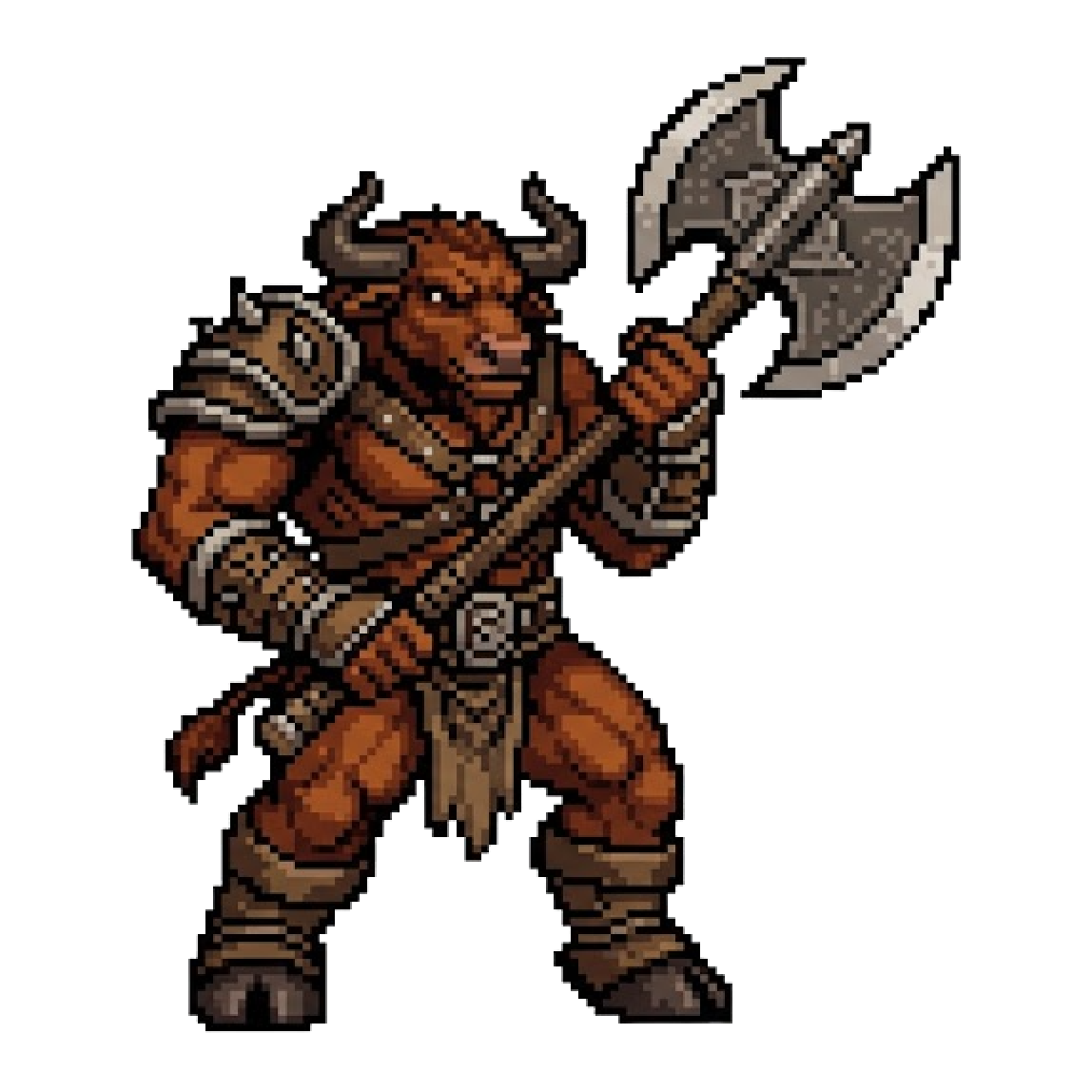
Ancient GreeceA monster of Greek mythLord of the labyrinth on Crete
A monster from Greek myth with a bull's head and a human body. It is told that it was shut up in the labyrinth on the island of Crete and was killed by the hero Theseus.
Key facts
| Type | A monster of Greek myth (half man, half bull) |
|---|---|
| Where and which cultures | Ancient Greece and ancient Rome. The story is set on the island of Crete. |
| Main sources | Well-known written versions include Ovid's "Metamorphoses" (about the year 8 CE), Plutarch's "Lives" (about the 1st to 2nd century CE) and Apollodorus's "Bibliotheca." In pictures, scenes of Theseus and the Minotaur are said to appear on pots and metal plates from about the 7th century BCE (accounts differ on which is the oldest). |
| Family and ties | Its mother was Pasiphae, wife of King Minos of Crete. Its father is said to be a bull sent by the sea god Poseidon (the Cretan Bull). |
| Appearance | It has a bull's head and a human body. It is usually drawn with a bull's head and tail on a human body. |
| Origin of the name | The name is said to mean "bull of Minos" (a joining of Minos and the Greek word "tauros," meaning bull). On Crete, it is also said to have been called "Asterion" (or "Asterios"). |
| Home | A labyrinth with no way out, said to have been built by the master craftsman Daedalus. |
What Kind of Monster Is It?
The Minotaur is a monster with a bull's head and a human body. It is told that it was shut up in King Minos's labyrinth on Crete and lived there.
Its name is said to mean "bull of Minos." It is also said to have been called "Asterion." It is often told as a monster that fed on the young people sent from Athens into the labyrinth.
Myth and Legend 1: Its Birth and the Labyrinth
It is said that King Minos kept a fine bull sent by the sea god Poseidon instead of offering it to the god. Angry, Poseidon made Queen Pasiphae fall in love with the bull. The Minotaur was born from this.
This story is also told in works from Roman times. King Minos ordered the master craftsman Daedalus to build a labyrinth, and he shut the Minotaur inside it. The labyrinth is said to have been so twisting that no one who went in could get out.
Myth and Legend 2: Theseus Kills the Minotaur
It is told that after King Minos beat Athens in war, he ordered Athens to hand over young people. A well-known version says seven boys and seven girls were sent every nine years (this is from Plutarch and others; some tales say every year, and the details differ a little by source).
The Athenian hero Theseus volunteered and went to Crete. Ariadne, King Minos's daughter, is said to have given Theseus a ball of thread to mark his way back out of the labyrinth. Theseus killed the Minotaur and followed the thread safely outside. The tales differ in how he did it: some say he killed the Minotaur with his bare hands, others that he used a club or a sword.
Was the Labyrinth Real?
The Palace of Knossos on Crete was a large palace of the Minoan civilization, which flourished from about 2000 BCE. It has very many rooms and corridors and looks like a maze. For this reason, people have long thought it may have been the source of the labyrinth story. The British archaeologist Arthur Evans, who excavated it, is also known for linking this palace with the labyrinth.
But this is not a firm theory, and opinions are divided. The labyrinth of the myth itself has not been found. No Minotaur bones have been found either. Some say the word "labyrinth" is related to "labrys" (a double-headed axe), but this is not certain (accounts differ).
How Minotaur-Like Monsters Are Usually Shown in Games and Stories
Large bull-headed monsters often appear in stories and games as tough enemies deep inside a labyrinth or dungeon. They are sometimes drawn as very strong and swinging heavy weapons. However, in the old myths, there is no clearly known story of the Minotaur holding an axe.
About this illustration
This is a pixel-art picture of a bull-headed Minotaur holding a big axe. It is a strong figure that suits a tough enemy in a labyrinth. The basic look of a bull's head on a human body follows the myth. The big axe, however, is the artist's own idea. It is not in real life or the old myths. In the old myths, the Minotaur is almost never told of as holding a weapon.
Fun facts
- The name Minotaur is said to join "Minos" (a king's name) and "tauros" (bull).
- The Palace of Knossos on Crete has been excavated since 1900 by Evans of Britain. People often talk about how it relates to the labyrinth story.
- Scenes of Theseus and the Minotaur are said to appear in art from about the 7th century BCE, which shows the tale was told from very long ago.
Quick quiz
Q. Which hero killed the Minotaur?
The Athenian hero Theseus is said to have killed the Minotaur in the labyrinth on Crete. It is told that he found his way out by following the ball of thread given to him by Ariadne, King Minos's daughter.
References
- Ovid, "Metamorphoses," Book 8 (supports the Minotaur's labyrinth and Ariadne's thread)
- Plutarch, "Lives," "Life of Theseus" (supports the Athenian hostages and Theseus's victory)
- Apollodorus, "Bibliotheca" (Greek mythology; supports the Minotaur's birth and Daedalus's labyrinth)
- Theoi Greek Mythology, "Minotauros" (a guide gathering ancient texts)
- World History Encyclopedia, "Minotaur" (supports the link between the myth and the Palace of Knossos)
Accounts may differ between sources and regions, and facts or figures can change with new research or rules. This page was translated from the Japanese original.
Download the pixel art
- Free
- No registration
- Commercial use OK
- Edits OK
- Credit optional
- No usage report needed
Please read the terms of use before using it.