



Food Encyclopedia No.012
Onigiri (Rice Ball)
A rice dishEasy to carryA Japanese classic
Onigiri is a classic Japanese food made by pressing rice together with your hands. A lump of rice thought to be an onigiri was found at a Yayoi period site in Ishikawa Prefecture. The fillings and shapes differ from region to region and from home to home.
Key facts
| Category | A dish made by pressing rice together by hand. It is also called "omusubi." |
|---|---|
| Main ingredients | Rice, salt, nori (seaweed pressed into thin sheets and dried), and a filling (such as pickled plum, salmon, or kelp) |
| Old clues | At the Sugiya Chanobatake site in Ishikawa Prefecture (a Yayoi period site, from a time centered around about 2,000 years ago), a "chimaki-shaped charred rice lump" was found. It was steamed rice that had turned black, like charcoal. There is a view that it was an onigiri (this is not certain). |
| Example in old writings | In the Heian period book "The Tale of Genji," a food called "tonjiki" appears. Some see it as the ancestor of onigiri, but this is debated. |
| Wrapping with nori | It is said that in the Edo period, the form close to today's, wrapped in nori, became widespread. |
| Regional differences in shape | It is sometimes said that triangles are common in the Kanto area and barrel (tawara) shapes are common in the Kansai area. Today, many people everywhere picture a triangle. |
| Special day | June 18 is "Onigiri Day." It is said to have been set by Nakanoto Town (formerly Kashika Town) in Ishikawa Prefecture to help revitalize the local area. |
| Preventing food poisoning | Wash your hands before making it. Do not shape it with bare hands. Use plastic wrap or disposable gloves. Eat it soon after making it, and do not eat onigiri that has been left at room temperature for a long time. |
What kind of food is it?
Onigiri is food made by pressing rice together with your hands. It is also called "omusubi." The triangle is the best-known shape, but there are also round ones and barrel-shaped (tawara) ones.
Common fillings are pickled plum, salmon, kelp, and dried bonito flakes. Nori is often wrapped around the outside, and its smell goes well with the rice.
You can hold it and eat it with your hands. You do not need chopsticks or a spoon. So it has been loved for a long time on school trips, in lunch boxes, and during work outdoors.
History and origins
There are many accounts of how onigiri began. At the Sugiya Chanobatake site in Ishikawa Prefecture (a place where traces of people's lives long ago were found), a black, charred, cone-shaped lump was found in 1987. It dates from the Yayoi period (a time centered around about 2,000 years ago). It is thought to be steamed rice that had been pressed together, and it is called a "chimaki-shaped charred rice lump." "Charred" here means that over a very long time it turned black, like charcoal. Some people introduce it as the oldest onigiri in Japan, but this is not a settled view.
In "The Tale of Genji," from the Heian period (about 1,000 years ago), a food called "tonjiki" appears. Some people think it was the food that onigiri came from. However, researchers disagree about it.
In the Edo period, the form wrapped in nori spread, and it came to be used in ordinary people's lunches too. A book from the late Edo period, "Morisada Manko," lists ten round, flat rice balls as a "makunouchi" meal that people ate while watching a play in Edo.
"Onigiri" and "omusubi"
One explanation says the word omusubi came from words used by women who served at the imperial court. Others point to the idea of "tying a bond with the gods." Accounts differ about where the word came from.
As for shape, it is sometimes said that triangles are common in the Kanto area and barrel shapes are common in the Kansai area. But this is only a rough guide, and it also differs from home to home and shop to shop. Today, partly because of the onigiri sold in stores, many people picture a triangle.
Tips for making tasty onigiri
Rice is easier to shape while it is still warm. But do not touch it directly with your hands. If you use plastic wrap, you can keep dirt from your hands and germs (tiny living things too small to see) off the rice.
Put a little salt on your palm and rub it onto the rice. If you squeeze too hard, the rice becomes hard. The trick is to press it softly, but firmly enough that it does not fall apart.
If you wrap the nori just before eating, it stays crisp. If you like it soft and moist, wrap it first.
Be careful about food poisoning
Depending on how it is made and stored, onigiri can cause food poisoning (an upset stomach caused by germs or other things on food). The Ministry of Agriculture, Forestry and Fisheries reports a case in an evacuation shelter where onigiri that was not handled carefully enough caused food poisoning from Staphylococcus aureus (a kind of germ).
The tips given for prevention are to wash your hands with soap and running water before making it, and not to shape it with bare hands, but to use plastic wrap or disposable gloves. People who feel sick or have a cut on the hand should not prepare food.
Also, eat it as soon as you can after making it, and do not eat onigiri that has been left at room temperature (the temperature of a room) for a long time. When you carry it, let it cool before wrapping it. In hot weather, it is safer to use a cooler bag with an ice pack.
About this illustration
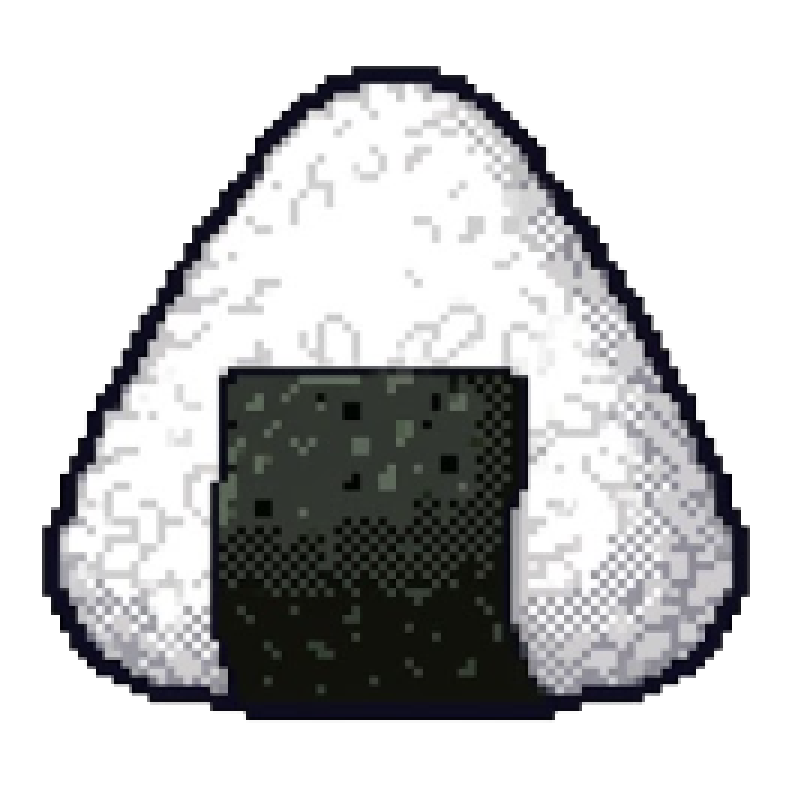
This is a pixel-art picture (made of tiny square dots) of a triangle-shaped onigiri wrapped in nori. The mix of white rice and black nori is its main feature. The colors and the small details of the shape are the artist's own way of drawing, and they are different from the real thing.
Fun facts
- June 18 is "Onigiri Day." It is said to have been set by Nakanoto Town (formerly Kashika Town) in Ishikawa Prefecture to help revitalize the local area. It is said that the date comes from the "roku" (6) in "Kashika" (the old name is read "Rokusei" in another way) and from the "Rice-Eating Day," which falls on the 18th of every month.
- January 17 is a separate special day called "Omusubi Day." It is said to have been set so that people will remember how onigiri given out at emergency meal services helped many people.
- The late Edo period book "Morisada Manko" lists ten round, flat rice balls as a "makunouchi" meal.
Quick quiz
Q. Which is correct for preventing food poisoning when making onigiri?
The Ministry of Agriculture, Forestry and Fisheries advises washing your hands before making onigiri, not shaping it with bare hands but using plastic wrap or disposable gloves, and not eating onigiri that has been left at room temperature for a long time.
References
- 農林水産省「災害時の食中毒」https://www.maff.go.jp/j/syouan/saigai_syokutyuudoku.html (Ministry of Agriculture, Forestry and Fisheries: food poisoning from onigiri and how to prevent it)
- 奈良文化財研究所「全国遺跡報告総覧」https://sitereports.nabunken.go.jp/ (National Institute for Cultural Properties, Nara: reports on the Sugiya Chanobatake site in Ishikawa Prefecture, and on onigiri-like charred rice and tonjiki)
- 喜田川守貞『守貞謾稿』 (a book describing life in the late Edo period; the makunouchi entry in the section on theater)
- 紫式部『源氏物語』 (The Tale of Genji, by Murasaki Shikibu, where tonjiki appears)
- 日本記念日協会「おにぎりの日」「おむすびの日」 (Japan Anniversary Association: the stories behind Onigiri Day and Omusubi Day)
Accounts may differ between sources and regions, and facts or figures can change with new research or rules. This page was translated from the Japanese original.
Download the pixel art
- Free
- No registration
- Commercial use OK
- Edits OK
- Credit optional
- No usage report needed
Please read the terms of use before using it.