



Food Encyclopedia No.009
Doughnut / Donut
A fried sweetMade from wheat flour doughLoved around the world
A round sweet made by frying wheat flour dough in oil. It is said to come from an "oil cake" that people of Dutch background brought to America. Accounts differ about where the hole came from.
Key facts
| Type | A sweet made by frying dough of wheat flour, sugar, eggs and more in oil (a fried sweet) |
|---|---|
| Name | Written in English as "doughnut" or "donut." "Dough" means kneaded batter |
| The sweet it came from | Olykoek, which means "oil cake" in Dutch. It is explained that people of Dutch background made it around the 17th century in the area that is now New York (accounts differ on the timing) |
| Origin of the hole | Unclear. A famous story says a 19th-century ship captain named Hanson Gregory made the first hole, but this is something he told people in later years and it has not been confirmed (accounts differ) |
| Purpose of the hole | One explanation is that heat reaches the middle easily, so the doughnut fries evenly (other explanations exist) |
| Main ingredients | Wheat flour, sugar, eggs, milk or butter, baking powder or yeast, and frying oil (these change with the recipe) |
| Kinds | Rings, round ones, twisted ones, and ones filled with cream or jam. They may be coated with sugar or chocolate, or topped with decorations |
| Allergy warning | Wheat, eggs and milk are often used. Some are topped with nuts, so check the label before eating |
What kind of food is it?
A doughnut is a sweet made by frying wheat flour dough in oil. Many are crisp outside and soft inside, with a golden-brown color. They are loved as snacks all over the world.
The most famous shape is the ring with a hole in the middle. But there are also round ones, twisted ones, and ones filled with cream or jam.
The finishing touches vary too. Some are dusted with sugar, covered in chocolate, or sprinkled with colorful decorations (called sprinkles). They look lively and cheerful, so they are also popular at celebrations.
An "oil cake" born in the Netherlands
It is often explained that doughnuts came from a sweet the Dutch called olykoek. It means "oil cake."
Around the 17th century, people of Dutch background lived in the area that is now New York (at that time, a Dutch colony). They are said to have rolled dough into balls and fried them in oil. Sweets from this time are said not to have been ring-shaped like today's. Some explanations say it arrived in the early 18th century.
Some say the name comes from the English word dough with "nut" added, as in a lump like a nut. But where the name comes from is not clear.
How did the hole come about?
There is a famous story about the hole. It says a ship captain in the 1800s, Hanson Gregory, hooked a doughnut on the ship's wheel (the handle that turns the ship) to steer during a storm. Gregory himself is said to have told a newspaper later that he first made the hole when he was a teenager. Another story says a hole was made to stop the middle from staying raw.
But none of these has been confirmed. They are thought likely to be made-up tales or legends. When, by whom and why the first hole was made is not clear.
A well-known explanation is that with a hole, heat reaches the middle of the dough easily, so it fries evenly. But this is just one reason people give, and other explanations exist.
Spreading in America and National Donut Day
In America, doughnuts became a familiar sweet. The first Friday of June each year is called "National Donut Day."
This day is explained as having started in Chicago in 1938. It was started by the Salvation Army (a group that works to help people). It honors the women volunteers (people who help of their own free will) of this group, who handed out doughnuts to soldiers to cheer them up during World War I. Today it is also a day when the group shares news of its work and asks for donations (gifts of money and other things to help people).
Note that this is not a national holiday set by the government. It is an observance held every year.
Tips for enjoying them, and a caution
Many people feel doughnuts taste best fresh from the fryer. As time passes after they are made, the dough tends to get damp or hard. Keep store-bought ones away from direct sunlight (sunlight shining straight on them) and high heat, and follow the date written on the store's label.
There is also an important safety note. Doughnuts often contain wheat, eggs and milk, so people with allergies must be careful. Some are topped with nuts, and some shops fry other foods in the same oil. So check the label or ask the shop staff before eating.
Also, doughnuts use a lot of oil and sugar, so try not to eat too many as a snack.
About this illustration
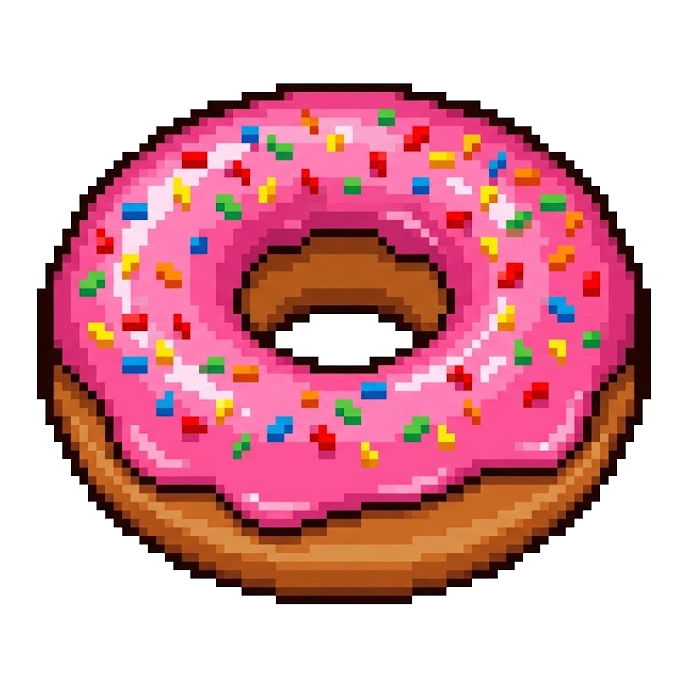
This is a pixel-art illustration (a picture made of tiny square dots) of a ring-shaped doughnut with pink chocolate and colorful sprinkles (tiny decorations). The pink shade and the placement of the sprinkles are special to this picture. Real doughnuts have different chocolate colors and decorations depending on the product, and there is no fixed look.
Fun facts
- In English, there are two spellings, "doughnut" and "donut," and both are used.
- One explanation says the hole helps heat reach the middle, so the dough can be fried all the way through.
- In America, the first Friday of June each year is called "Donut Day."
Quick quiz
Q. Which name, meaning "oil cake" in Dutch, is said to be the sweet doughnuts came from?
Around the 17th century, people of Dutch background in the area that is now New York made "olykoek." It is said to be the sweet that doughnuts came from.
References
- 『Encyclopaedia Britannica』 entry "doughnut" (history of the doughnut, people of Dutch background, and the story of the hole)
- Snopes "What You Donut Know About Doughnuts" (an article on the history of doughnuts and the hole story)
- The Salvation Army USA "The Sweet History Behind National Donut Day" (origin of Donut Day)
- Smithsonian Magazine "The History of the Doughnut" (Dutch immigrants and the spread of doughnuts)
- 消費者庁 (Consumer Affairs Agency, Japan) guide to "食品表示" (food labeling; allergy labeling for wheat, eggs, milk and more)
Accounts may differ between sources and regions, and facts or figures can change with new research or rules. This page was translated from the Japanese original.
Download the pixel art
- Free
- No registration
- Commercial use OK
- Edits OK
- Credit optional
- No usage report needed
Please read the terms of use before using it.