



Periodic Table Encyclopedia No.017
Chlorine
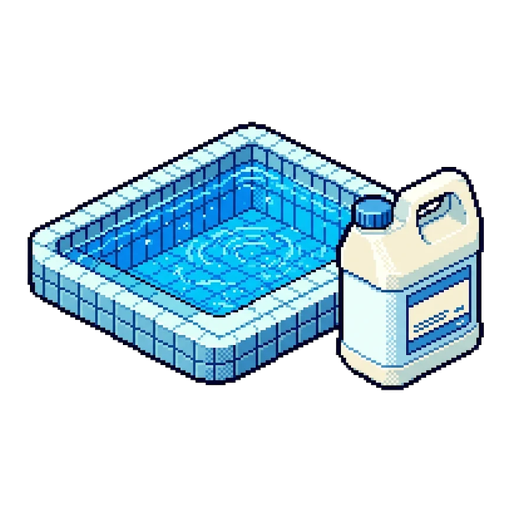
HalogenNonmetalGroup 17, Period 3
Atomic number 17, symbol Cl. It is a yellow-green gas and one of the parts of table salt. It is used to disinfect tap water and swimming pools, but it must be handled with care.
Key facts
| Atomic number / Symbol | 17 / Cl |
|---|---|
| Type | Halogen (a member of Group 17). A nonmetal |
| Place in the periodic table | Group 17, Period 3 |
| State at room temperature | Gas (yellow-green, with a sharp smell). The pure form is Cl₂, in which two atoms stick together |
| Atomic weight | About 35.45 (the IUPAC standard atomic weight, as of the 2020s) |
| Boiling point (the temperature at which it becomes a liquid) | About minus 34 °C (some sources give minus 34 to minus 35 °C) |
| Discovery | In 1774, Scheele of Sweden took out the gas. But he did not think it was a new element. Around 1810, Davy of Britain concluded that it was an element (the year differs by source, from 1808 to 1811, so accounts differ) |
| Origin of the name | From a Greek word meaning "yellow-green." Davy gave it this name after the color of the gas. The Japanese word for chlorine is said to come from the fact that it is a part of table salt |
What kind of element is it?
Chlorine is the element with the symbol Cl and atomic number 17. In the periodic table, it sits in Group 17, with fluorine and iodine. This family is called the halogens.
When chlorine is taken out on its own, it is a yellow-green gas. It has a strong, sharp smell. Breathing it in hurts the throat and nose, so it must be handled with care.
Chlorine is very good at joining with other elements. In nature, it is almost never found as a gas. Most of it exists as compounds (substances made by combining with other elements). The most familiar example is table salt (sodium chloride), which is chlorine joined with sodium.
The history of its discovery
In 1774, the Swedish chemist Scheele poured hydrochloric acid onto pyrolusite (a mineral that contains manganese dioxide). He got a yellow-green gas. But Scheele did not think it was a new element. In the chemistry of that time, people thought it was a substance containing oxygen.
Later, around 1810, Davy of Britain studied it closely. He concluded, "This is not a compound. It is an element." Some sources give 1808 or 1811 for the year, so accounts differ.
The name comes from a Greek word meaning "yellow-green," after the color of the gas. The Japanese word for chlorine is said to have been used by Udagawa Yoan, a scholar of Western learning in the Edo period.
How we use it
The most familiar use is disinfection. Under rules based on the Waterworks Act, tap water is disinfected so that a little chlorine remains in the water coming out of the faucet. The enforcement regulations of the Waterworks Act say that the chlorine left in the water (free residual chlorine) must usually be kept at 0.1 mg or more per liter. Chemicals that contain chlorine are also used in swimming pool water, and in chlorine-based bleaches and germ-killing cleaners for the kitchen and bath.
Chlorine is also a raw material for a plastic called vinyl chloride, which is used for water pipes and the covering of electric wires. It is also needed to bleach paper and cloth, and to make medicines and other chemical products.
The "chlorine smell" you notice at a pool is said to come, in fact, from substances made when chlorine reacts with dirt in the water.
The secret of its nature
Chlorine reacts easily with other substances (it joins with them and makes new substances). That is why it can weaken germs. This is the reason it is useful for disinfection.
But the same power can also harm the human body. That is why household cleaners carry a warning that says, "Do not mix. Dangerous." According to materials from Tokyo and other sources, mixing a chlorine-based product with an acidic product gives off poisonous chlorine gas, which is dangerous. Vinegar and citric acid are acidic too, so do not mix them with chlorine-based products.
Follow the directions on the product, and open a window to let in fresh air. For details, check the product label and official information from the Consumer Affairs Agency or local governments.
Chlorine on Earth and in space
On Earth, a lot of chlorine is found in seawater. The main parts of the salt dissolved in seawater are chloride ions (chlorine carrying an electric charge) and sodium ions. Chlorine is said to make up about 2% of the weight of seawater.
It is also found as rock salt (lumps of salt underground).
Natural chlorine has two stable kinds (isotopes) with different weights. They are chlorine-35 and chlorine-37, and they are mixed together. The atomic weight is an uneven number like 35.45 because of this mixing.
About this illustration
This is an illustration of a scene with a blue swimming pool and a container of disinfectant beside it. The blue water and the container show that chlorine helps keep water clean. Real chlorine is a yellow-green gas, and pool water is not blue because of chlorine. The pool, the container and its shape are the artist's own ideas and differ from the real thing.
Fun facts
- Chlorine gas is yellow-green, but table salt (sodium chloride) is a white crystal. Their colors and natures are completely different.
- The atomic weight is an uneven 35.45 because two stable isotopes, chlorine-35 and chlorine-37, are mixed together in nature.
- The Japanese word for chlorine is said to come from the fact that it is part of table salt. It is said to have been used by Udagawa Yoan in the Edo period.
Quick quiz
Q. Who took out chlorine gas in 1774 but did not think it was a new element?
Scheele of Sweden took out the yellow-green gas in 1774. It is said that Davy of Britain, around 1810, was the one who concluded it was an element.
References
- Encyclopaedia Britannica "Chlorine" (for how it was discovered, the origin of the name, and isotopes)
- IUPAC (International Union of Pure and Applied Chemistry) table of standard atomic weights (for the atomic weight value)
- Elementymology & Elements Multidict (a reference on the origins of element names; for the origin of the name)
- 水道法・水道法施行規則 (Waterworks Act and its enforcement regulations, Article 17; for chlorine disinfection of tap water and the residual chlorine standard) / materials on water supply from the Ministry of Health, Labour and Welfare and the Ministry of the Environment
- 東京都 消費生活総合センター materials on "Do not mix" warnings (Tokyo Consumer Affairs Center; for the cautions about chlorine-based and acidic cleaners)
- 国立天文台編『理科年表』 (Chronological Scientific Tables, edited by the National Astronomical Observatory of Japan; for the values of element properties)
Accounts may differ between sources and regions, and facts or figures can change with new research or rules. This page was translated from the Japanese original.
Download the pixel art
- Free
- No registration
- Commercial use OK
- Edits OK
- Credit optional
- No usage report needed
Please read the terms of use before using it.