



Periodic Table Encyclopedia No.016
Sulfur
NonmetalGroup 16, Period 3Yellow solid
Atomic number 16, symbol S. It is a yellow solid often seen near volcanoes and hot springs. It is also a raw material for things that support daily life, such as sulfuric acid and rubber products.
Key facts
| Atomic number / Symbol | 16 / S |
|---|---|
| Type | Nonmetal |
| Place in the periodic table | Group 16, Period 3 (in the same column as oxygen, below it) |
| State at room temperature | Solid (usually pale yellow, with almost no smell) |
| Atomic weight | About 32.06 (IUPAC standard atomic weight, as of the 2020s; the way it is written differs a little between sources) |
| Melting point (temperature where it melts) | About 113 to 119 °C (it depends on the crystal form; rhombic sulfur is about 113 to 115 °C and monoclinic sulfur is about 119 °C, and sources differ a little) |
| Boiling point (temperature where it becomes a gas) | About 445 °C |
| Discovery | Known since ancient times. It was recognized as an element in the time of Lavoisier in the 18th century (sources explain the year differently, around 1777 or around 1789, so accounts differ) |
| Origin of the name | The Japanese characters mean "sulfur" and "yellow." The English name sulfur is linked to the Latin word sulphur (the original meaning of the word is not clear) |
What kind of element is it?
Sulfur is the element with the symbol S and atomic number 16. It is not a metal. It is a nonmetal. At ordinary temperatures it is a solid, and it is a bright yellow.
In the periodic table, it sits in Group 16, the same group as oxygen. Its properties are a little like those of oxygen.
It hardly dissolves in water. When lit, it burns with a blue flame and turns into a gas with a sharp smell (sulfur dioxide).
History of its discovery
People have known sulfur since very ancient times. Yellow lumps were easy to find near volcanoes. It is said that people in the past used it in many ways, such as for medicine, for scent, and to keep insects away.
The people who thought, "This is an element that cannot be split into other substances," were Lavoisier and his colleagues in France. But sources explain the year differently, around 1777, around 1789, and so on, so we cannot say for sure (accounts differ).
The Japanese word for sulfur is written by joining the characters for "sulfur" and "yellow." The way it is read is said to have changed from an older reading, "yuwau."
Everyday uses
The most important use of sulfur is as a raw material for sulfuric acid (an acid used in huge amounts in factories). Sulfuric acid is used to make fertilizer, detergent, batteries, and many kinds of chemicals.
Sulfur also helps rubber. When a little sulfur is added to rubber and heated, the rubber becomes strong and springs back after it is stretched. This process is called vulcanization. It is said that Goodyear of the United States discovered it in 1839. It is used in rubber goods all around us, such as tires and the soles of shoes.
Substances that contain sulfur are also used in matches, in medicines for farming, and as a way to keep wine fresh when it is made.
Secrets of its properties
Sulfur can exist in different forms even though it is the same element. These are called allotropes (things made of the same element but with different forms or arrangements). An ordinary yellow crystal is a gathering of rings, each made of eight sulfur atoms joined together.
When heated, it melts at around 115 °C (it differs a little depending on the crystal form) and becomes a pale yellow liquid. If the temperature goes up more, its color and stickiness change, which is also a strange property.
The "rotten egg smell" of hot springs is not the smell of pure sulfur. It is the smell of hydrogen sulfide, a gas that contains sulfur.
Sulfur on Earth and in space
On Earth, yellow sulfur is found in its natural form around volcanoes. This is because gases containing sulfur in volcanic gas cool down and turn into crystals. Substances containing sulfur are also found in minerals deep underground, and in oil and natural gas.
Japan has many volcanoes, and there have long been places where sulfur could be collected.
Near volcanoes and hot springs, gases such as hydrogen sulfide and sulfur dioxide may come out. They are bad for the body when they are strong, so follow the "no entry" signs and the local guidance. For details on safety, check information from the Japan Meteorological Agency and local governments.
About this illustration
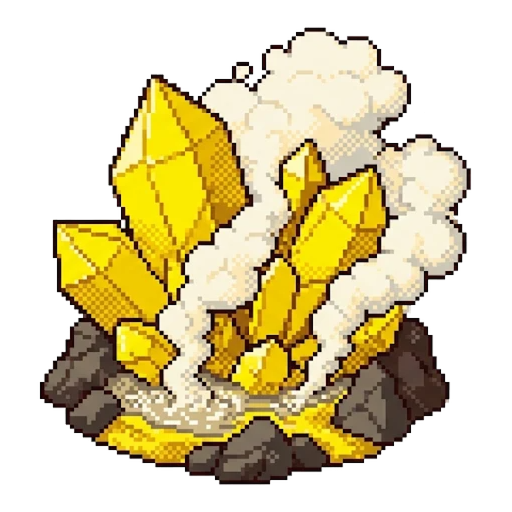
This is a picture of yellow sulfur crystals and steam rising from a hot spring beside a volcano. The bright yellow of the crystals is based on the real color of sulfur. The shape and spread of the steam and the fine details of the scenery are the artist's own style, different from the real thing.
Fun facts
- Yellow sulfur burns with a blue flame when it is lit.
- Vulcanization, which means adding sulfur to rubber and heating it, is said to have been discovered by Goodyear in 1839.
- The special smell of hot springs is not from sulfur itself. It is the smell of a gas called hydrogen sulfide.
Quick quiz
Q. What is the name of the acid made from sulfur that is used in huge amounts in factories?
Sulfur is important as a raw material for sulfuric acid. Sulfuric acid is used to make fertilizer, batteries, chemicals, and more.
References
- IUPAC 原子量・同位体存在度委員会(CIAAW)「Standard Atomic Weights」 (IUPAC Commission on Isotopic Abundances and Atomic Weights; supports the standard atomic weight of sulfur, about 32.06)
- 国立天文台編『理科年表』(丸善出版) (Chronological Scientific Tables, edited by the National Astronomical Observatory of Japan; supports physical data such as the melting and boiling points of sulfur)
- 『日本大百科全書(ニッポニカ)』(小学館)「硫黄」の項 (Nipponica encyclopedia, entry on sulfur; supports its properties, uses and where it is found)
- Royal Society of Chemistry「Periodic Table: Sulfur」 (supports the history, properties and uses of sulfur)
- 気象庁「火山ガスに関する情報」 (Japan Meteorological Agency, information on volcanic gas; supports the safety notes on hydrogen sulfide and sulfur dioxide)
Accounts may differ between sources and regions, and facts or figures can change with new research or rules. This page was translated from the Japanese original.
Download the pixel art
- Free
- No registration
- Commercial use OK
- Edits OK
- Credit optional
- No usage report needed
Please read the terms of use before using it.