



Periodic Table Encyclopedia No.014
Silicon
Semimetal (metalloid)Material for semiconductorsGroup 14, Period 3
Atomic number 14, symbol Si. It is plentiful in sand and quartz (a relative of crystal), and it is the second most common element in the Earth's crust after oxygen. It is a star material for semiconductors, which can be adjusted in how much electricity they carry.
Key facts
| Atomic number / symbol | 14 / Si |
|---|---|
| Type | Semimetal (metalloid). It has properties between a metal and a nonmetal |
| Place in the periodic table | Group 14, Period 3 (just below carbon) |
| State at room temperature | Solid (gray, with a metal-like shine) |
| Atomic weight | About 28.09 (the standard atomic weight of IUPAC, the International Union of Pure and Applied Chemistry, is 28.085) |
| Melting point (the temperature at which it melts) | About 1414 °C (some sources give 1410 °C and so on) |
| Amount in the Earth's crust | About 27 to 28% by weight. Second only to oxygen (numbers differ a little between sources) |
| Discovery | In 1824 (some sources say 1823), Berzelius of Sweden is said to have obtained it as a powdery pure substance (a substance made of only one kind of element). It is also said that in 1811 Gay-Lussac and Thénard of France had obtained an impure form, so accounts differ. The crystal form is said to have been obtained by Deville of France in 1854 |
| Origin of the name | Named after "silex," the Latin word for flint. How the name came about involves Davy, Berzelius, Thomson and others, and explanations differ between sources |
What kind of element is it?
Silicon is the element with the symbol Si and atomic number 14. In the periodic table, it sits right below carbon, in the same family.
It has properties between those of a metal and a nonmetal, so it is called a semimetal (metalloid). At room temperature it is a gray solid with a metal-like shine.
In nature, it is hardly ever found by itself. Most of it is joined with oxygen and is found in sand and rocks.
Silicon on Earth
In the Earth's crust (the hard outer layer that covers the Earth's surface), silicon is the second most common element after oxygen. By weight, it makes up a little over a quarter (about 27 to 28%) (numbers differ a little between sources).
Quartz, crystal, sand, and many ordinary rocks are silicon joined with oxygen. You could say the ground we walk on and the beaches are made of silicon compounds (substances made by combining it with other elements).
By the way, the Japanese way of writing "silicon" is said to go back to translated words such as "keido" in the book Seimi Kaiso by the Edo-period scholar Udagawa Yoan. Explanations of the details differ between sources.
History of its discovery
People long ago did not know that sand and quartz contain silicon. In the late 18th century, Lavoisier is said to have thought that the substance in quartz might be an oxide (something joined with oxygen) of an unknown element. But it was strongly bound to oxygen, and he could not take it out.
In 1811, Gay-Lussac and Thénard of France are said to have obtained impure silicon. Then in 1824 (some sources say 1823), Berzelius of Sweden washed powdery silicon clean, took it out as an element, and studied it in detail.
Later, in 1854, Deville of France is said to have obtained silicon as crystals. The year and the person of the discovery are explained differently by different sources, so accounts differ.
Everyday uses
The most familiar use is glass. The main material of glass is silica sand (grains of quartz), which is silicon joined with oxygen. Concrete, ceramics and bricks also use materials that contain silicon.
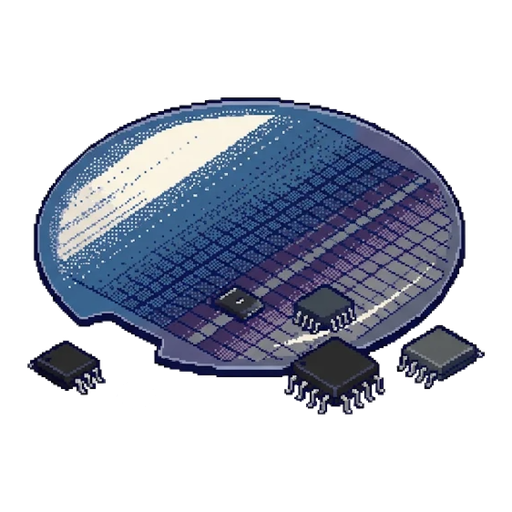
Another big use is semiconductors. Silicon made very pure (with little else mixed in) is cut into thin disks (wafers). Tiny electronic circuits are built on them to make parts (chips) for computers and smartphones.
Silicon is also often used in solar cells, which turn sunlight into electricity.
By the way, "silicone," which appears in the names of things, is a rubber-like or oil-like material made of silicon and oxygen linked to parts that contain carbon. It is a different substance from silicon itself.
The secret of its properties
Silicon has the properties of a semiconductor. A semiconductor is something in between metals, which carry electricity, and things like rubber, which do not. By mixing in just a little of another element, or by applying voltage, you can change how easily electricity flows.
Using this property, you can make tiny switches that turn the flow of electricity on and off. Hundreds of millions of them lined up on one chip form the brain part of a computer.
Silicon also has a high melting point (the temperature at which it melts) of about 1414 °C, so it is strong against heat. Usually it does not dissolve in water, and it has no smell.
About this illustration
This picture shows a round, thin silicon wafer and small square semiconductor chips side by side. A wafer is the disk that semiconductors are made from, and it is later cut into small pieces to become chips. The colors, layout and background are the illustration's own style to make things easy to understand, and they differ from real ones.
Fun facts
- Silicon and carbon sit one above the other in the periodic table, and both easily join with other atoms using four "hands."
- Silicon for semiconductors is refined to a very high purity (very little else mixed in) before use.
- Silicon is plentiful in the Earth's crust, but it is hardly ever found by itself. Most of it exists joined with oxygen.
Quick quiz
Q. Which statement about silicon is correct?
Silicon is plentiful in the Earth's crust as part of quartz, sand and rocks, and it is the second most common element after oxygen. At room temperature it is a solid, and it is not a main part of air.
References
- Encyclopaedia Britannica, "Silicon" (supports the history of discovery, the origin of the name and properties)
- Royal Society of Chemistry (RSC), "Periodic Table," Silicon entry (supports basic data such as atomic weight and melting point)
- IUPAC (International Union of Pure and Applied Chemistry), table of standard atomic weights (supports atomic weight)
- Rika Nenpyo (Chronological Scientific Tables), edited by the National Astronomical Observatory of Japan (supports element properties and crust composition)
- Kagaku Jiten (Dictionary of Chemistry), Tokyo Kagaku Dojin, "Keiso (silicon)" entry (supports properties, uses and naming)
Accounts may differ between sources and regions, and facts or figures can change with new research or rules. This page was translated from the Japanese original.
Download the pixel art
- Free
- No registration
- Commercial use OK
- Edits OK
- Credit optional
- No usage report needed
Please read the terms of use before using it.