



World & Culture Encyclopedia No.011
Great Pyramid of Giza
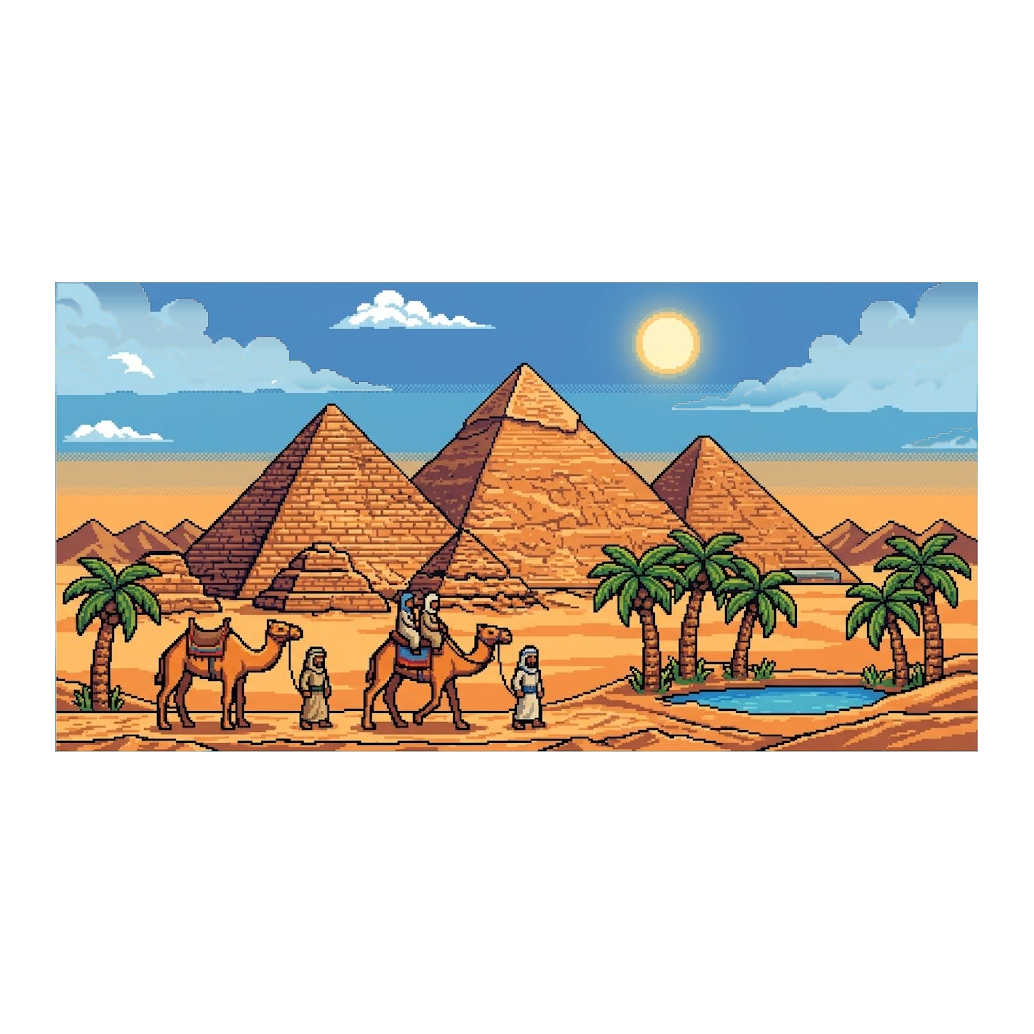
Giza, EgyptTomb of an ancient kingPart of the World Heritage Site "Memphis and its Necropolis"
This is the most famous pyramid in the world. It stands in Giza, Egypt. People think it was built about 4,500 years ago by stacking stones, as a tomb for King Khufu.
Key facts
| Type | A tomb for an ancient Egyptian king (a pyramid). A building made by stacking stones |
|---|---|
| Location | A plateau in Giza, Egypt (near the capital, Cairo) |
| When it was built | The Old Kingdom, 4th Dynasty (the 4th royal family line). The middle of the 2500s BCE (many sources say about 2560 BCE, but dates can differ by a few decades depending on the source) |
| Whose it was | Thought to be the tomb of King Khufu |
| Height | About 146.6 meters when it was new (some sources say 146.5 meters). Today the top and the outer stones are gone, so it is about 138 meters (this varies a little by source) |
| Base (one side of the square bottom) | About 230 meters. The four sides are said to differ in length by only a tiny amount |
| Number of stones | Said to be about 2.3 million (counts differ depending on how they are made) |
| World Heritage Site | In 1979 it was added to the World Heritage list (places protected as a treasure for all people) as part of "Memphis and its Necropolis – the Pyramid Fields from Giza to Dahshur" |
What kind of place is it?
Near Cairo, the capital of Egypt, three big pyramids stand side by side on a plateau (a flat area of land higher than the land around it) in a place called Giza. The biggest of them is the Great Pyramid. People think it was built as the tomb of a king named Khufu.
A pyramid has a square bottom and four triangle-shaped sides that meet at a point. The Great Pyramid stands out high above the surrounding desert. You can see it from far away.
It is said that the Great Pyramid is the only one still standing of the "Seven Wonders of the World" (a traditional list of seven famous buildings told about in places like ancient Greece).
History and origin
The Great Pyramid was built in the Old Kingdom of ancient Egypt (a time when the kings were very powerful, about 4,500 years ago). It is often said to have been finished around 2560 BCE, but the date can differ by several decades depending on the source.
In ancient Egypt, a king was thought of as a special person close to the gods. It is said that a huge tomb was built so that the king could live in peace in the afterlife after he died.
About the people who built it, a story once spread that "slaves (people forced to work) built it." But from the remains of a town found nearby and other clues, we now know more about the lives of the craftsmen and workers. They worked and were given food such as bread and beer.
Highlights and features
When it was new, it was about 146.6 meters high, and each side of its base was about 230 meters long. Its height today (about 138 meters) is about the same as a 40-story tall building.
The number of stones used is said to be about 2.3 million. Most are limestone (a whitish, hard stone) found nearby. Each stone is very heavy. People think workers moved them by pulling and pushing.
The amazing part is how exact the shape is. The four sides face almost exactly north, south, east and west. The four sides of the base are said to differ in length by only a few centimeters.
At first, the outside was covered with smooth white casing stones (decorative stones), which people think shone brightly in the sunlight. In later times those stones were taken off and used elsewhere. That is why the pyramid is a little lower today, at about 138 meters.
Inside the pyramid
Inside the pyramid there are narrow passages and several rooms. The room called the "King's Chamber" is built from especially large stones.
For safety, the number of people and the time allowed inside may be limited. When you visit, please follow the local rules.
In 2017, a study using muons (tiny particles that rain down from space and pass through objects) announced that there is a space (a void) that was not known before, above the large passage called the "Grand Gallery." But what the space was for is not clear. Even a huge building can still bring new discoveries.
Culture worth knowing
The Giza pyramids were added to the World Heritage list in 1979. The official name on the list is "Memphis and its Necropolis – the Pyramid Fields from Giza to Dahshur." Memphis was the place where the capital of the ancient Egyptian Old Kingdom stood.
Near the pyramids there is also the Sphinx (a big statue with the body of a lion and the face of a person). The pyramids and the Sphinx are a famous view of Egypt, and people visit from all over the world.
In the desert you can often see camels carrying visitors. But the scene in this illustration is only a picture. Taking good care of big stone buildings like this, so they last, is our job.
About this illustration
This is a pixel-art illustration (a picture made by lining up tiny squares) of the Great Pyramid of Giza and a desert with camels. The big triangle-shaped pyramid, the wide desert and the camels are the stars of the picture. The colors of the pyramid, the number and arrangement of the camels, and the sky in the background are all part of the artwork. They are not an exact copy of the real place. This is an illustration, so it differs from the real thing.
Fun facts
- It is said that the Great Pyramid was the tallest human-made building in the world for about 3,800 years (the number of years differs by source).
- The outer stones, which are thought to have shone white when the pyramid was new, are said to have been taken off in later times and used for other buildings.
- The Great Pyramid is about 138 meters high today. This is because the stones at the top and on the outside are gone.
Quick quiz
Q. Whose tomb is the Great Pyramid thought to have been built as?
The Great Pyramid of Giza is thought to be the tomb of King Khufu of the Old Kingdom of ancient Egypt. It is often said to have been built around 2560 BCE, but the date can differ by several decades depending on the source.
References
- UNESCO World Heritage Centre, "Memphis and its Necropolis – the Pyramid Fields from Giza to Dahshur" (supports the official name and the 1979 listing)
- Smarthistory, "Pyramid of Khufu" (supports the features and the time period of the pyramid of Khufu)
- Harvard University Giza Project (Digital Giza), "Great Pyramid of Khufu" (supports the size figures and similar numbers)
- Britannica International Encyclopedia (『ブリタニカ国際大百科事典』), entries "Pyramid" and "Khufu" (used to check the time period and size)
- Morishima et al., "Discovery of a big void in Khufu's Pyramid by observation of cosmic-ray muons," Nature, 2017 (supports the announcement of the space above the Grand Gallery)
Accounts may differ between sources and regions, and facts or figures can change with new research or rules. This page was translated from the Japanese original.
Download the pixel art
- Free
- No registration
- Commercial use OK
- Edits OK
- Credit optional
- No usage report needed
Please read the terms of use before using it.