



Science Encyclopedia No.005
Venus
The Solar SystemA rocky planet (terrestrial planet)The hottest planet
Venus is the second planet from the Sun and is about the same size as Earth. It has a thick carbon dioxide atmosphere and clouds of sulfuric acid. Its surface is about 467°C, the hottest of any planet in the Solar System.
Key facts
| Type | A planet of the Solar System (a rocky, terrestrial planet) |
|---|---|
| How it works (in a nutshell) | A thick carbon dioxide atmosphere traps heat, so the surface becomes very hot. |
| Diameter | About 12,104 km (Earth is about 12,756 km) |
| Average distance from the Sun | About 108 million km (about 0.72 astronomical units) |
| Orbital period (time to go around the Sun once) | About 225 days |
| Rotation period (time to spin once) | About 243 days (the opposite direction to most other planets) |
| Sunrise to sunset | About 117 days (in Earth days) |
| Surface temperature | About 467°C (the hottest in the Solar System) |
| Surface air pressure | About 93 times Earth's pressure at sea level |
| Moons and rings | It has neither. (It does have a quasi-satellite called Zoozve.) |
What kind of planet is it?
Venus is the second planet from the Sun. Its diameter is about 12,104 km. Earth's is about 12,756 km, so the two are almost the same size. That is why Venus is sometimes called Earth's "twin."
Venus is made of rock. It has no moons (small bodies that travel around a planet) and no rings. But even though the size is similar, the surface of Venus is completely different from Earth's.
Thick clouds and air
Venus is wrapped all over in thick clouds. The clouds are made of tiny drops of sulfuric acid, a strong acid that can dissolve things.
Most of the air is carbon dioxide. The air pressure at the surface is about 93 times Earth's pressure at sea level. NASA compares this to the pressure at a depth of about 930 m in Earth's ocean. Because the clouds are so thick, you cannot see the ground even from space.
The hottest planet in the Solar System
The surface of Venus is about 467°C. That is hot enough to melt lead. Venus is hotter than Mercury, even though Mercury is closer to the Sun. The reason is that the thick carbon dioxide air traps heat. This is called the "greenhouse effect."
There is also almost no difference in temperature between day and night. The thick air carries heat around, so the whole planet stays evenly hot.
It spins slowly, in the opposite direction
Venus goes around the Sun in about 225 days. But it takes about 243 days to spin once. So one day (one spin) is longer than one year on Venus.
Also, Venus spins in the opposite direction to most other planets. So if you stood on the surface of Venus, the Sun would rise in the west and set in the east. Sunrise to sunset takes about 117 days in Earth days.
The history of exploring Venus
Many probes from the former Soviet Union's Venera program went to Venus. In 1970, Venera 7 landed on the surface of another planet and sent back data for about 23 minutes. Because of the heat and high pressure, the Venera landers could work on the surface for only about 23 minutes at the shortest and about 2 hours at the longest.
The American probe Magellan was launched in 1989. It used radar to look beneath the clouds. It mapped about 98% of the surface and showed that the surface is "geologically young," with few craters.
Venus in the sky
Venus is often the brightest object in the sky after the Moon. When you see it in the western sky in the evening, it is called the "evening star." When you see it in the eastern sky at dawn, it is called the "morning star."
It looks bright because its thick clouds reflect a lot of sunlight. Through a telescope, Venus shows phases, getting bigger and smaller in shape like the Moon.
About this illustration
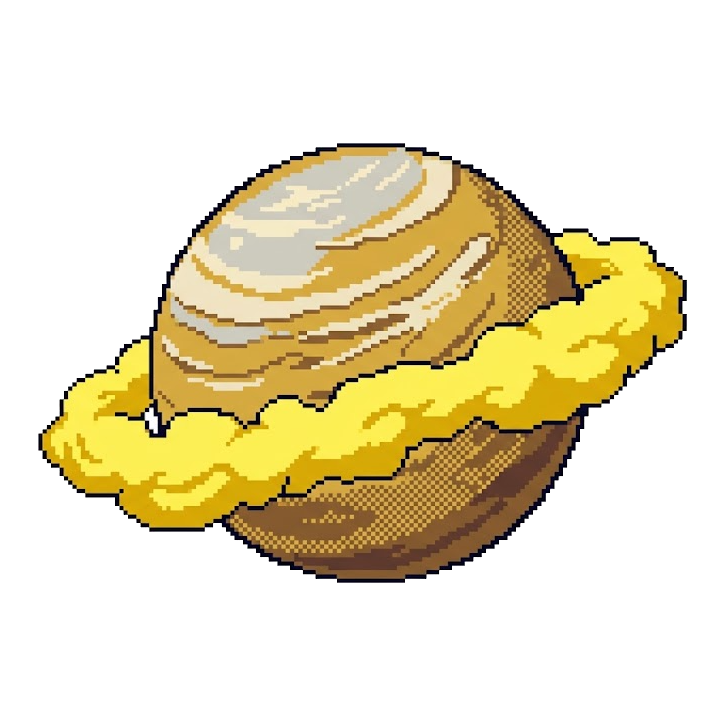
This is a pixel-art picture (a picture made by lining up tiny squares) of Venus wrapped in thick yellow clouds. The fact that clouds hide the ground matches the real Venus. The depth of the colors and the shapes of the dots are not like the real planet. They are just the artist's way of drawing it.
Fun facts
- Venus is often the brightest object in the sky after the Moon.
- Venus has no moons. But it has a small object called Zoozve, a quasi-satellite (a body that moves in a strange way near a planet). Its size is estimated at about 200 to 500 m.
- In the Venera program, the Soviet Union sent many probes to Venus from the 1960s to the early 1980s.
Quick quiz
Q. Which of these is true about Venus?
Venus spins in the opposite direction, so from its surface the Sun rises in the west. The hottest planet is Venus, which has a thick atmosphere. Venus has no moons.
References
- NASA Science 'Venus Facts' (supports size, distance, orbit and rotation, sunrise to sunset, surface temperature, air pressure, moons, Zoozve, Venera lander working times, and Magellan's radar observations)
- NASA 'Magellan' mission pages (support radar mapping, the 1989 launch, and about 98% of the surface mapped)
- 国立天文台『理科年表』 (Chronological Scientific Tables, National Astronomical Observatory of Japan; supports basic planet data)
- European Space Agency (ESA) 'Venus Express' pages (support information on Venus's atmosphere and its exploration)
Accounts may differ between sources and regions, and facts or figures can change with new research or rules. This page was translated from the Japanese original.
Download the pixel art
- Free
- No registration
- Commercial use OK
- Edits OK
- Credit optional
- No usage report needed
Please read the terms of use before using it.