



Science Encyclopedia No.003
Mercury
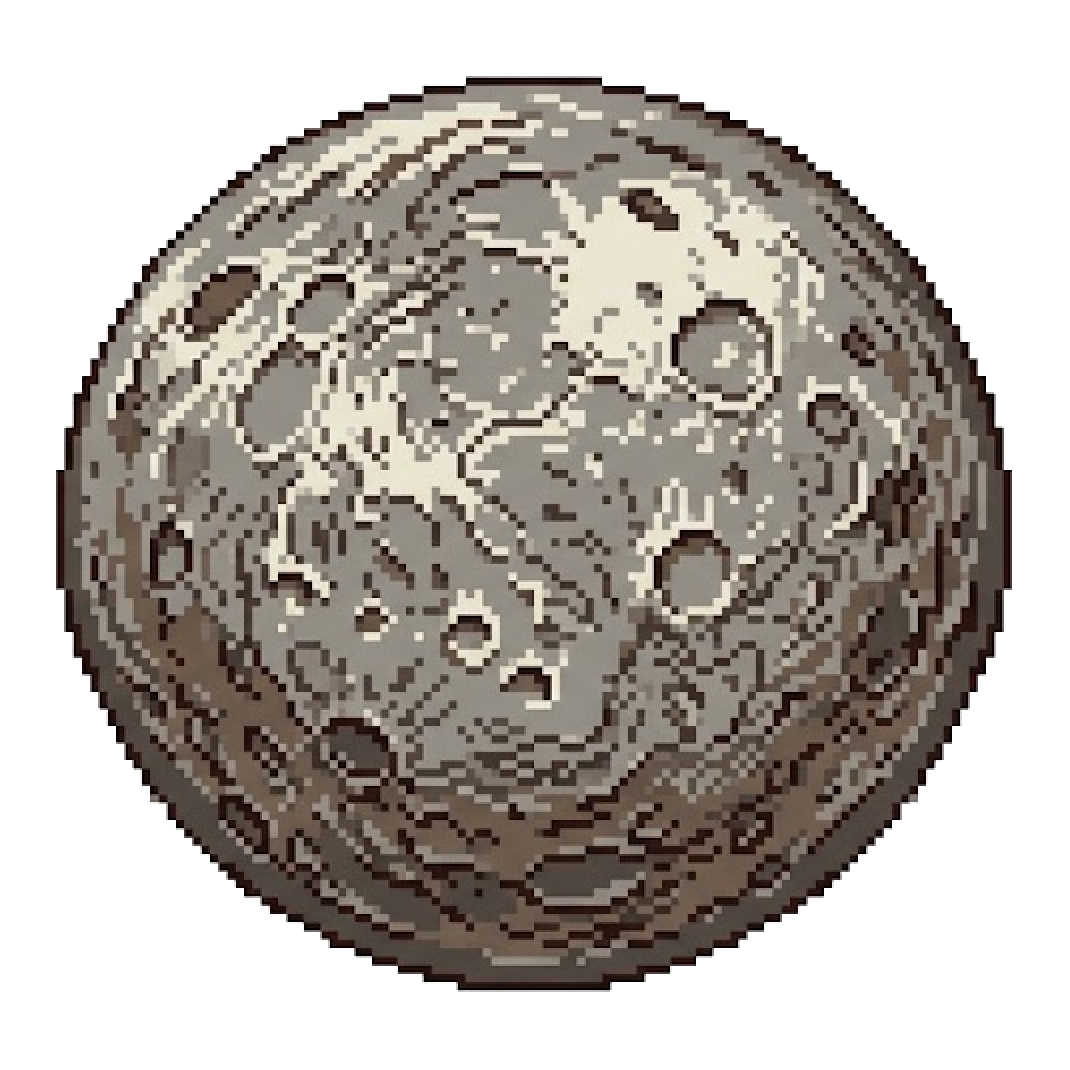
Solar SystemRocky planet (terrestrial planet)The planet closest to the Sun
Mercury is the planet closest to the Sun, and the smallest planet in the Solar System. Its surface is covered with craters. It gets very hot in the day and very cold at night.
Key facts
| Type | A planet of the Solar System (a rocky, terrestrial planet) |
|---|---|
| How it works (in a nutshell) | It is close to the Sun and has almost no atmosphere, so the temperature difference between day and night is large. |
| Radius | About 2,440 km (a little more than one third of Earth's) |
| Average distance from the Sun | About 58 million km (about 0.4 astronomical units) |
| Orbital period (time to go once around the Sun) | About 88 days |
| Rotation period (time to spin once) | About 59 days |
| Time for one full cycle of day and night | About 176 days (about 2 Earth years) |
| Surface temperature | Up to about 430°C in the day, and down to about minus 180°C at night |
| Moons and rings | Neither |
What kind of planet is it?
Mercury is the planet that circles closest to the Sun. It is the smallest of the eight planets in the Solar System, with a radius of about 2,440 km. That is a little more than one third of Earth's radius.
It is made of rock, and its surface looks grayish. Like the Moon, it has many round holes called craters. It has no moons (small objects that travel around it) and no rings.
A short year and a long day
Because Mercury is close to the Sun, it moves very fast. It takes only about 88 days to go once around the Sun. So one Mercury year is about 88 Earth days. It is the fastest planet in the Solar System, moving at about 47 km per second.
On the other hand, it takes about 59 days to spin once on its own axis (rotation). Putting these two together, the time from one sunrise on Mercury to the next is about 176 days. On Mercury, a day is longer than a year!
Burning by day, freezing by night
On Mercury's daytime side, the surface can reach about 430°C. But at night it drops to about minus 180°C.
This is because Mercury has almost no air. It does not have a thick atmosphere like Earth's. Only a very thin spread of particles, such as oxygen, sodium, hydrogen, helium and potassium, surrounds it. This thin layer is called an "exosphere." With no air to hold the heat, the ground cools quickly once it is in shadow. By the way, the hottest planet is Venus, because its thick atmosphere traps heat.
A big core and a shrinking surface
At the center of Mercury is a large core made of metals such as iron. The core has a radius of about 2,074 km, which is about 85% of the whole planet's radius. Part of it may be melted.
It is said that Mercury's inside cooled over a very long time and shrank little by little. Because of this, cliffs up to about 1 mile (about 1.6 km) high formed on its surface. Also, the Caloris Basin is a huge round landform made long ago when an object crashed into the planet. It is about 1,550 km wide.
The history of exploration
Mercury is close to the Sun, so it is a hard place to explore. A U.S. space probe called MESSENGER was launched in 2004. In March 2011, it became the first spacecraft to enter orbit around Mercury.
MESSENGER made a map of the whole planet. It showed that volcanic activity played a big part in shaping the surface. It also found signs that there may be water ice inside deep craters near the north and south poles, where sunlight never reaches. It also showed that Mercury's magnetic field is weaker than Earth's.
About this illustration
This is a pixel-art picture of a small gray planet covered with craters. Its round shape and the dents (craters) on its surface are the main features. The fine coloring and the background are the artist's own style and are different from the real planet.
Fun facts
- One day on Mercury (from one sunrise to the next) is about 176 days. That is twice as long as its year of about 88 days.
- Mercury is the fastest-moving planet in the Solar System, traveling at about 47 km per second.
- Sunlight takes about 3.2 minutes to reach Mercury.
Quick quiz
Q. Which of these is true about Mercury?
Mercury is closest to the Sun and is the smallest of the planets. It has no moons. The hottest planet is Venus, which has a thick atmosphere.
References
- NASA Science, "Mercury Facts" (supports size, distance, orbit and rotation, temperature, core, Caloris Basin, and having no moons or rings)
- NASA, pages about the "MESSENGER" mission (supports the 2004 launch and the exploration after it entered orbit around Mercury in 2011)
- National Astronomical Observatory of Japan, "Rika Nenpyo" (Chronological Scientific Tables) (supports basic planet data)
Accounts may differ between sources and regions, and facts or figures can change with new research or rules. This page was translated from the Japanese original.
Download the pixel art
- Free
- No registration
- Commercial use OK
- Edits OK
- Credit optional
- No usage report needed
Please read the terms of use before using it.