



Monster Encyclopedia No.001
Oni
JapanMonster of Japanese folklore and old talesDemon Gate and Onmyodo
The oni is a scary being with horns and great strength who appears in Japanese old tales and folklore. The word first meant something unseen and frightening. It is said that the oni took its present look over time.
Key facts
| Category | A monster in Japanese folklore and old tales (one that attacks people, and sometimes something like a guardian spirit) |
|---|---|
| Region and culture | Japan. Its look is said to have become clear in stories and picture scrolls from the Heian period onward. |
| Earliest records | The character for "oni" appears in the Nihon Shoki (720). A story of a one-eyed oni eating a person, from the Ayo district in the Izumo no Kuni Fudoki (Nara period, 733), is counted among the oldest surviving written examples. |
| Origin of the name | A well-known theory says it changed from "on," meaning "hidden." It is said to mean something unseen and hiding. But this is not settled (accounts differ). |
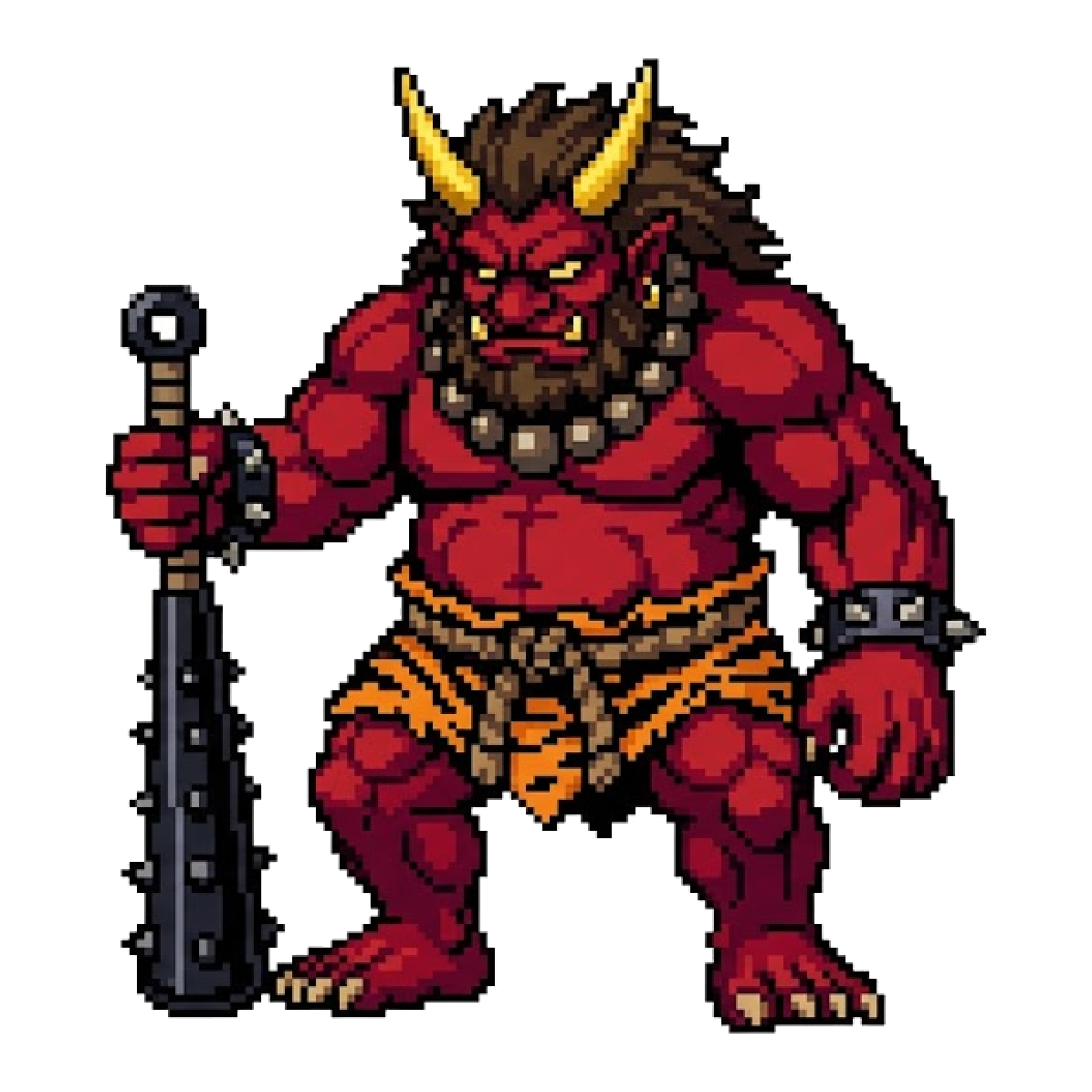
| Typical look | Horns on the head, sharp fangs, a big body and great strength. In later pictures, the standard look became cow horns, a tiger-skin loincloth and an iron club (kanabo). The skin is drawn in colors such as red or blue. |
| Link to the Demon Gate | In Onmyodo (a way of thinking from China that tells good and bad luck by direction and day), the northeast (ushitora) was called the "Demon Gate," where oni were thought to come and go. |
| Famous oni tales | Shuten-doji (the oni-slaying at Mount Oe), Momotaro (the oni-slaying on Onigashima), and others. |
What kind of being is it?
The oni is a being in Japanese folklore that threatens people. But it did not always look the way it does now.
For example, in the Man'yoshu (a Nara-period collection of poems), the character for "oni" is said to have been read as "mono." "Mono" meant a frightening power whose true nature was unknown. Later, toward the Heian period, the character came to be read as "oni."
There is a theory about the origin of the name, the "hidden" theory. The Heian-period dictionary Wamyo Ruijusho gives, as "one theory," that "oni" came from the sound of the word for "hidden," because an oni hides and does not want to show itself. However, some people think that part was added by a later writer. There are other theories too, and none of them is decisive.
How did its look take shape?
Today's oni has cow horns and a tiger-skin loincloth. A widely known explanation says this comes from "ushitora," the direction of the Demon Gate. Ushi means cow, and tora means tiger. But this is an interpretation from a later age, and it has not been confirmed that it was like this from the start.
The oni holding a kanabo also became common in later pictures. The saying "Oni ni kanabo" (an iron club for an oni, meaning something strong gets even stronger) is sometimes linked to this image.
Myth and folklore ①: The one-eyed oni of the Izumo no Kuni Fudoki
The Izumo no Kuni Fudoki (a local record of Izumo Province), compiled in the Nara period, has an oni story that explains how the place called Ayo got its name. A one-eyed oni appears before a man working in a field and eats him. The man's parents were hiding in a bamboo thicket. The bamboo leaves shook, and the oni is said to have noticed them. The man being eaten cried out "ayo, ayo," so the place was called "Ayo" in one spelling, and later "Ayo" in another. This is counted among the oldest oni stories in surviving writings. However, scholars have not settled what the oni in this story stands for. One theory links it to metalworking (the craft of hammering metal).
Myth and folklore ②: Shuten-doji
Shuten-doji is told of as the chief of the oni who kidnapped people of the capital. In the story, the Heian-period warrior Minamoto no Yorimitsu and his four chief retainers disguise themselves as mountain monks, visit the oni's home, make the oni careless with sake, and defeat him.
The original form of this story is thought to be older than the picture scroll Oeyama Ekotoba, from the late 14th century (the Nanboku-cho period). In the Muromachi period it became a noh play script, and near the end of the Muromachi period it spread as Shuten-doji, one of the Otogizoshi (short tales of the Muromachi period). The setting is told as Mount Oe in the northwest of Kyoto (Tanba and Tango), but the mountain's location differs by work, and some versions name Mount Ibuki in Omi.
Myth and folklore ③: Momotaro and Setsubun
In the old tale of Momotaro, a boy born from a peach takes a dog, a monkey and a pheasant to Onigashima and defeats the oni. It is said that the tale took its present form through picture books and other works from the Edo period onward (accounts differ).
Also, an old myth says Izanaki threw peaches in the land of the dead to drive off his pursuers, so peaches have been thought to have power against evil. The bean-throwing of Setsubun, with the call "Oni wa soto" ("Oni, get out!"), is also an event to drive oni away. We can see that fear of oni and the wisdom to drive them away have been handed down together.
How it is commonly shown in stories and games
A big oni with horns and a kanabo often appears in Japanese-style stories and games as a strong enemy or boss. The red-skinned oni is widely used because it can be recognized as an oni at a glance.
About this illustration
This is a pixel-art picture of a red-skinned oni holding a spiked iron club. It is a design that could be used as an enemy in a Japanese-style game. The spiked club is a widely known item for an oni, but the red skin and the shape of the spikes are not fixed by any particular source. They are the artist's own expression and differ from the real thing.
Fun facts
- In the Man'yoshu, the character for "oni" is sometimes read as "mono," and it is said that the reading moved to "oni" toward the Heian period.
- In Onmyodo, the northeast (ushitora) is the "Demon Gate." It is said that Enryaku-ji temple was placed on Mount Hiei, to the northeast of Heian-kyo, and took the role of guarding the Demon Gate.
- The story of Shuten-doji became widely known, in the Otogizoshi, as the oni-slaying at Mount Oe.
Quick quiz
Q. What is the widely known explanation for the oni's "cow horns and tiger skin"?
The northeast direction, "ushitora," was called the Demon Gate. Ushi is a cow and tora is a tiger. The explanation is that the look of cow horns and tiger skin came from there. But it is an interpretation from a later age, and nothing is certain.
References
- 『日本書紀』 (Nihon Shoki; early example of the character for "oni" and the story of the peach as protection against evil)
- 『出雲国風土記』 (Izumo no Kuni Fudoki; the story of the one-eyed oni of Ayo)
- 源順『和名類聚抄』 (Minamoto no Shitagau, Wamyo Ruijusho; the "hidden" theory of the word "oni")
- 『精選版 日本国語大辞典』 (Nihon Kokugo Daijiten, concise edition; first examples and origin of the word "oni")
- 『日本大百科全書(ニッポニカ)』 (Nipponica encyclopedia; the formation of the Shuten-doji tale and the Oeyama Ekotoba)
- 『日本国語大辞典』『デジタル大辞泉』 (Nihon Kokugo Daijiten and Digital Daijisen dictionaries; explanation of the Demon Gate and Onmyodo)
Accounts may differ between sources and regions, and facts or figures can change with new research or rules. This page was translated from the Japanese original.
Download the pixel art
- Free
- No registration
- Commercial use OK
- Edits OK
- Credit optional
- No usage report needed
Please read the terms of use before using it.